Vol. 114
Latest Volume
All Volumes
PIERB 116 [2026] PIERB 115 [2025] PIERB 114 [2025] PIERB 113 [2025] PIERB 112 [2025] PIERB 111 [2025] PIERB 110 [2025] PIERB 109 [2024] PIERB 108 [2024] PIERB 107 [2024] PIERB 106 [2024] PIERB 105 [2024] PIERB 104 [2024] PIERB 103 [2023] PIERB 102 [2023] PIERB 101 [2023] PIERB 100 [2023] PIERB 99 [2023] PIERB 98 [2023] PIERB 97 [2022] PIERB 96 [2022] PIERB 95 [2022] PIERB 94 [2021] PIERB 93 [2021] PIERB 92 [2021] PIERB 91 [2021] PIERB 90 [2021] PIERB 89 [2020] PIERB 88 [2020] PIERB 87 [2020] PIERB 86 [2020] PIERB 85 [2019] PIERB 84 [2019] PIERB 83 [2019] PIERB 82 [2018] PIERB 81 [2018] PIERB 80 [2018] PIERB 79 [2017] PIERB 78 [2017] PIERB 77 [2017] PIERB 76 [2017] PIERB 75 [2017] PIERB 74 [2017] PIERB 73 [2017] PIERB 72 [2017] PIERB 71 [2016] PIERB 70 [2016] PIERB 69 [2016] PIERB 68 [2016] PIERB 67 [2016] PIERB 66 [2016] PIERB 65 [2016] PIERB 64 [2015] PIERB 63 [2015] PIERB 62 [2015] PIERB 61 [2014] PIERB 60 [2014] PIERB 59 [2014] PIERB 58 [2014] PIERB 57 [2014] PIERB 56 [2013] PIERB 55 [2013] PIERB 54 [2013] PIERB 53 [2013] PIERB 52 [2013] PIERB 51 [2013] PIERB 50 [2013] PIERB 49 [2013] PIERB 48 [2013] PIERB 47 [2013] PIERB 46 [2013] PIERB 45 [2012] PIERB 44 [2012] PIERB 43 [2012] PIERB 42 [2012] PIERB 41 [2012] PIERB 40 [2012] PIERB 39 [2012] PIERB 38 [2012] PIERB 37 [2012] PIERB 36 [2012] PIERB 35 [2011] PIERB 34 [2011] PIERB 33 [2011] PIERB 32 [2011] PIERB 31 [2011] PIERB 30 [2011] PIERB 29 [2011] PIERB 28 [2011] PIERB 27 [2011] PIERB 26 [2010] PIERB 25 [2010] PIERB 24 [2010] PIERB 23 [2010] PIERB 22 [2010] PIERB 21 [2010] PIERB 20 [2010] PIERB 19 [2010] PIERB 18 [2009] PIERB 17 [2009] PIERB 16 [2009] PIERB 15 [2009] PIERB 14 [2009] PIERB 13 [2009] PIERB 12 [2009] PIERB 11 [2009] PIERB 10 [2008] PIERB 9 [2008] PIERB 8 [2008] PIERB 7 [2008] PIERB 6 [2008] PIERB 5 [2008] PIERB 4 [2008] PIERB 3 [2008] PIERB 2 [2008] PIERB 1 [2008]
2025-08-09
PIER B
Vol. 114, 107-118, 2025
download: 150
Development of a Half-Sphere Microwave Absorber with Enhanced Performance
Aya Raad Thanoon and Khalil Hassan Sayidmarie
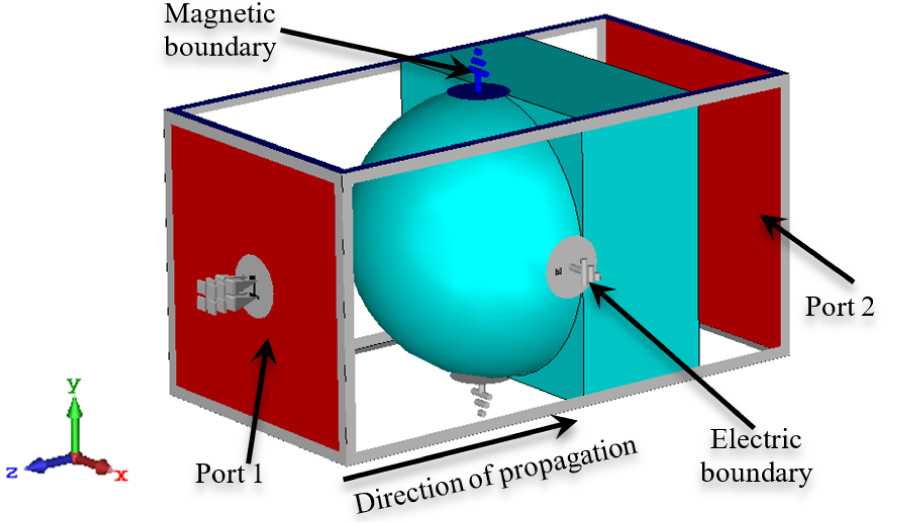
The paper proposes a microwave absorber in the form of half-spheres placed on a base layer as an alternative to the conventional pyramidal shape. The performance of the absorber is investigated, focusing on the influence of the diameter of the half-sphere, permittivity, loss tangent, and angle of the incident waves. The study also evaluates the case when the absorber is backed by a conducting plate that is required for shielded anechoic chambers. Simulation results using the CST Microwave suite indicate that increasing loss tangent enhances absorption while decreasing permittivity reduces reflectivity. The proposed absorber offers low sensitivity of reflection concerning the angle of incidence due to the symmetry of the spherical surface. The results show that the proposed absorber has a comparative performance to the pyramidal absorber of the same total thickness.
Development of a Half-sphere Microwave Absorber with Enhanced Performance
2025-08-08
PIER B
Vol. 114, 99-106, 2025
download: 300
Transfer Matrix Method for General Bianisotropic Layers
Morgan Alecsandre Blankenship, Edgar Bustamante and Raymond C. Rumpf
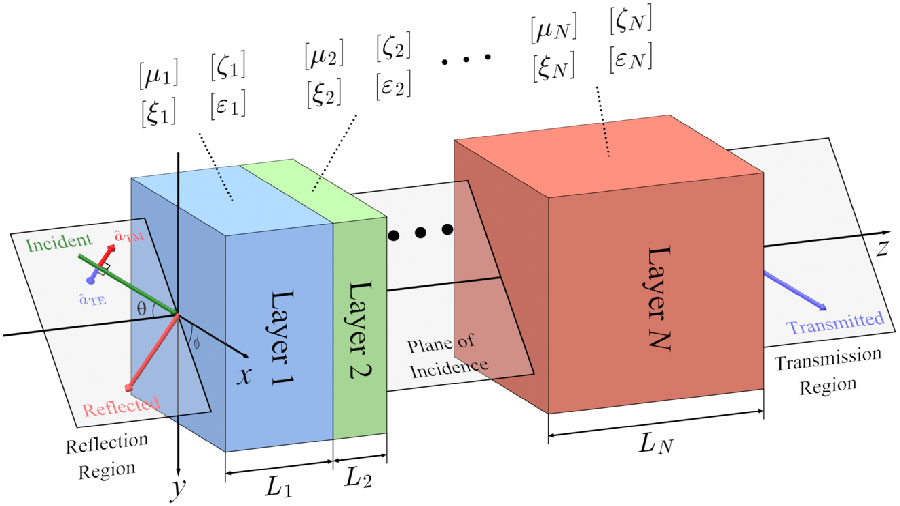
The transfer matrix method (TMM) with scattering matrices has been a valuable tool, facilitating the rapid characterization of multilayer devices in a very fast, stable, and memory-efficient manner. This paper presents a generalization of TMM with improved scattering matrices capable of simulating devices with full nine-element material tensors for the layers and any combination of signs for the real and imaginary parts of the isotropic external regions. The formulation of the bianisotropic transfer matrix method (BTMM) algorithm is covered in detail, and notes on implementation are provided. Example devices found in literature were used to benchmark the accuracy of the algorithm. The simulation of the bianisotropic device was corroborated with a bianisotropic finite-difference frequency-domain (FDFD) algorithm and a finite-element method (FEM).
Transfer Matrix Method for General Bianisotropic Layers
2025-08-06
PIER B
Vol. 114, 89-98, 2025
download: 183
A Physics-Assisted Learning Method Based on the Improved U-Net for Reconstructing 2-d Dielectric Objects
Zhangyue Zhao and Chunxia Yang
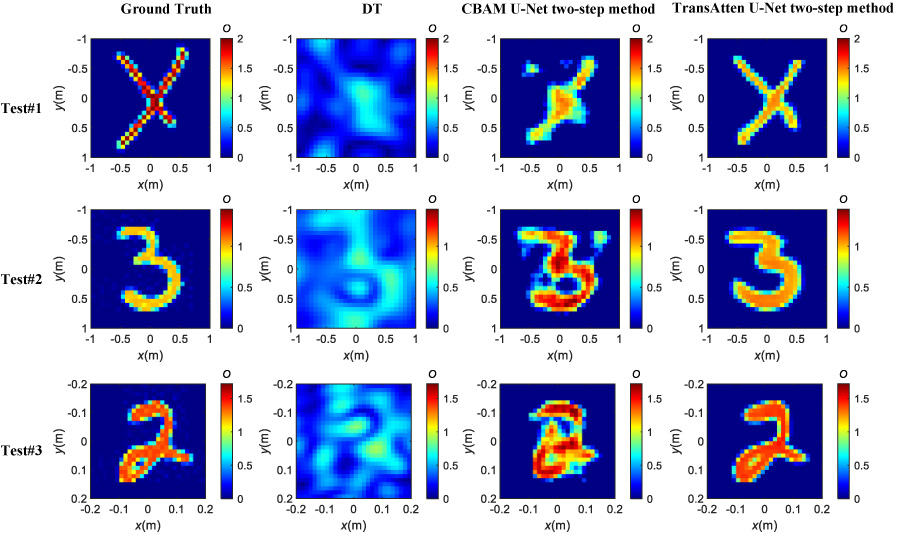
In the past few years, deep learning has emerged as a transformative force in tackling challenges within the realm of electromagnetic inverse scattering, driving remarkable advances and reshaping conventional approaches. Among them, the physics-assisted learning method that combines traditional inverse scattering algorithms with deep neural networks has demonstrated excellent real-time inversion capability and lower computational complexity. For two-dimensional inverse scattering problems, an approximate solution of the target is first obtained using a linear approximation algorithm, followed by mapping learning from low to high precision with a neural network. To enhance both precision and generalizability, this study integrates a Transformer module into a CBAM U-Net framework, giving rise to a refined architecture aptly named TransAtten U-Net. By retaining certain positional information while enhancing the correlations between features, the overall feature extraction effect is improved. Through simulation experiments, the paper compares the performance of the proposed TransAtten U-Net two-step method, TransAtten U-Net direct method, and CBAM U-Net two-step method. Experimental results demonstrate that the proposed TransAtten U-Net two-step method not only achieves higher accuracy than the other two approaches, but also exhibits a stronger generalization capability across diverse scenarios, along with enabling real-time imaging.
A Physics-assisted Learning Method Based on the Improved U-net for Reconstructing 2-D Dielectric Objects
2025-08-04
PIER B
Vol. 114, 77-88, 2025
download: 153
Twelve-Element MIMO Antenna System Using Open-Slots for 5G Smartphones at Sub-6 GHz Band
Tanishk Thakur and Naveen Jaglan
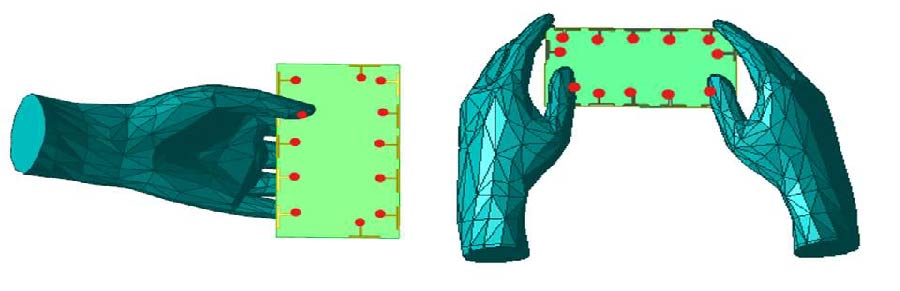
This research offers a 12-element antenna array optimized for MIMO utilization in fifth-generation (5G) mobile phones. The antennas operate in the sub-6 GHz long-term evolution (LTE) frequency range, specifically between 3.4 and 3.6 GHz. To fulfil the growing demand for faster data speeds and reliable connection in 5G networks, the presented MIMO antenna setup offers a balance between compact size and high performance, making it well suited for integration into smartphones. Every radiating element in the array is tuned to approximately 3.5 GHz and features an open-slot structure, which effectively reduces mutual coupling and enhances isolation. Antenna arrangement has been constructed on an FR-4 substrate of dimensions 150 mm × 80 mm × 0.8 mm, corresponding to the layout restrictions of standard 6-inches smartphones. A prototype was developed to validate the design through measurements. The results demonstrate excellent impedance matching (return loss > 10 dB), high isolation (> 20 dB), strong radiation efficiency (exceeding 66%), and a low envelope correlation coefficient (< 0.03) covering the target frequency range.
Twelve-element MIMO Antenna System Using Open-slots for 5G Smartphones at Sub-6 GHz Band
2025-08-04
PIER B
Vol. 114, 67-75, 2025
download: 286
A Novel Machine Learning Supported Compact, High Sensitivity EBG Based Microwave Sensor for Dielectric Characterization of Liquids
Tulshidas R. Mane, Reena Sonkusare, Pramod Bhavarthe and Kompella S. L. Parvathi
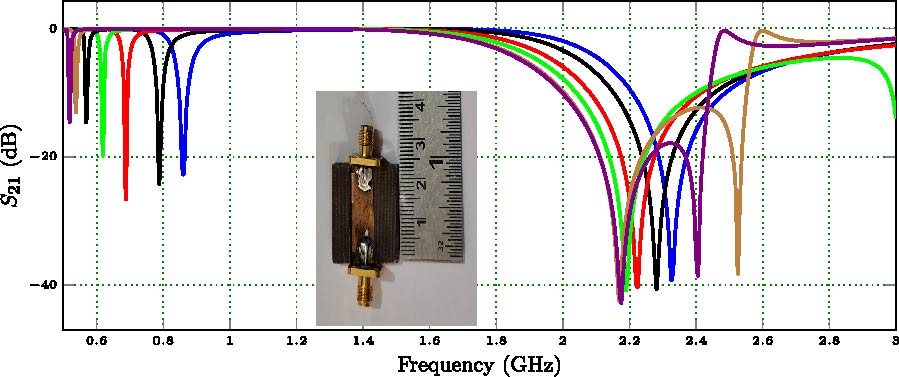
In this paper, machine learning supports a compact electromagnetic band gap structure (EBG) based dual band microwave sensor which is proposed for dielectric characterization of liquids with high sensitivity. Two edges, located via metalized holes, are electrically coupled with a suspended microstrip line. Two channels are placed in the electric field region of each EBG patch. Therefore, the change in frequency shift and quality factor are observed, which will help to describe the dielectric characterization of Liquid Under Test (LUT). A matrix-based mathematical model, and machine learning based prediction model are developed for the calibration and validation of the sensor. The results are experimentally verified through fabricated prototype for the binary mixture of water and ethanol. The proposed sensor achieved a compactness with size of 0.164λ2.47GHz × 0.164λ2.47GHz, an average sensitivity of 0.931, 0.243, and a quality factor of 170, 230 for band-1 and band-2, respectively. The calculated dielectric constant of different samples shows good agreement with the values reported in the literature. The machine learning based model is developed using the Support Vector Regression algorithm and achieves the high value of coefficient determination (R2) which is 99.01, and the less root mean square error (RMSE) value is 0.009.
A Novel Machine Learning Supported Compact, High Sensitivity EBG Based Microwave Sensor for Dielectric Characterization of Liquids
2025-08-03
PIER B
Vol. 114, 51-66, 2025
download: 146
Improved Model Predictive Torque Control for PMSM Based on Anti-Stagnation Particle Swarm Online Parameter Identification
Yang Zhang, Ping Yang, Chenhui Liu, Sicheng Li, Kun Cao, Ziying Liu and Zhun Cheng
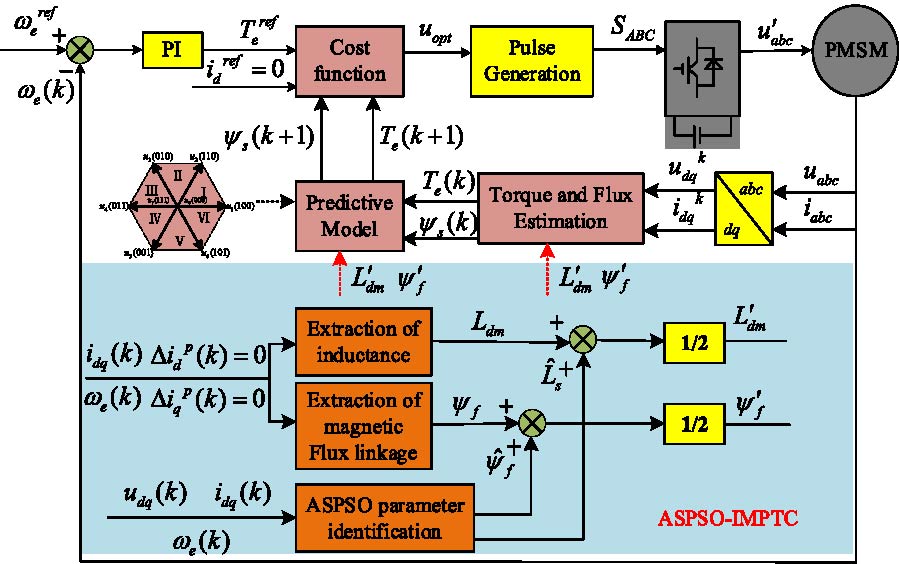
To address the problem that the control performance of permanent magnet synchronous motor (PMSM) in model predictive torque control (MPTC) is highly sensitive to motor parameters, an improved model predictive torque control scheme for PMSM based on anti-stagnation particle swarm online parameter identification (ASPSO-IMPTC) is proposed. First, an improved MPTC strategy based on inductance and magnetic chain parameter compensation is proposed. Compared with conventional MPTC, the proposed method can acquire accurate motor parameters in real-time, thereby enhancing both the control performance and parameter robustness of PMSM. Second, a review mechanism is proposed to enhance traditional PSO parameter identification. This method prevents particle swarm stagnation, enhances the parameter identification ability of the traditional method, and improves the real-time accuracy of the motor parameters. The parameter robustness of the motor is further enhanced. Finally, the experimental results show that the proposed ASPSO-IMPTC strategy can effectively improve the control performance and parameter robustness of PMSM when parameters mismatch occurs in PMSM.
Improved Model Predictive Torque Control for PMSM Based on Anti-stagnation Particle Swarm Online Parameter Identification
2025-08-03
PIER B
Vol. 114, 37-50, 2025
download: 241
A Racket-Shaped UWB MIMO Antenna Based on Characteristic Mode Analysis
Zhonggen Wang, Fukuan Zhang, Wenyan Nie, Ming Yang and Chenlu Li
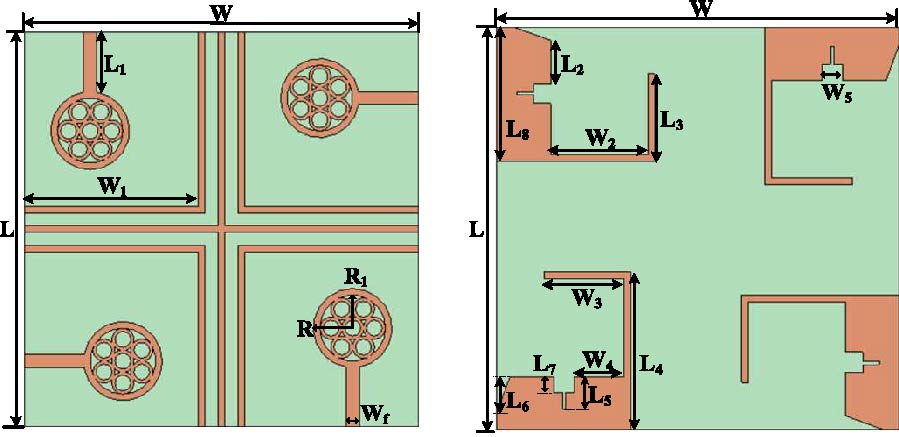
In this paper, a racket-shaped ultra-wideband (UWB) multiple-input multiple-output (MIMO) antenna is analytically designed using characteristic mode analysis. The antenna has an overall size of 60 × 60 × 1.6 mm3 and consists of four racket-type radiating elements, four ground planes shaped like the number 6, and a cross-shaped decoupling structure between the radiating units. In the single antenna configuration, the feed position is determined by analyzing the current and electric field distributions of its characteristic modes. The bandwidth and current distribution are optimized by integrating seven small rings, L-shaped branches, and etched slots to ensure the simultaneous excitation of six characteristic modes, thereby enabling its UWB performance. In the MIMO setup, four elements are orthogonally arranged, and a cross-shaped decoupling structure along with a defected ground structure is employed to reduce mutual coupling, achieving over 20 dB isolation between any two elements. Simulated and measured results confirm that the antenna operates over the 3-21 GHz range, fully encompassing the UWB range of 3.1-10.6 GHz. Furthermore, the antenna achieves up to 77% radiation efficiency, a peak gain of 5.75 dBi, and a low envelope correlation coefficient (ECC).
A Racket-shaped UWB MIMO Antenna Based on Characteristic Mode Analysis
2025-07-31
PIER B
Vol. 114, 27-35, 2025
download: 267
Fundamental GDOP Bounds and Base Station Deployment in 2D TDOA Positioning Systems
Shaohan Feng, Weiguang Shi, Yongtao Ma, Wanru Ning and Zihang Meng
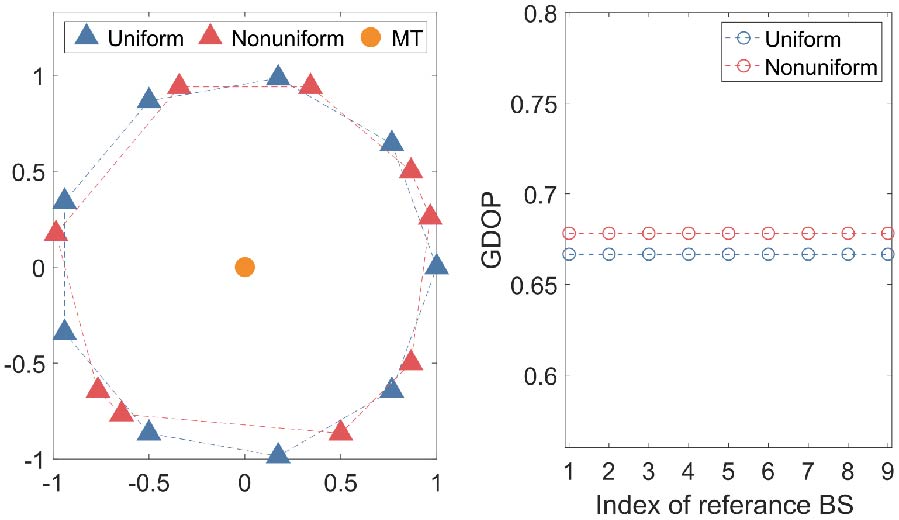
This paper investigates the theoretical bounds of geometric dilution of precision (GDOP) in two-dimensional time difference of arrival (TDOA) positioning systems. The corresponding base station (BS) deployment for a single mobile terminal (MT) is subsequently derived. Considering the correlation of time difference measurements, a simplified closed-form expression for GDOP is first derived, and it is shown that GDOP is independent of the selection of the reference BS. Theoretical bounds for GDOP are rigorously established, along with the conditions under which these bounds are valid. Based on these boundary conditions, the study demonstrates that optimal deployment occurs when BSs are grouped, and the azimuths of BSs within each group are evenly distributed around a circle centered at the MT. For systems with up to five BSs, the optimal deployment is proven to be unique, whereas non-unique solutions emerge for larger configurations. In contrast, the complete solution set for the worst-case deployment occurs when BSs are collinear and symmetrically aligned along a specific coordinate origin or axis. Numerical simulations validate the theoretical findings, highlighting the superiority of uniform angular distributions. These results provide actionable guidelines for enhancing positioning accuracy in cellular networks and a foundational framework for multi-BS deployment optimization.
Fundamental GDOP Bounds and Base Station Deployment in 2D TDOA Positioning Systems
2025-07-29
PIER B
Vol. 114, 13-25, 2025
download: 139
Parameter-Adaptive Composite Active Disturbance Rejection Control for Permanent Magnet Synchronous Motor Drives
Yanguo Huang, Yingmin Xie, Weilong Han and Ling Liang
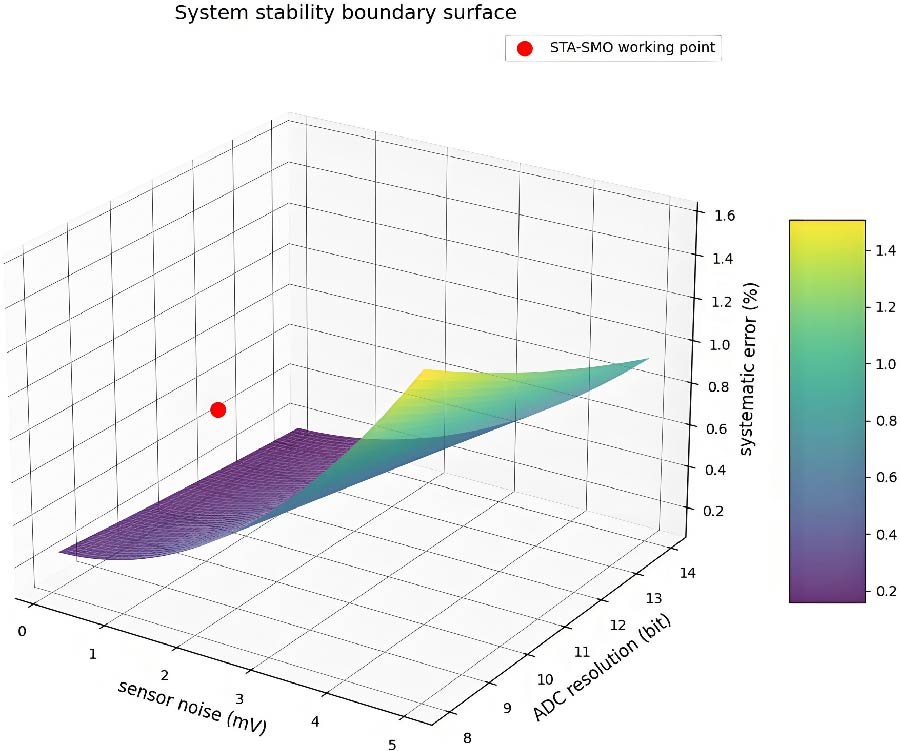
This paper proposes an sensorless control strategy to improve rotor position estimation accuracy and system robustness for permanent magnet synchronous motors (PMSMs) under dynamic conditions. By integrating a surface-mounted PMSM (SMPMSM) model with a super-twisting sliding mode observer (STA-SMO), the study achieves reductions in position estimation errors and enhanced noise attenuation capabilities. The system's performance under saturation and cross-coupling effects was validated through element simulations and experimental testing. Furthermore, the integration of parameter identification and computing models demonstrates the system's adaptability in high-noise and non-stationary environments. Results indicate that the proposed method achieves precision rotor position estimation with superior dynamic response and robustness, laying a solid foundation for subsequent research.
Parameter-adaptive Composite Active Disturbance Rejection Control for Permanent Magnet Synchronous Motor Drives
2025-07-24
PIER B
Vol. 114, 1-12, 2025
download: 226
PSF-Based Antenna Array Optimization Method for Synthetic Aperture Interferometric Radiometer
Xinqian Chen, Yujie Ruan and Jianfei Chen
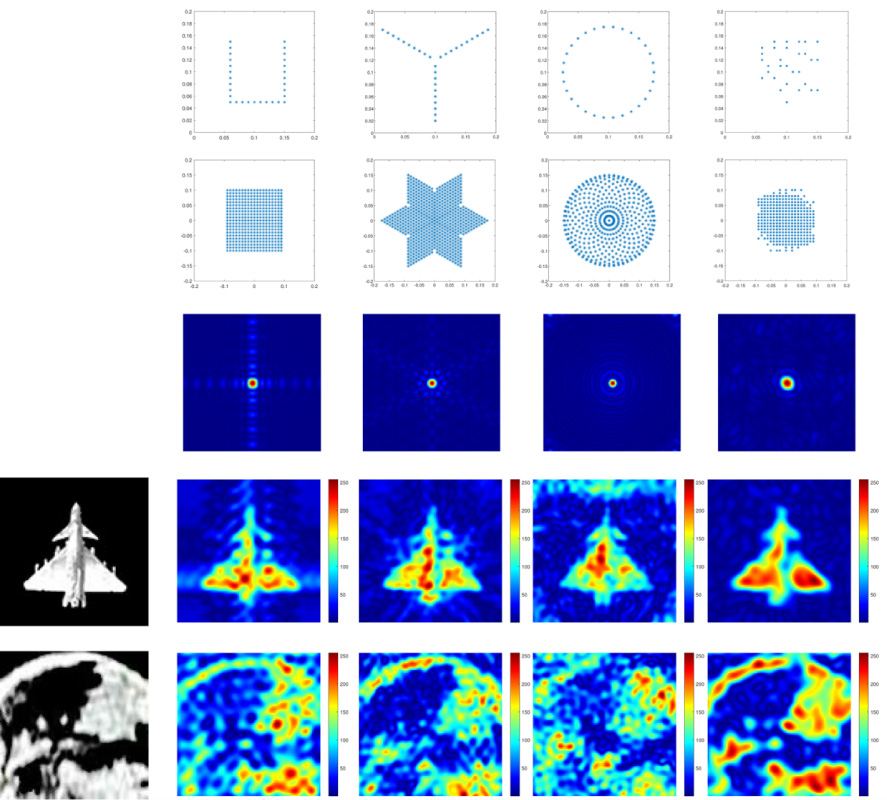
The antenna array structure represents a pivotal technology for synthetic aperture interferometric radiometers (SAIRs). However, current array optimization metrics often have conflicting relationships among themselves, posing a significant challenge to achieving a harmonious balance. To tackle this issue, this paper introduces the point spread function (PSF) into the array optimization process and proposes a PSF-based antenna array optimization method. As a crucial characterization of the SAIR system, PSF can effectively evaluate the SAIR's comprehensive imaging performance. The mainlobe-sidelobe comprehensive quality (MSCQ) is innovatively proposed is proposed as a system-level metric to evaluate PSF quality and guide array optimization. The MSCQ consists of two parts: the main lobe width and the side lobe energy ratio. The main lobe width can evaluate the spatial resolution of SAIR, and the side lobe energy ratio can evaluate the noise performance. In addition, in order to overcome the defect that the traditional optimization algorithm is prone to fall into the local optimum, this paper adopts the improved velocity-paused particle swarm algorithm (VPPSO) for high-precision optimization. The experimental results show that the PSF-based optimized array can effectively enhance SAIR's comprehensive performance and achieve high-performance imaging.
PSF-based Antenna Array Optimization Method for Synthetic Aperture Interferometric Radiometer