Vol. 133
Latest Volume
All Volumes
PIERL 133 [2026] PIERL 132 [2026] PIERL 131 [2026] PIERL 130 [2026] PIERL 129 [2026] PIERL 128 [2025] PIERL 127 [2025] PIERL 126 [2025] PIERL 125 [2025] PIERL 124 [2025] PIERL 123 [2025] PIERL 122 [2024] PIERL 121 [2024] PIERL 120 [2024] PIERL 119 [2024] PIERL 118 [2024] PIERL 117 [2024] PIERL 116 [2024] PIERL 115 [2024] PIERL 114 [2023] PIERL 113 [2023] PIERL 112 [2023] PIERL 111 [2023] PIERL 110 [2023] PIERL 109 [2023] PIERL 108 [2023] PIERL 107 [2022] PIERL 106 [2022] PIERL 105 [2022] PIERL 104 [2022] PIERL 103 [2022] PIERL 102 [2022] PIERL 101 [2021] PIERL 100 [2021] PIERL 99 [2021] PIERL 98 [2021] PIERL 97 [2021] PIERL 96 [2021] PIERL 95 [2021] PIERL 94 [2020] PIERL 93 [2020] PIERL 92 [2020] PIERL 91 [2020] PIERL 90 [2020] PIERL 89 [2020] PIERL 88 [2020] PIERL 87 [2019] PIERL 86 [2019] PIERL 85 [2019] PIERL 84 [2019] PIERL 83 [2019] PIERL 82 [2019] PIERL 81 [2019] PIERL 80 [2018] PIERL 79 [2018] PIERL 78 [2018] PIERL 77 [2018] PIERL 76 [2018] PIERL 75 [2018] PIERL 74 [2018] PIERL 73 [2018] PIERL 72 [2018] PIERL 71 [2017] PIERL 70 [2017] PIERL 69 [2017] PIERL 68 [2017] PIERL 67 [2017] PIERL 66 [2017] PIERL 65 [2017] PIERL 64 [2016] PIERL 63 [2016] PIERL 62 [2016] PIERL 61 [2016] PIERL 60 [2016] PIERL 59 [2016] PIERL 58 [2016] PIERL 57 [2015] PIERL 56 [2015] PIERL 55 [2015] PIERL 54 [2015] PIERL 53 [2015] PIERL 52 [2015] PIERL 51 [2015] PIERL 50 [2014] PIERL 49 [2014] PIERL 48 [2014] PIERL 47 [2014] PIERL 46 [2014] PIERL 45 [2014] PIERL 44 [2014] PIERL 43 [2013] PIERL 42 [2013] PIERL 41 [2013] PIERL 40 [2013] PIERL 39 [2013] PIERL 38 [2013] PIERL 37 [2013] PIERL 36 [2013] PIERL 35 [2012] PIERL 34 [2012] PIERL 33 [2012] PIERL 32 [2012] PIERL 31 [2012] PIERL 30 [2012] PIERL 29 [2012] PIERL 28 [2012] PIERL 27 [2011] PIERL 26 [2011] PIERL 25 [2011] PIERL 24 [2011] PIERL 23 [2011] PIERL 22 [2011] PIERL 21 [2011] PIERL 20 [2011] PIERL 19 [2010] PIERL 18 [2010] PIERL 17 [2010] PIERL 16 [2010] PIERL 15 [2010] PIERL 14 [2010] PIERL 13 [2010] PIERL 12 [2009] PIERL 11 [2009] PIERL 10 [2009] PIERL 9 [2009] PIERL 8 [2009] PIERL 7 [2009] PIERL 6 [2009] PIERL 5 [2008] PIERL 4 [2008] PIERL 3 [2008] PIERL 2 [2008] PIERL 1 [2008]
2026-11-11 Latest Published
By Xinwei Chen Xingwang Xie Jinrong Su Guorui Han Wenmei Zhang Runbo Ma
Progress In Electromagnetics Research Letters, Vol. 133, 22-28, 2026
Abstract
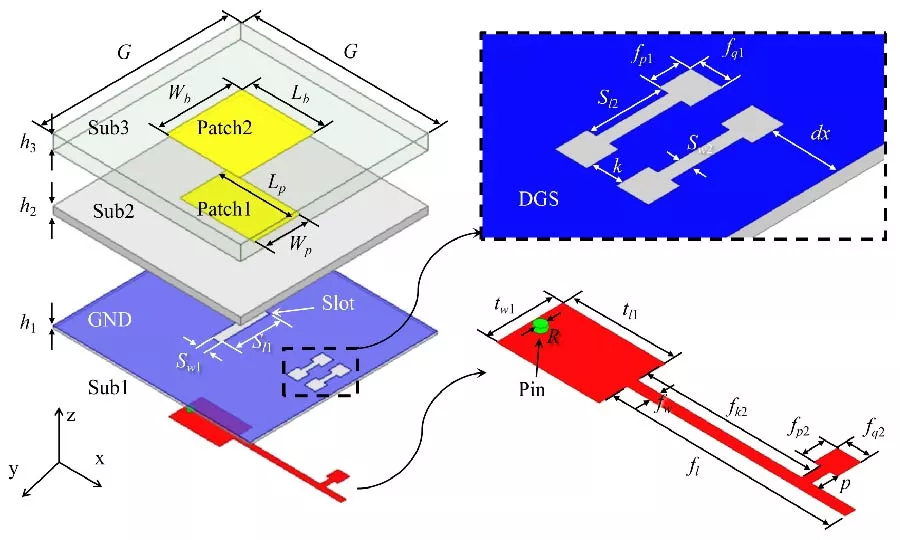
This paper presents a compact broadband filtering antenna with wide stopband suppression performance. A quarter-wavelength shorted stub is integrated into the feeding structure to excite an additional low-frequency resonant mode and introduce a controllable transmission zero. Meanwhile, a parasitic patch is loaded to generate high-frequency resonant modes and upper-band transmission zeros, further expanding the impedance bandwidth. In addition, the hybrid integration of a dumbbell-shaped defected ground structure (DGS) and an open-circuited feed stub effectively suppresses high-order harmonic radiation, achieving wide stopband suppression. To clarify the multi-resonance coupling principle and inherent filtering mechanism of the integrated antenna configuration, a corresponding equivalent circuit model is established and analyzed. Measured results verify that the proposed filtering antenna achieves a broad impedance bandwidth of 19.01%, covering 3.76-4.55 GHz, with a peak realized gain of 6.35 dBi. Remarkably, the designed antenna achieves a wide stopband suppression range up to 3.07f0 in the -10 dBi gain suppression level. The proposed filtering antenna is suitable for application in the extended frequency bands of 5G-Advanced.
2026-11-11
PIER Letters
Vol. 133, 22-28, 2026
download: 8
Design of a Compact Filtering Antenna with Wide Bandwidth and Wide Stopband Suppression
Xinwei Chen, Xingwang Xie, Jinrong Su, Guorui Han, Wenmei Zhang and Runbo Ma
This paper presents a compact broadband filtering antenna with wide stopband suppression performance. A quarter-wavelength shorted stub is integrated into the feeding structure to excite an additional low-frequency resonant mode and introduce a controllable transmission zero. Meanwhile, a parasitic patch is loaded to generate high-frequency resonant modes and upper-band transmission zeros, further expanding the impedance bandwidth. In addition, the hybrid integration of a dumbbell-shaped defected ground structure (DGS) and an open-circuited feed stub effectively suppresses high-order harmonic radiation, achieving wide stopband suppression. To clarify the multi-resonance coupling principle and inherent filtering mechanism of the integrated antenna configuration, a corresponding equivalent circuit model is established and analyzed. Measured results verify that the proposed filtering antenna achieves a broad impedance bandwidth of 19.01%, covering 3.76-4.55 GHz, with a peak realized gain of 6.35 dBi. Remarkably, the designed antenna achieves a wide stopband suppression range up to 3.07f0 in the -10 dBi gain suppression level. The proposed filtering antenna is suitable for application in the extended frequency bands of 5G-Advanced.

Design of a Compact Filtering Antenna with Wide Bandwidth and Wide Stopband Suppression
2026-11-11
PIER Letters
Vol. 133, 15-21, 2026
download: 4
Line-of-Sight Pre-Analysis for Efficient Bayesian Optimization of Indoor Transmitter Placement
Sejin Kim, Seungchan Lee, In-Sik Choi and Seongwon Oh
Optimizing indoor transmitter placement via 3D ray-tracing is computationally intensive. To overcome this limitation, this study proposes an efficient method that integrates geometry-informed line-of-sight (LoS) pre-analysis with Bayesian optimization (BO). A boundary-line-based 2D occupancy grid is generated from CAD drawings to prevent the loss of vertical structures, and LoS scores for all 770 Tx candidate locations are obtained in approximately 3 s, including all preprocessing of the CAD geometry, without ray-tracing simulation. Spatially distributed candidates with high LoS scores are selected as initial points for BO to improve search efficiency and surrogate model accuracy. Simulation results in a smart factory environment show that the proposed method avoids local optima pitfalls of randomly initialized BO and reaches the global optimum in only 37 evaluations (5.9 h). This achieved a 33% reduction in search time compared to Particle swarm optimization (PSO) and up to 69% compared to the grey wolf optimizer (GWO) while finding the identical global optimum, demonstrating superior efficiency for computationally expensive propagation environments.
Line-of-Sight Pre-Analysis for Efficient Bayesian Optimization of Indoor Transmitter Placement
2026-11-09
PIER Letters
Vol. 133, 6-14, 2026
download: 6
A DGS Decoupling Method for PIFA Antennas Based on Common-Mode/Differential-Mode Analysis
Tao Yang and Yafei Wang
To address mutual coupling between antennas in MIMO antenna systems, this paper proposes a decoupling method for a MIMO PIFA using a defected ground structure (DGS) based on common-mode/differential-mode (CM/DM) theory. We use the CM/DM response relationship as an explicit design criterion to guide DGS structure evolution and the selection of critical geometric parameters. Simulation results show that the proposed PIFA MIMO antenna achieves more than 20 dB of port isolation over the 3.8-3.9 GHz band, with a peak isolation of 57 dB, while maintaining good impedance matching. Moreover, the measured results of the fabricated prototype agree well with the simulated results, further validating the effectiveness of the proposed method.
A DGS Decoupling Method for PIFA Antennas Based on Common-Mode/Differential-Mode Analysis
2026-11-09
PIER Letters
Vol. 133, 1-5, 2026
download: 6
Displacement of the Field of a Current Source Located near a Layered Stack Composed of Single-Negative Layers
Leonid Pazynin, Kostyantyn Sirenko and Vadym Pazynin
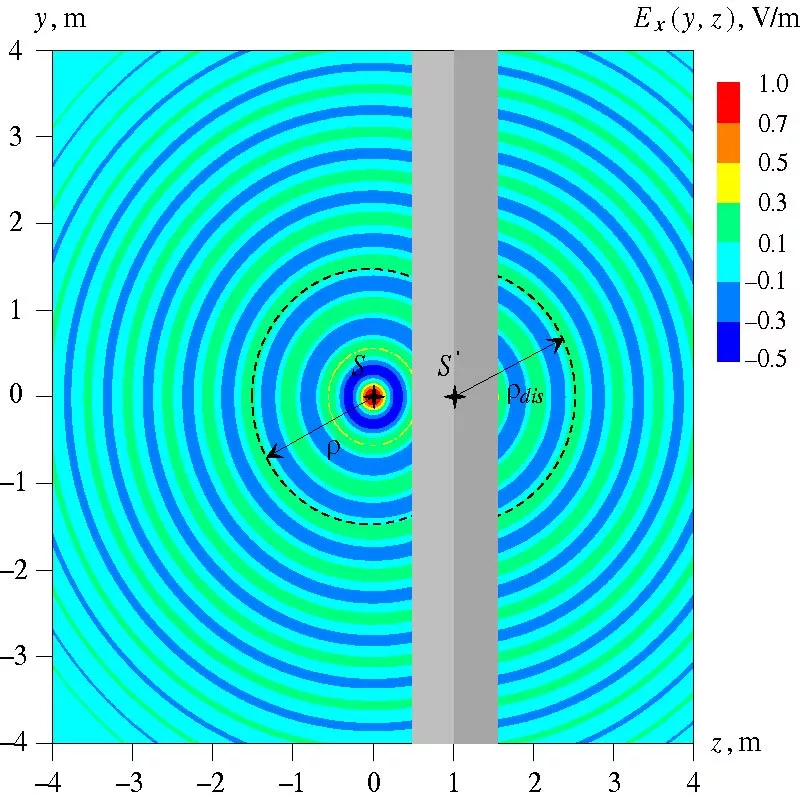
A rigorous analytical solution is obtained for two-dimensional boundary value problems describing E-polarized fields of a current source located near two- and three-layer stacks composed of single-negative layers. Conditions for complete tunneling of the source field into the half-space behind the multilayer stacks are formulated. It is rigorously demonstrated that such structures exhibit the previously predicted effect of ideal image displacement.
Displacement of the Field of a Current Source Located near a Layered Stack Composed of Single-Negative Layers