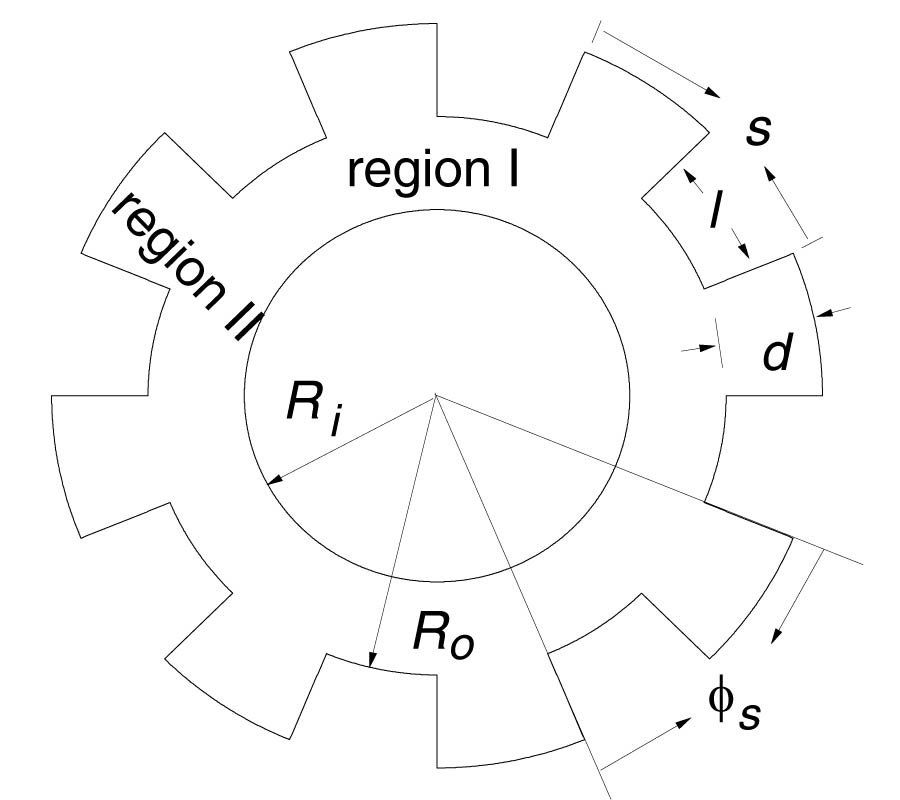
1. Grudiev, A., J. Y. Raguin, and K. Schunemann, "Numerical study of mode competition in coaxial cavity gyrotrons with corrugated insert," Int. J. Infrared Millimeter Waves, Vol. 24, 173-187, 2003.
doi:10.1023/A:1021890602624 Google Scholar
2. Singh, K., P. K. Jain, and B. N. Basu, "Analysis of a corrugated coaxial waveguide resonator for mode rarefaction in a gyrotron," IEEE Trans. Plasma Sci., Vol. 33, No. 3, 1024-1030, 2005.
doi:10.1109/TPS.2005.848604 Google Scholar
3. Iatrou, C. T., "Mode selective properties of coaxial gyrotron resonators," IEEE Trans. Plasma Sci., Vol. 24, No. 3, 596-605, 1996.
doi:10.1109/27.532942 Google Scholar
4. Iatrou, C. T., S. Kern, and A. B. Pavelyev, "Coaxial cavities with corrugated inner conductor for gyrotrons," IEEE Trans. on Microwave Theory Tech., Vol. 44, No. 1, 56-64, 1996.
doi:10.1109/22.481385 Google Scholar
5. Dumbrajs, O. and G. I. Zaginaylov, "Ohmic losses in coaxial gyrotron cavities with corrugated insert," IEEE Trans. Plasma Sci., Vol. 32, No. 3, 861-866, 2004.
doi:10.1109/TPS.2004.827591 Google Scholar
6. Zaginaylov, G. I., N. N. Tkachuk, V. L. Shcherbinin, and K. Schuenemann, "Rigorous calculation of energy losses in cavity of ITER relevant coaxial gyrotron," Proc. of 35th EuMW, 1107-1110, 2005. Google Scholar
7. Zaginaylov, G. I. and I. V. Mitina, "Electromagnetic analysis of coaxial gyrotron cavity with the inner conductor having corrugations of an arbitrary shape," Progress In Electromagnetics Research B, Vol. 31, 339-356, 2011. Google Scholar
8. Ioannidis, Z. C., O. Dumbrajs, and I. G. Tigelis, "Linear and non-linear inserts for genuinely wide-band continuous frequency tunable coaxial gyrotron cavities," Int. J. Infrared Millimeter Waves, Vol. 29, No. 4, 416-423, 2008.
doi:10.1007/s10762-008-9336-y Google Scholar
9. Piosczyk, B., A. Arnold, G. Dammertz, et al. "Coaxial cavity gyrotron-recent experimental results," IEEE Trans. Plasma Sci., Vol. 30, No. 3, 819-827, 2002.
doi:10.1109/TPS.2002.801557 Google Scholar
10. Flyagin, V. A. and G. S. Nusinovich, "Gyrotron oscillators Proceedings of the IEEE,", Vol. 76, 644-656, Oct. 1988. Google Scholar
11. Felch, K., H. Huey, and H. Jory, "Gyrotrons for ECH applications," J. Fusion Energy, Vol. 9, 59-75, 1990.
doi:10.1007/BF01057322 Google Scholar
12. Makowski, M., "ECRF systems for ITER," IEEE Trans. Plasma Sci., Vol. 24, 1023-1032, 1996.
doi:10.1109/27.533109 Google Scholar
13. Thumm, M., "MW gyrotron development for fusion plasma applications," Plasma Physics and Controlled Fusion, Vol. 45, No. 12A, 143-161, 2003.
doi:10.1088/0741-3335/45/12A/011 Google Scholar
14. Dammertz, G., S. Alberti, A. Arnold, et al. "High-power gyrotron development at Forschungszentrum Karlsruhe for fusion applications," IEEE Trans. Plasma Sci., Vol. 34, No. 2, 173-186, 2006.
doi:10.1109/TPS.2006.872176 Google Scholar
15. La Haye, R. J., et al. "Control of neoclassical tearing modes in DIII-D," Phys. Plasmas, Vol. 9, 2051, 2002.
doi:10.1063/1.1456066 Google Scholar
16. Dammertz, G., E. Borie, C. T. Iatrou, M. Kuntze, B. Pioscyk, and M. K. Thumm, "140-GHz gyrotron with multimegawatt output power," IEEE Trans. Plasma Sci., Vol. 28, No. 3, 561-566, 2000.
doi:10.1109/27.887673 Google Scholar
17. Borie, E. and O. Dumbrajs, "Calculation of eigenmodes of tapered gyrotron resonators," International Journal of Electron., Vol. 60, No. 2, 143-154, 1986.
doi:10.1080/00207218608920768 Google Scholar
18. Liu, R. and H. Li, "Study of eigenmodes of coaxial resonators using coupled-wave theory," J. Infrared Milli. Terahertz Waves, Vol. 31, 995-1003, 2010. Google Scholar