1. Pendry, J. B., D. Schurig, and D. R. Smith, "Controlling electromagnetic fields," Science, Vol. 312, 1780-1782, New York, N.Y., Jun. 2006.
doi:10.1126/science.1125907 Google Scholar
2. Kwon, D.-H. and D. H. Werner, "Transformation electromagnetics: An overview of the theory and applications," IEEE Antennas and Propagation Magazine, Vol. 52, No. 1, 24-46, 2010.
doi:10.1109/MAP.2010.5466396 Google Scholar
3. Leonhardt, U. and T. G. Philbin, "Transformation optics and the geometry of light," Progress in Optics, Vol. 53, No. 8, 69-152, 2009.
doi:10.1016/S0079-6638(08)00202-3 Google Scholar
4. Valentine, J., J. Li, T. Zentgraf, G. Bartal, and X. Zhang, "An optical cloak made of dielectrics," Nature Materials, Vol. 8, No. 7, 568, 2009.
doi:10.1038/nmat2461 Google Scholar
5. Ergin, T., N. Stenger, Brenner, J. B. Pendry, and M. Wegener, "Three-dimensional invisibility cloak at optical wavelengths," Science, 1186351, 2010. Google Scholar
6. Gabrielli, L. H., J. Cardenas, C. B. Poitras, and M. Lipson, "Silicon nanostructure cloak operating at optical frequencies," Nature Photonics, Vol. 3, No. 8, 461, 2009.
doi:10.1038/nphoton.2009.117 Google Scholar
7. Liu, R., C. Ji, J. Mock, J. Chin, T. Cui, and D. Smith, "Broadband ground-plane cloak," Science, Vol. 323, No. 5912, 366-369, 2009.
doi:10.1126/science.1166949 Google Scholar
8. Rahm, M., D. Schurig, D. A. Roberts, S. A. Cummer, D. R. Smith, and J. B. Pendry, "Design of electromagnetic cloaks and concentrators using form-invariant coordinate transformations of Maxwell's equations," Photonics and Nanostructures-fundamentals and Applications, Vol. 6, No. 1, 87-95, 2008. Google Scholar
9. Li, J. and J. B. Pendry, "Hiding under the carpet: a new strategy for cloaking," Physical Review Letters, Vol. 101, No. 20, 203901, 2008.
doi:10.1103/PhysRevLett.101.203901 Google Scholar
10. Ma, H. F. and T. J. Cui, "Three-dimensional broadband and broad-angle transformation-optics lens," Nature communications, Vol. 1, 124, 2010.
doi:10.1038/ncomms1126 Google Scholar
11. Roberts, D., N. Kundtz, and D. Smith, "Optical lens compression via transformation optics," Optics Express, Vol. 17, No. 19, 16535-16542, 2009.
doi:10.1364/OE.17.016535 Google Scholar
12. Rahm, M., D. Roberts, J. Pendry, and D. Smith, "Transformation-optical design of adaptive beam bends and beam expanders," Optics Express, Vol. 16, No. 15, 11555-11567, 2008.
doi:10.1364/OE.16.011555 Google Scholar
13. Rahm, M., S. A. Cummer, D. Schurig, J. B. Pendry, and D. R. Smith, "Optical design of reflectionless complex media by finite embedded coordinate transformations," Physical Review Letters, Vol. 100, No. 6, 063903, 2008.
doi:10.1103/PhysRevLett.100.063903 Google Scholar
14. Kwon, D.-H. and D. H. Werner, "Polarization splitter and polarization rotator designs based on transformation optics," Optics Express, Vol. 16, No. 23, 18731-18738, 2008.
doi:10.1364/OE.16.018731 Google Scholar
15. Jiang, W. X., T. J. Cui, Q. Cheng, J. Y. Chin, X. M. Yang, R. Liu, and D. R. Smith, "Design of arbitrarily shaped concentrators based on conformally optical transformation of nonuniform rational b-spline surfaces," Applied Physics Letters, Vol. 92, No. 26, 264101, 2008.
doi:10.1063/1.2951485 Google Scholar
16. Yang, J., M. Huang, C. Yang, Z. Xiao, and J. Peng, "Metamaterial electromagnetic concentrators with arbitrary geometries," Optics Express, Vol. 17, No. 22, 19656-19661, 2009.
doi:10.1364/OE.17.019656 Google Scholar
17. Schurig, D., J. Mock, B. Justice, S. A. Cummer, J. B. Pendry, A. Starr, and D. Smith, "Metamaterial electromagnetic cloak at microwave frequencies," Science, Vol. 314, No. 5801, 977-980, 2006.
doi:10.1126/science.1133628 Google Scholar
18. Hu, J., X. Zhou, and G. Hu, "Design method for electromagnetic cloak with arbitrary shapes based on laplace's equation," Optics Express, Vol. 17, No. 3, 1308-1320, 2009.
doi:10.1364/OE.17.001308 Google Scholar
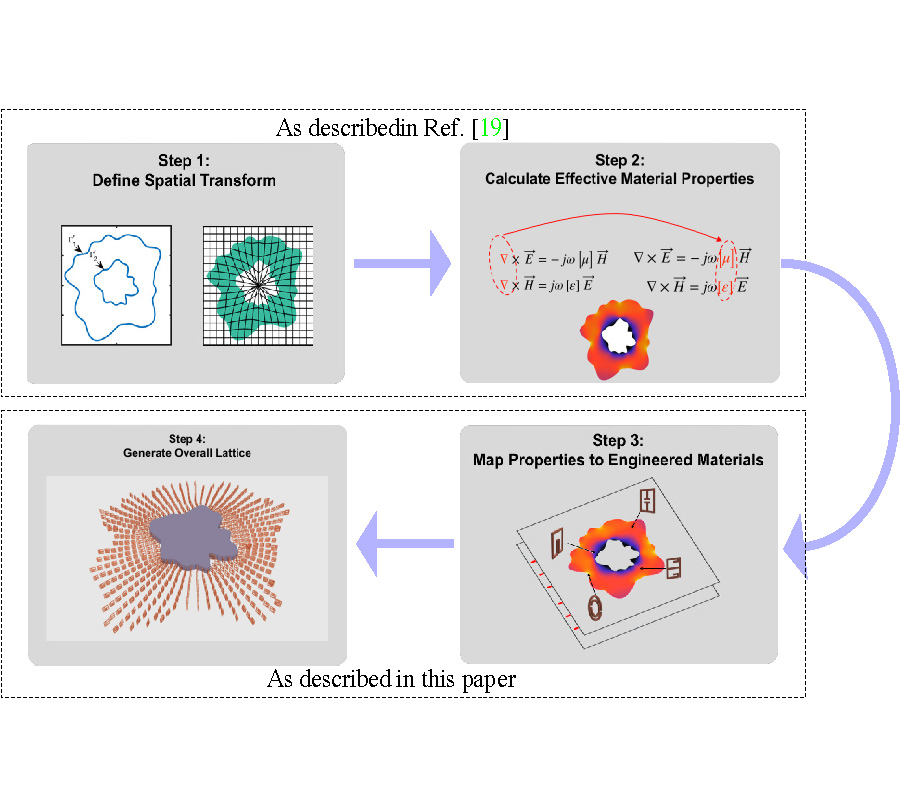
19. Berry, E. A., J. J. Gutierrez, and R. C. Rumpf, "Design and simulation of arbitrarily-shaped transformation optic devices using a simple finite-difference method," Progress In Electromagnetics Research, Vol. 68, 1-16, 2016. Google Scholar
20. Chen, H., C. T. Chan, and Sheng, "Transformation optics and metamaterials," Nature Materials, Vol. 9, No. 5, 387, 2010.
doi:10.1038/nmat2743 Google Scholar
21. Mei, Z.-L., J. Bai, T. M. Niu, and T.-J. Cui, "A planar focusing antenna design with the quasi-conformal mapping," Progress In Electromagnetics Research, Vol. 13, 261-273, 2010.
doi:10.2528/PIERM10053102 Google Scholar
22. Pendry, J. B., A. Holden, W. Stewart, and I. Youngs, "Extremely low frequency plasmons in metallic mesostructures," Physical Review Letters, Vol. 76, No. 25, 4773, 1996.
doi:10.1103/PhysRevLett.76.4773 Google Scholar
23. Pendry, J. B., A. J. Holden, D. J. Robbins, and W. Stewart, "Magnetism from conductors and enhanced nonlinear phenomena," IEEE Transactions on Microwave Theory and Techniques, Vol. 47, No. 11, 2075-2084, 1999.
doi:10.1109/22.798002 Google Scholar
24. Pedrola, G. L., Beam Propagation Method for Design of Optical Waveguide Devices, John Wiley & Sons, 2015.
doi:10.1002/9781119083405
25. Basser, J., J. Mattiello, and D. LeBihan, "Mr diffusion tensor spectroscopy and imaging," Biophysical Journal, Vol. 66, No. 1, 259-267, 1994.
doi:10.1016/S0006-3495(94)80775-1 Google Scholar
26. Nye, J. F., Physical Properties of Crystals: Their Representation by Tensors and Matrices, Oxford University Press, 1985.
27. Kuprel, B. and A. Grbic, "Anisotropic inhomogeneous metamaterials using nonuniform transmission-line grids aligned with the principal axes," IEEE Antennas and Wireless Propagation Letters, Vol. 11, 358-361, 2012.
doi:10.1109/LAWP.2012.2191257 Google Scholar
28. Lam, T. A., D. C. Vier, J. A. Nielsen, C. G. Parazzoli, and M. H. Tanielian, "Steering phased array antenna beams to the horizon using a buckyball nim lens," Proceedings of the IEEE, Vol. 99, No. 10, 1755-1767, 2011.
doi:10.1109/JPROC.2011.2128290 Google Scholar
29. Ansys, H., "v15," ANSYS Corporation Software, Pittsburgh, PA, USA, 2014. Google Scholar
30. Smith, D. R., S. Schultz, Markoš, and C. Soukoulis, "Determination of effective permittivity and permeability of metamaterials from reflection and transmission coefficients," Physical Review B, Vol. 65, No. 19, 195104, 2002.
doi:10.1103/PhysRevB.65.195104 Google Scholar
31. Chen, X., T. M. Grzegorczyk, B.-I. Wu, J. Pacheco, Jr, and J. A. Kong, "Robust method to retrieve the constitutive effective parameters of metamaterials," Physical Review E, Vol. 70, No. 1, 016608, 2004.
doi:10.1103/PhysRevE.70.016608 Google Scholar
32. Liu, R., T. J. Cui, D. Huang, B. Zhao, and D. R. Smith, "Description and explanation of electromagnetic behaviors in artificial metamaterials based on effective medium theory," Physical Review E, Vol. 76, No. 2, 026606, 2007.
doi:10.1103/PhysRevE.76.026606 Google Scholar
33. Smith, D., D. Vier, T. Koschny, and C. Soukoulis, "Electromagnetic parameter retrieval from inhomogeneous metamaterials," Physical Review E, Vol. 71, No. 3, 036617, 2005.
doi:10.1103/PhysRevE.71.036617 Google Scholar
34. Barton, J. H., C. R. Garcia, E. A. Berry, R. Salas, and R. C. Rumpf, "3-d printed all-dielectric frequency selective surface with large bandwidth and field of view," IEEE Transactions on Antennas and Propagation, Vol. 63, 1032-1039, March 2015.
doi:10.1109/TAP.2015.2388541 Google Scholar
35. Fraser, A. S., "Simulation of genetic systems by automatic digital computers vi. epistasis," Australian Journal of Biological Sciences, Vol. 13, No. 2, 150-162, 1960.
doi:10.1071/BI9600150 Google Scholar
36. Clerc, M., Particle Swarm Optimization, Vol. 93, John Wiley & Sons, 2010.
37. Rumpf, R. C., C. R. Garcia, E. A. Berry, and J. H. Barton, "Finite-difference frequency-domain algorithm for modeling electromagnetic scattering from general anisotropic objects," Progress In Electromagnetics Research, Vol. 61, 55-67, 2014.
doi:10.2528/PIERB14071606 Google Scholar
38. Rumpf, R. C. and J. Pazos, "Synthesis of spatially variant lattices," Optics Express, Vol. 20, No. 14, 15263-15274, 2012.
doi:10.1364/OE.20.015263 Google Scholar
39. Rumpf, R. C., "Engineering the dispersion and anisotropy of periodic electromagnetic structures," Solid State Physics, Vol. 66, 213-300, Elsevier, 2015. Google Scholar
40. Rumpf, R. C., J. Pazos, C. R. Garcia, L. Ochoa, and R. Wicker, "3d printed lattices with spatially variant self-collimation," Progress In Electromagnetics Research, Vol. 139, 1-15, 2013.
doi:10.2528/PIER13030507 Google Scholar
41. Rumpf, R. C., J. J. Pazos, J. L. Digaum, and S. M. Kuebler, "Spatially variant periodic structures in electromagnetics," Philosophical Transactions of the Royal Society A: Mathematical, Physical and Engineering Sciences, Vol. 373, No. 2049, 20140359, 2015.
doi:10.1098/rsta.2014.0359 Google Scholar
42. Greville, T., "Some applications of the pseudoinverse of a matrix," SIAM Review, Vol. 2, No. 1, 15-22, 1960.
doi:10.1137/1002004 Google Scholar
43. Noble, B. and J. W. Daniel, Applied Linear Algebra, 3rd Ed., Prentice Hall, 1988.
44. Sacks, Z. S., D. M. Kingsland, R. Lee, and J.-F. Lee, "A perfectly matched anisotropic absorber for use as an absorbing boundary condition," IEEE Transactions on Antennas and Propagation, Vol. 43, No. 12, 1460-1463, 1995.
doi:10.1109/8.477075 Google Scholar