Vol. 170
Latest Volume
All Volumes
PIERC 170 [2026] PIERC 169 [2026] PIERC 168 [2026] PIERC 167 [2026] PIERC 166 [2026] PIERC 165 [2026] PIERC 164 [2026] PIERC 163 [2026] PIERC 162 [2025] PIERC 161 [2025] PIERC 160 [2025] PIERC 159 [2025] PIERC 158 [2025] PIERC 157 [2025] PIERC 156 [2025] PIERC 155 [2025] PIERC 154 [2025] PIERC 153 [2025] PIERC 152 [2025] PIERC 151 [2025] PIERC 150 [2024] PIERC 149 [2024] PIERC 148 [2024] PIERC 147 [2024] PIERC 146 [2024] PIERC 145 [2024] PIERC 144 [2024] PIERC 143 [2024] PIERC 142 [2024] PIERC 141 [2024] PIERC 140 [2024] PIERC 139 [2024] PIERC 138 [2023] PIERC 137 [2023] PIERC 136 [2023] PIERC 135 [2023] PIERC 134 [2023] PIERC 133 [2023] PIERC 132 [2023] PIERC 131 [2023] PIERC 130 [2023] PIERC 129 [2023] PIERC 128 [2023] PIERC 127 [2022] PIERC 126 [2022] PIERC 125 [2022] PIERC 124 [2022] PIERC 123 [2022] PIERC 122 [2022] PIERC 121 [2022] PIERC 120 [2022] PIERC 119 [2022] PIERC 118 [2022] PIERC 117 [2021] PIERC 116 [2021] PIERC 115 [2021] PIERC 114 [2021] PIERC 113 [2021] PIERC 112 [2021] PIERC 111 [2021] PIERC 110 [2021] PIERC 109 [2021] PIERC 108 [2021] PIERC 107 [2021] PIERC 106 [2020] PIERC 105 [2020] PIERC 104 [2020] PIERC 103 [2020] PIERC 102 [2020] PIERC 101 [2020] PIERC 100 [2020] PIERC 99 [2020] PIERC 98 [2020] PIERC 97 [2019] PIERC 96 [2019] PIERC 95 [2019] PIERC 94 [2019] PIERC 93 [2019] PIERC 92 [2019] PIERC 91 [2019] PIERC 90 [2019] PIERC 89 [2019] PIERC 88 [2018] PIERC 87 [2018] PIERC 86 [2018] PIERC 85 [2018] PIERC 84 [2018] PIERC 83 [2018] PIERC 82 [2018] PIERC 81 [2018] PIERC 80 [2018] PIERC 79 [2017] PIERC 78 [2017] PIERC 77 [2017] PIERC 76 [2017] PIERC 75 [2017] PIERC 74 [2017] PIERC 73 [2017] PIERC 72 [2017] PIERC 71 [2017] PIERC 70 [2016] PIERC 69 [2016] PIERC 68 [2016] PIERC 67 [2016] PIERC 66 [2016] PIERC 65 [2016] PIERC 64 [2016] PIERC 63 [2016] PIERC 62 [2016] PIERC 61 [2016] PIERC 60 [2015] PIERC 59 [2015] PIERC 58 [2015] PIERC 57 [2015] PIERC 56 [2015] PIERC 55 [2014] PIERC 54 [2014] PIERC 53 [2014] PIERC 52 [2014] PIERC 51 [2014] PIERC 50 [2014] PIERC 49 [2014] PIERC 48 [2014] PIERC 47 [2014] PIERC 46 [2014] PIERC 45 [2013] PIERC 44 [2013] PIERC 43 [2013] PIERC 42 [2013] PIERC 41 [2013] PIERC 40 [2013] PIERC 39 [2013] PIERC 38 [2013] PIERC 37 [2013] PIERC 36 [2013] PIERC 35 [2013] PIERC 34 [2013] PIERC 33 [2012] PIERC 32 [2012] PIERC 31 [2012] PIERC 30 [2012] PIERC 29 [2012] PIERC 28 [2012] PIERC 27 [2012] PIERC 26 [2012] PIERC 25 [2012] PIERC 24 [2011] PIERC 23 [2011] PIERC 22 [2011] PIERC 21 [2011] PIERC 20 [2011] PIERC 19 [2011] PIERC 18 [2011] PIERC 17 [2010] PIERC 16 [2010] PIERC 15 [2010] PIERC 14 [2010] PIERC 13 [2010] PIERC 12 [2010] PIERC 11 [2009] PIERC 10 [2009] PIERC 9 [2009] PIERC 8 [2009] PIERC 7 [2009] PIERC 6 [2009] PIERC 5 [2008] PIERC 4 [2008] PIERC 3 [2008] PIERC 2 [2008] PIERC 1 [2008]
2026-05-14
A Unified Conformal FDTD Formulation Based on Harmonic Mean Weighting for Dielectric and PEC Objects
By
Progress In Electromagnetics Research C, Vol. 170, 202-209, 2026
Abstract
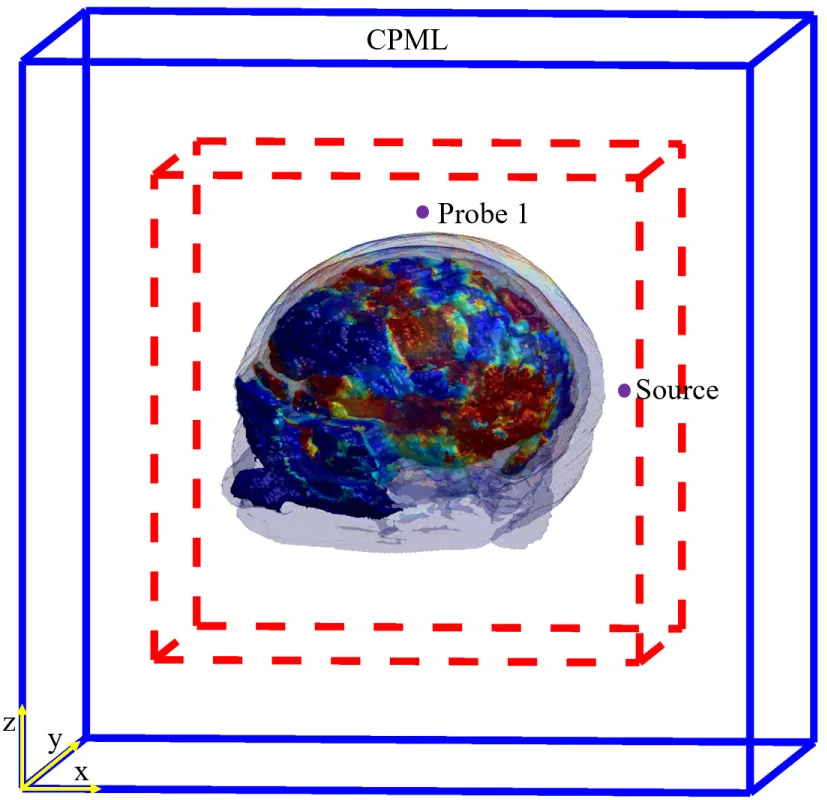
To address the need to differentiate between dielectric and perfect electric conductor (PEC) conformal methods in the finite-difference time-domain (FDTD), this study proposes a conformal approach based on the harmonic mean to achieve a unified formulation. In this approach, the relevant electromagnetic parameters are weighted using harmonic mean weighting, enabling a conformal implementation within the FDTD framework. Both dielectric and PEC conformality are incorporated into a single mathematical framework, allowing for a unified treatment in the FDTD. The proposed method provides a consistent formulation that can be seamlessly integrated with standard FDTD procedures while ensuring high compatibility and accuracy of the results. The conformal method based on harmonic mean requires only 60% of the computational time and 36% of the memory compared to the CST method, indicating its high computational efficiency. Furthermore, it demonstrates strong applicability to complex biological models, such as specific absorption rate (SAR) calculations in the human head. This approach is particularly well suited for RF device design and biomedical applications, offering improved modeling efficiency and reliability.
Citation
Cuihua Li, Haofeng Wang, Jun Zheng, and Minquan Li, "A Unified Conformal FDTD Formulation Based on Harmonic Mean Weighting for Dielectric and PEC Objects," Progress In Electromagnetics Research C, Vol. 170, 202-209, 2026.
doi:10.2528/PIERC26041401
References

1. Taflove, A., Computational Electrodynamics, Artech House, 2005.

2. Niu, Kaikun, Zhixiang Huang, Minquan Li, and Xianliang Wu, "Optimization of the artificially anisotropic parameters in WCS-FDTD method for reducing numerical dispersion," IEEE Transactions on Antennas and Propagation, Vol. 65, No. 12, 7389-7394, Dec. 2017.
doi:10.1109/tap.2017.2758844        Google Scholar

3. Holland, R., "Pitfalls of staircase meshing," IEEE Transactions on Electromagnetic Compatibility, Vol. 35, No. 4, 434-439, Nov. 1993.
doi:10.1109/15.247856        Google Scholar

4. Dey, S. and R. Mittra, "A locally conformal finite-difference time-domain (FDTD) algorithm for modeling three-dimensional perfectly conducting objects," IEEE Microwave and Guided Wave Letters, Vol. 7, No. 9, 273-275, Sep. 1997.
doi:10.1109/75.622536        Google Scholar

5. Xiao, Tian and Q. H. Liu, "Enlarged cells for the conformal FDTD method to avoid the time step reduction," IEEE Microwave and Wireless Components Letters, Vol. 14, No. 12, 551-553, Dec. 2004.
doi:10.1109/lmwc.2004.837384        Google Scholar

6. Beggs, J. H., R. J. Luebbers, K. S. Yee, and K. S. Kunz, "Finite-difference time-domain implementation of surface impedance boundary conditions," IEEE Transactions on Antennas and Propagation, Vol. 40, No. 1, 49-56, Jan. 1992.
doi:10.1109/8.123352        Google Scholar

7. Sarto, M. S., "A new model for the FDTD analysis of the shielding performances of thin composite structures," IEEE Transactions on Electromagnetic Compatibility, Vol. 41, No. 4, 298-306, Nov. 1999.
doi:10.1109/15.809798        Google Scholar

8. Fujita, Kazuhiro, "Hybrid Newmark-conformal FDTD method for multiphysics modeling of short spark gaps with curved metallic surfaces," IEEE Journal on Multiscale and Multiphysics Computational Techniques, Vol. 2, 66-77, 2017.
doi:10.1109/jmmct.2017.2701827        Google Scholar

9. Xiao, Tian and Qing Huo Liu, "A 3-D enlarged cell technique (ECT) for the conformal FDTD method," IEEE Transactions on Antennas and Propagation, Vol. 56, No. 3, 765-773, Mar. 2008.
doi:10.1109/tap.2008.916876        Google Scholar

10. Zheng, Hongxing, Yue Wu, Kanglong Zhang, Lu Wang, Mengjun Wang, and Erping Li, "Wide-band modeling on-chip spiral inductors using frequency-dependent conformal ADI-FDTD method," IEEE Access, Vol. 7, 184940-184949, 2019.
doi:10.1109/access.2019.2960284        Google Scholar

11. Liu, Hanhong, Xiaoying Zhao, Xiang-Hua Wang, Shunchuan Yang, and Zhizhang Chen, "An unconditionally stable conformal LOD-FDTD method for curved PEC objects and its application to EMC problems," IEEE Transactions on Electromagnetic Compatibility, Vol. 64, No. 3, 827-839, Jun. 2022.
doi:10.1109/temc.2021.3139910        Google Scholar

12. Hu, Xiao-Juan and De-Biao Ge, "Study on conformal FDTD for electromagnetic scattering by targets with thin coating," Progress In Electromagnetics Research, Vol. 79, 305-319, 2008.
doi:10.2528/pier07101902        Google Scholar

13. Ni, Jianfu, Xue Han, Qi Lu, and Sixin Liu, "Simulation of borehole radar responses to rough fractures based on 3-D conformal FDTD," IEEE Transactions on Geoscience and Remote Sensing, Vol. 60, 1-15, 2022.
doi:10.1109/tgrs.2022.3172966        Google Scholar

14. Gabriel, C., S. Gabriel, and E. Corthout, "The dielectric properties of biological tissues: I. Literature survey," Physics in Medicine & Biology, Vol. 41, No. 11, 2231-2249, 1996.
doi:10.1088/0031-9155/41/11/001        Google Scholar

15. Zhang, Huan Huan, Zhong Chao Lin, Wei E. I. Sha, Wai Wa Choi, Kam Weng Tam, Daniel Garcia Donoro, and Guangming Shi, "Electromagnetic-thermal analysis of human head exposed to cell phones with the consideration of radiative cooling," IEEE Antennas and Wireless Propagation Letters, Vol. 17, No. 9, 1584-1587, Sep. 2018.
doi:10.1109/lawp.2018.2856365        Google Scholar