Design and Optimization of Four-Coil Magnetic Coupled Resonant Wireless Power Transfer
Sylcolin Rakotonandrasana,
Bilal A. Khawaja,
Habachi Bilal,
Jeannot Velontsoa,
Leonide Tongazara,
Sébastien Lallechere,
Glauco Fontgalland,
Fayu Wan and
Blaise Ravelo
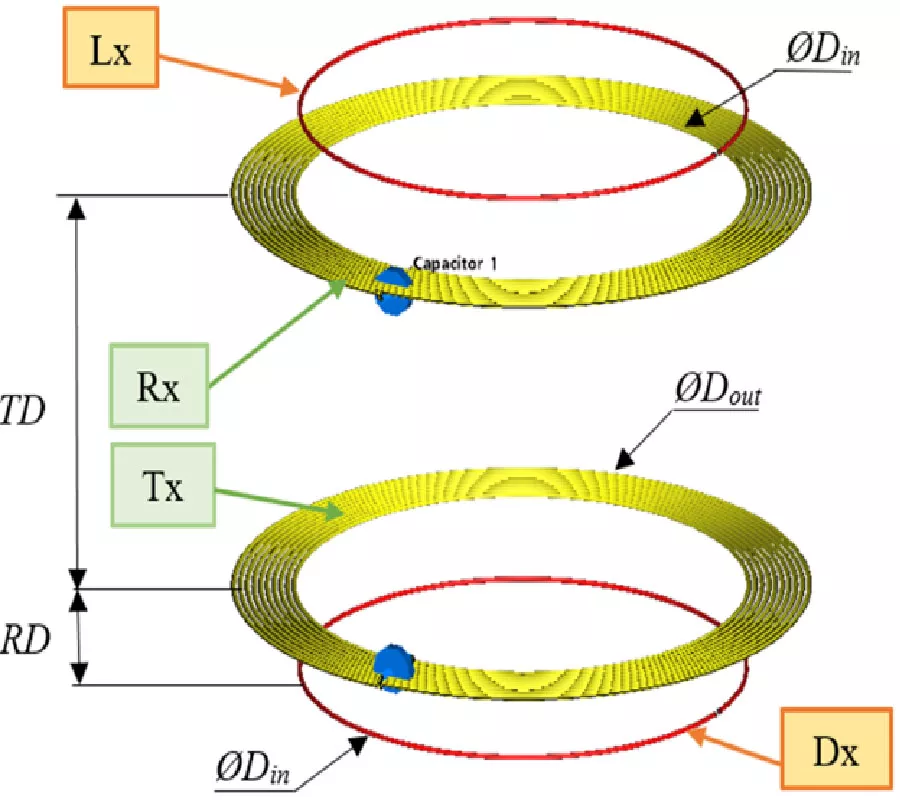
Magnetic Coupled Resonant (MCR) Wireless Power Transfer (WPT) is typically used for electrical charging, offering high tolerance to misalignment and wider transmission range. However, MCR-WPT is assumed to be a two-port circuit, including transmitter (Tx) and receiver (Rx), and exhibits lower efficiency than conventional inductive power transfer. Various studies have been proposed to increase the 4-coil MCR-WPT efficiency, but further challenges remain due to the turn technology complexity. A relevant and simple design solution is developed in the present paper that enables the optimization of Power Transfer Efficiency (PTE) by minimizing implementation cost. To achieve that goal, the transfer- and resonator-distances, TD and RD, respectively were optimized through theory, both circuit and 3-D electromagnetic (EM) simulations via 3-D modeling and experimentation. The validation PTE results obtained from analytic calculation, simulation and experimentation affirm that the maximum efficiencies of 94.10, 90.15% and 69.35% were obtained at optimal positions around RD = 7.5 mm and TD = 100 mm, respectively. The slight difference of the obtained PTE among theory and simulation with experiment is due to the setup instrument imperfection. The performed study is useful for the WPT charging systems, such as electronic sensors, wearable devices, and communication systems.