Vol. 138
Latest Volume
All Volumes
PIERM 138 [2026] PIERM 137 [2026] PIERM 136 [2025] PIERM 135 [2025] PIERM 134 [2025] PIERM 133 [2025] PIERM 132 [2025] PIERM 131 [2025] PIERM 130 [2024] PIERM 129 [2024] PIERM 128 [2024] PIERM 127 [2024] PIERM 126 [2024] PIERM 125 [2024] PIERM 124 [2024] PIERM 123 [2024] PIERM 122 [2023] PIERM 121 [2023] PIERM 120 [2023] PIERM 119 [2023] PIERM 118 [2023] PIERM 117 [2023] PIERM 116 [2023] PIERM 115 [2023] PIERM 114 [2022] PIERM 113 [2022] PIERM 112 [2022] PIERM 111 [2022] PIERM 110 [2022] PIERM 109 [2022] PIERM 108 [2022] PIERM 107 [2022] PIERM 106 [2021] PIERM 105 [2021] PIERM 104 [2021] PIERM 103 [2021] PIERM 102 [2021] PIERM 101 [2021] PIERM 100 [2021] PIERM 99 [2021] PIERM 98 [2020] PIERM 97 [2020] PIERM 96 [2020] PIERM 95 [2020] PIERM 94 [2020] PIERM 93 [2020] PIERM 92 [2020] PIERM 91 [2020] PIERM 90 [2020] PIERM 89 [2020] PIERM 88 [2020] PIERM 87 [2019] PIERM 86 [2019] PIERM 85 [2019] PIERM 84 [2019] PIERM 83 [2019] PIERM 82 [2019] PIERM 81 [2019] PIERM 80 [2019] PIERM 79 [2019] PIERM 78 [2019] PIERM 77 [2019] PIERM 76 [2018] PIERM 75 [2018] PIERM 74 [2018] PIERM 73 [2018] PIERM 72 [2018] PIERM 71 [2018] PIERM 70 [2018] PIERM 69 [2018] PIERM 68 [2018] PIERM 67 [2018] PIERM 66 [2018] PIERM 65 [2018] PIERM 64 [2018] PIERM 63 [2018] PIERM 62 [2017] PIERM 61 [2017] PIERM 60 [2017] PIERM 59 [2017] PIERM 58 [2017] PIERM 57 [2017] PIERM 56 [2017] PIERM 55 [2017] PIERM 54 [2017] PIERM 53 [2017] PIERM 52 [2016] PIERM 51 [2016] PIERM 50 [2016] PIERM 49 [2016] PIERM 48 [2016] PIERM 47 [2016] PIERM 46 [2016] PIERM 45 [2016] PIERM 44 [2015] PIERM 43 [2015] PIERM 42 [2015] PIERM 41 [2015] PIERM 40 [2014] PIERM 39 [2014] PIERM 38 [2014] PIERM 37 [2014] PIERM 36 [2014] PIERM 35 [2014] PIERM 34 [2014] PIERM 33 [2013] PIERM 32 [2013] PIERM 31 [2013] PIERM 30 [2013] PIERM 29 [2013] PIERM 28 [2013] PIERM 27 [2012] PIERM 26 [2012] PIERM 25 [2012] PIERM 24 [2012] PIERM 23 [2012] PIERM 22 [2012] PIERM 21 [2011] PIERM 20 [2011] PIERM 19 [2011] PIERM 18 [2011] PIERM 17 [2011] PIERM 16 [2011] PIERM 14 [2010] PIERM 13 [2010] PIERM 12 [2010] PIERM 11 [2010] PIERM 10 [2009] PIERM 9 [2009] PIERM 8 [2009] PIERM 7 [2009] PIERM 6 [2009] PIERM 5 [2008] PIERM 4 [2008] PIERM 3 [2008] PIERM 2 [2008] PIERM 1 [2008]
2026-05-03 Latest Published
By Xiao-Mei Ni Xin-Hao Ding Zhen Tan Xin Wang Ming-Zhu Du
Progress In Electromagnetics Research M, Vol. 138, 22-32, 2026
Abstract
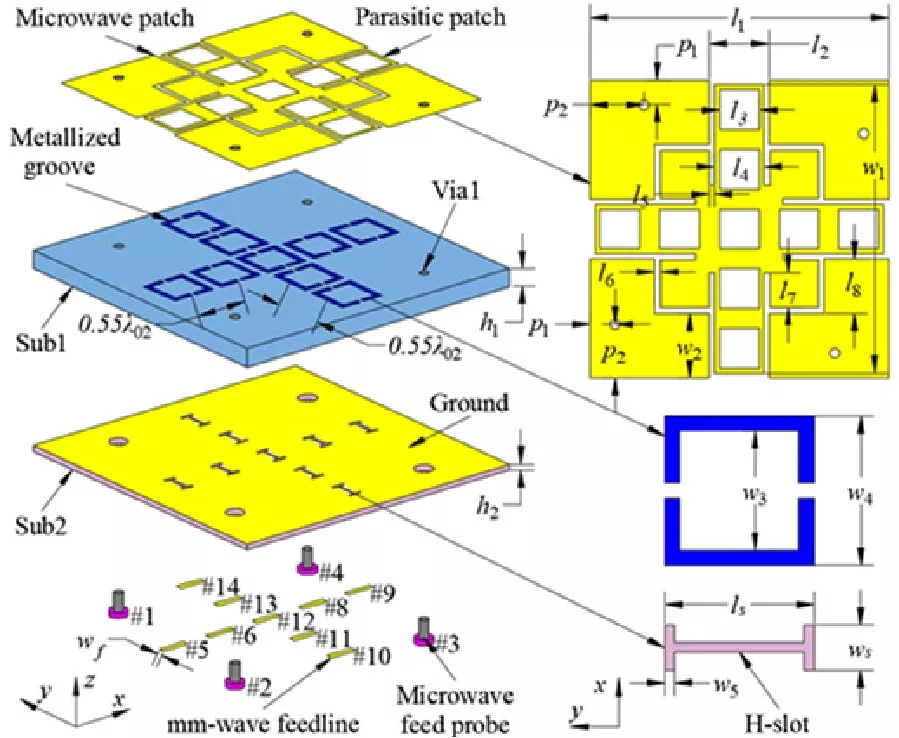
To meet the stringent space constraints and diverse connectivity requirements of modern intelligent connected vehicles, a compact MIMO antenna system designed for microwave and millimeter-wave (mm-wave) vehicle-to-everything (V2X) communications is presented. The proposed antenna features a compact footprint adaptable for integration into space-limited automotive modules, such as shark fin antenna housings. By employing a structure reuse technique, the system integrates a four-element microwave MIMO array and two orthogonal mm-wave phased arrays within a size of 30 mm × 30 mm × 2 mm. In the microwave band, a parasitic patch is introduced to achieve dual-mode resonance, ensuring a wide bandwidth for reliable control signaling. Two orthogonal rows of metallized cavities serve a dual purpose: acting as decoupling structures for the microwave MIMO system and functioning as mm-wave arrays to enable two-dimensional beam scanning. This capability is crucial for overcoming blockage effects in dynamic vehicular environments. Experimental results demonstrate that the proposed antenna achieves wide coverage in the microwave band (4.62-5.11 GHz) and high-gain beam scanning (±40°) in the mm-wave band (25.8-30.4 GHz). The measured isolation exceeds 17 dB with an envelope correlation coefficient below 0.11, validating its suitability for next-generation vehicle terminals.
2026-05-03
PIER M
Vol. 138, 22-32, 2026
download: 55
A Compact Shared-Aperture MIMO Antenna System for Microwave and Millimeter-Wave V2X Communications
Xiao-Mei Ni, Xin-Hao Ding, Zhen Tan, Xin Wang and Ming-Zhu Du
To meet the stringent space constraints and diverse connectivity requirements of modern intelligent connected vehicles, a compact MIMO antenna system designed for microwave and millimeter-wave (mm-wave) vehicle-to-everything (V2X) communications is presented. The proposed antenna features a compact footprint adaptable for integration into space-limited automotive modules, such as shark fin antenna housings. By employing a structure reuse technique, the system integrates a four-element microwave MIMO array and two orthogonal mm-wave phased arrays within a size of 30 mm × 30 mm × 2 mm. In the microwave band, a parasitic patch is introduced to achieve dual-mode resonance, ensuring a wide bandwidth for reliable control signaling. Two orthogonal rows of metallized cavities serve a dual purpose: acting as decoupling structures for the microwave MIMO system and functioning as mm-wave arrays to enable two-dimensional beam scanning. This capability is crucial for overcoming blockage effects in dynamic vehicular environments. Experimental results demonstrate that the proposed antenna achieves wide coverage in the microwave band (4.62-5.11 GHz) and high-gain beam scanning (±40°) in the mm-wave band (25.8-30.4 GHz). The measured isolation exceeds 17 dB with an envelope correlation coefficient below 0.11, validating its suitability for next-generation vehicle terminals.
A Compact Shared-Aperture MIMO Antenna System for Microwave and Millimeter-Wave V2X Communications
2026-04-27
PIER M
Vol. 138, 10-21, 2026
download: 59
Performance Evaluation of a Dual-Band h-Shaped Metamaterial Perfect Absorber with Polarization-Insensitive Characteristics for Satellite Communication Applications
Vanam Chinna Narasimhulu, Govardhani Immadi and Madhavareddy Venkata Narayana
A compact, double split-ring H-shaped resonator-based polarization-independent dual-band metamaterial microwave absorber (MMA) with an outstanding absorption efficiency was designed and analyzed for satellite communication applications. The H-shaped resonator-based unit cell was printed on an FR4 material using copper as the conducting material. Copper material was chosen for the radiating patch and the ground plane. A detailed parametric analysis was performed by tuning the geometrical parameters of the H-shaped MMA to achieve dual absorption bands with broad bandwidth and high absorptivity. The recommended H-shaped absorber exhibits dual absorption bandwidths of 710 MHz and 1630 MHz with FBW of 22.95% and 19.35%. Furthermore, it maintains an absorptivity of greater than 90% across the entire spectrum of dual operating bands with almost perfect absorption of 99.99% at the resonant frequencies (3.17 GHz, 7.78 GHz) of each band. The MMA maintains an area of 0.09λ × 0.09λ. A simulated absorber model was fabricated, and the results have been tested using an Anritsu Combinational Analyzer (MS2037C) for experimental validation. The simulated and tested outcomes of the developed prototype are in strong alignment, rendering the absorber suitable for S-band and LEO and geostationary satellite uplinks/downlinks, with specific bands often at 7.145-7.235 GHz (uplink) and 8.4-8.5 GHz (downlink).
Performance Evaluation of a Dual-band H-shaped Metamaterial Perfect Absorber with Polarization-insensitive Characteristics for Satellite Communication Applications
2026-04-14
PIER M
Vol. 138, 1-9, 2026
download: 116
A Dual-Band Shared-Aperture Antenna Employing a Meshed Patch and AMC-Backed Fabry-Perot Cavity
Chaoyuan Guo, Zhihan Liu and Yufeng Liu
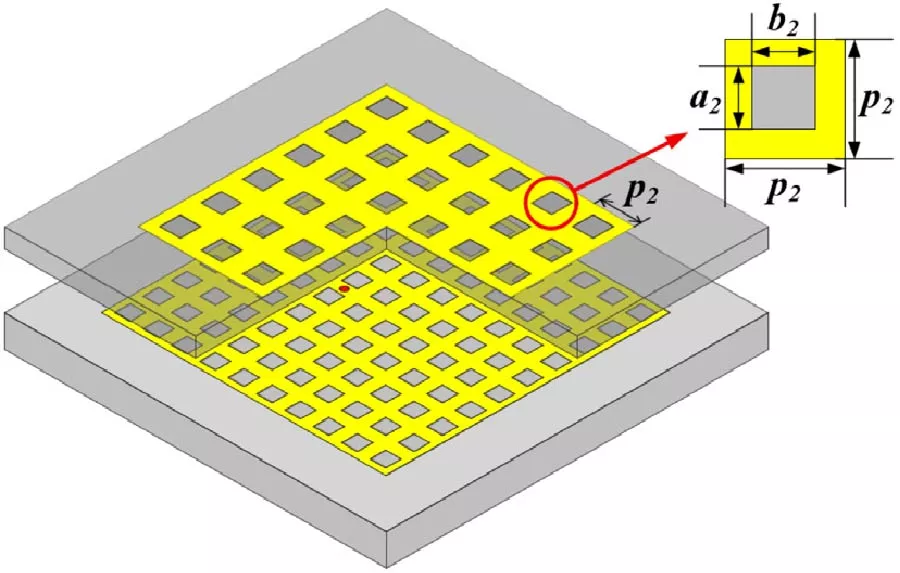
A low-profile, dual-band, shared-aperture antenna with a large frequency ratio is presented, based on a meshed patch and an AMC-backed Fabry-Perot (F-P) cavity. By taking advantage of the weak frequency sensitivity of grid slotting in meshed patches, the upper meshed patch is utilized as both the parasitic patch for the low-frequency antenna and the partially reflective surface (PRS) for the high-frequency F-P cavity, thereby simplifying the overall structure. Meanwhile, the AMC ground is employed to control the reflection phase and reduce the cavity height to λ/4, which enables both antennas to share the same aperture within an 8-mm profile. A prototype is fabricated and tested at 1.6 GHz and 15.14-15.46 GHz. Measured results demonstrate a frequency ratio of 1:9.6, a peak gain of 6.2 dBi at 1.6 GHz, a peak gain of 11.8 dBi in the high-frequency band, and a port isolation better than 17 dB. The proposed antenna features compact size, low profile, and efficient structural reuse, making it attractive for integrated multi-band communication systems.
A Dual-Band Shared-Aperture Antenna Employing a Meshed Patch and AMC-Backed Fabry-Perot Cavity