Ultrasensitive Multiplexed Detection of Breast Cancer Exosomal EpCAM, VEGF and CD63 via Phase-Interrogated SPR with Zr/Ce-MOF@Fe3O4
Magnetic Amplification and Preliminary Extension to CAR-T Immune Monitoring
Sailing He,
Faten Bashar Kamal Eddin,
Alamgir,
Houxin Fan,
Kaixin Zheng,
Shuang E,
Junbo Liang,
Junbo Cai,
Bojian Xie,
Jinhua Ding,
Mohammed Zourob,
Hongsheng Lu,
De-Man Han and
Wenda Luo
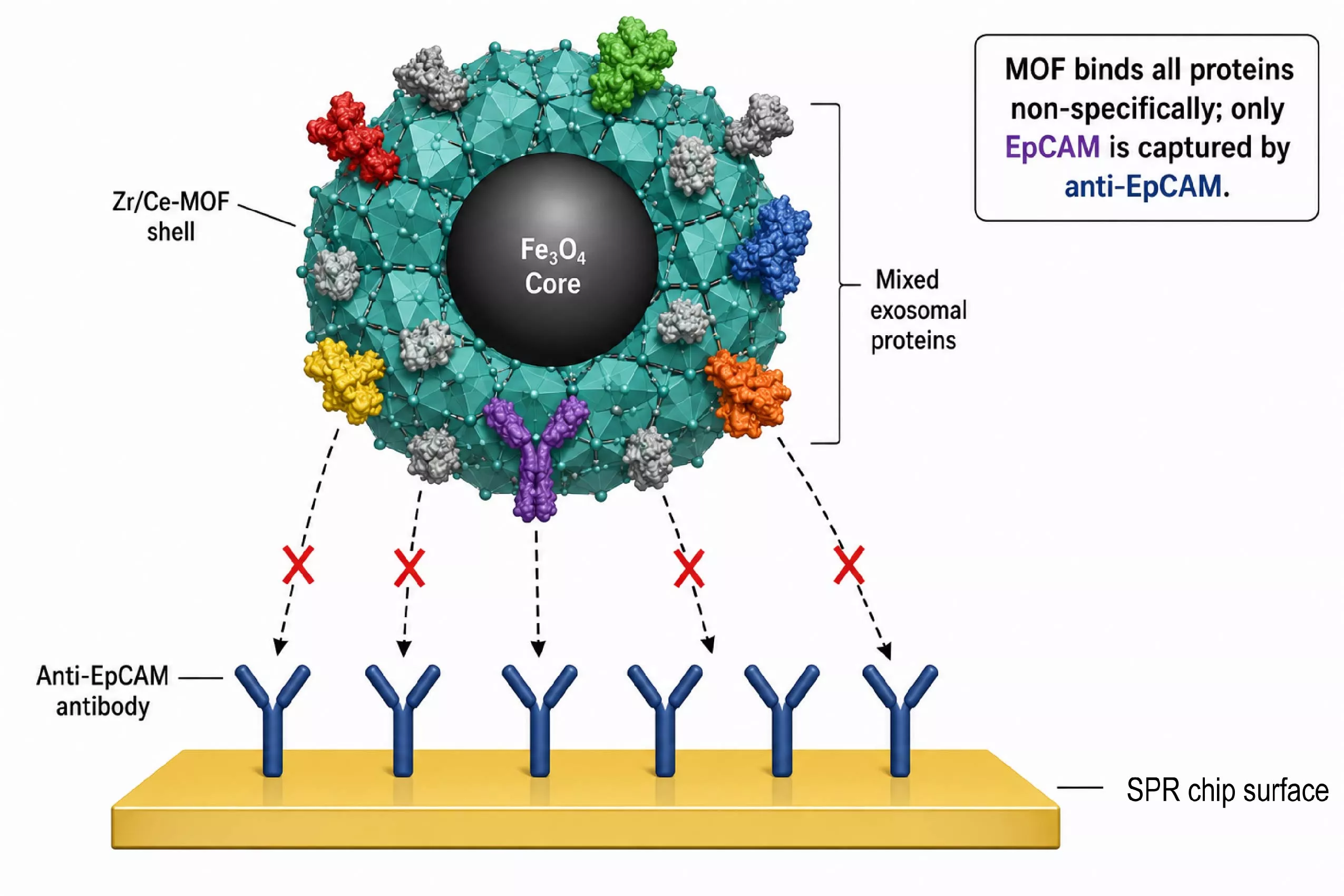
Exosomal surface proteins are emerging as minimally invasive liquid-biopsy biomarkers for breast cancer, yet their trace-level abundance poses challenges for biosensor sensitivity and multiplexing capacity, and conventional assays miss the substantial cargo in vesicles. Here, we report a mass-amplification-enhanced multiplexed SPR platform coupling antibody-directed magnetic enrichment with a phase-interrogated Ag/ZnSe waveguide chip for simultaneous detection of EpCAM, VEGF, and CD63, with a proof-of-concept extension to the immune-activation marker IFN-γ. A bimetallic Zr/Ce-MOF@Fe3O4 nanocomposite (confirmed by SEM-EDS) provided high refractive-index mass loading and magnetic separability, interfaced with a multi-channel Ag/ZnSe/APTES/GO chip (anti-EpCAM, anti-VEGF, anti-CD63) via a phase-polarization-modulation SPR system and PDMS microfluidics. MOF amplification improved the LOD for EpCAM from 0.86 to 0.07 pg mL-1 (12.3-fold) and for VEGF from 2.45 to 0.21 pg mL-1 (11.7-fold). Intact exosomes gave antibody-specific responses on anti-EpCAM (6.22°), anti-VEGF (3.09°), and anti-CD63 (9.54°), with signal-to-background ratios up to 106.0 and cross-reactivity below 0.4°; in matched healthy and patient serum, MOF-amplified responses were consistently higher in patients across all three markers (6.5-fold EpCAM, 6.2-fold VEGF, 8-fold CD63), with comparable discrimination extended to urine on the CD63 channel. Lysates analyzed on anti-EpCAM channels showed negligible healthy signals (0.29° without MOF, 1.63° with MOF) versus a patient increase from 5.80° to 18.4° (3.17-fold), corresponding to an apparent 41 pg mL-1 total solubilized EV-associated EpCAM. As proof of concept for immune-status phenotyping, CD63-captured exosomes from a patient with clinical suspicion of immune activation showed a 12-fold higher IFN-γ signal than healthy samples (9-fold with MOF), with Langmuir kinetics indicating higher apparent binding affinity in the patient. Nanoparticle tracking confirmed exosome populations within the characteristic 30-150 nm range (mean 66.5-92.8 nm), and inter-chip/inter-channel reproducibility were 2.72% and 0.64% CV. As a complementary label-free imaging readout, the EV/MOF workflow was also implemented on a differential guided-mode resonance (dGMR) platform, where intact whole-EV binding produced MOF-amplified resonance-stripe pixel shifts without vesicle lysis; patient-derived EVs showed ~9.4-fold enhancement (vs 6.86-fold by phase-interrogated SPR), and healthy-derived EVs showed $\sim10.8$-fold enhancement, pushing the dGMR whole-EV response into a near-order-of-magnitude amplification regime. In a comparative discussion, sandwich SERS detection of EV-associated IFN-γ in CAR-T therapy further demonstrated that molecular fingerprint-based SERS can resolve specific immune markers, complementing the quantitative strengths of SPR and extending the platform toward immune-status monitoring. This platform demonstrates proof-of-concept feasibility for multiplexed exosomal marker detection directly in crude clinical matrices, with larger cohort studies required to establish diagnostic utility.