Vol. 142
Latest Volume
All Volumes
PIERM 142 [2026] PIERM 141 [2026] PIERM 140 [2026] PIERM 139 [2026] PIERM 138 [2026] PIERM 137 [2026] PIERM 136 [2025] PIERM 135 [2025] PIERM 134 [2025] PIERM 133 [2025] PIERM 132 [2025] PIERM 131 [2025] PIERM 130 [2024] PIERM 129 [2024] PIERM 128 [2024] PIERM 127 [2024] PIERM 126 [2024] PIERM 125 [2024] PIERM 124 [2024] PIERM 123 [2024] PIERM 122 [2023] PIERM 121 [2023] PIERM 120 [2023] PIERM 119 [2023] PIERM 118 [2023] PIERM 117 [2023] PIERM 116 [2023] PIERM 115 [2023] PIERM 114 [2022] PIERM 113 [2022] PIERM 112 [2022] PIERM 111 [2022] PIERM 110 [2022] PIERM 109 [2022] PIERM 108 [2022] PIERM 107 [2022] PIERM 106 [2021] PIERM 105 [2021] PIERM 104 [2021] PIERM 103 [2021] PIERM 102 [2021] PIERM 101 [2021] PIERM 100 [2021] PIERM 99 [2021] PIERM 98 [2020] PIERM 97 [2020] PIERM 96 [2020] PIERM 95 [2020] PIERM 94 [2020] PIERM 93 [2020] PIERM 92 [2020] PIERM 91 [2020] PIERM 90 [2020] PIERM 89 [2020] PIERM 88 [2020] PIERM 87 [2019] PIERM 86 [2019] PIERM 85 [2019] PIERM 84 [2019] PIERM 83 [2019] PIERM 82 [2019] PIERM 81 [2019] PIERM 80 [2019] PIERM 79 [2019] PIERM 78 [2019] PIERM 77 [2019] PIERM 76 [2018] PIERM 75 [2018] PIERM 74 [2018] PIERM 73 [2018] PIERM 72 [2018] PIERM 71 [2018] PIERM 70 [2018] PIERM 69 [2018] PIERM 68 [2018] PIERM 67 [2018] PIERM 66 [2018] PIERM 65 [2018] PIERM 64 [2018] PIERM 63 [2018] PIERM 62 [2017] PIERM 61 [2017] PIERM 60 [2017] PIERM 59 [2017] PIERM 58 [2017] PIERM 57 [2017] PIERM 56 [2017] PIERM 55 [2017] PIERM 54 [2017] PIERM 53 [2017] PIERM 52 [2016] PIERM 51 [2016] PIERM 50 [2016] PIERM 49 [2016] PIERM 48 [2016] PIERM 47 [2016] PIERM 46 [2016] PIERM 45 [2016] PIERM 44 [2015] PIERM 43 [2015] PIERM 42 [2015] PIERM 41 [2015] PIERM 40 [2014] PIERM 39 [2014] PIERM 38 [2014] PIERM 37 [2014] PIERM 36 [2014] PIERM 35 [2014] PIERM 34 [2014] PIERM 33 [2013] PIERM 32 [2013] PIERM 31 [2013] PIERM 30 [2013] PIERM 29 [2013] PIERM 28 [2013] PIERM 27 [2012] PIERM 26 [2012] PIERM 25 [2012] PIERM 24 [2012] PIERM 23 [2012] PIERM 22 [2012] PIERM 21 [2011] PIERM 20 [2011] PIERM 19 [2011] PIERM 18 [2011] PIERM 17 [2011] PIERM 16 [2011] PIERM 14 [2010] PIERM 13 [2010] PIERM 12 [2010] PIERM 11 [2010] PIERM 10 [2009] PIERM 9 [2009] PIERM 8 [2009] PIERM 7 [2009] PIERM 6 [2009] PIERM 5 [2008] PIERM 4 [2008] PIERM 3 [2008] PIERM 2 [2008] PIERM 1 [2008]
2026-11-12 Latest Published
By Shivangi Barthwal Rishi Prakash Anurag Vidyarthi
Progress In Electromagnetics Research M, Vol. 142, 1-11, 2026
Abstract
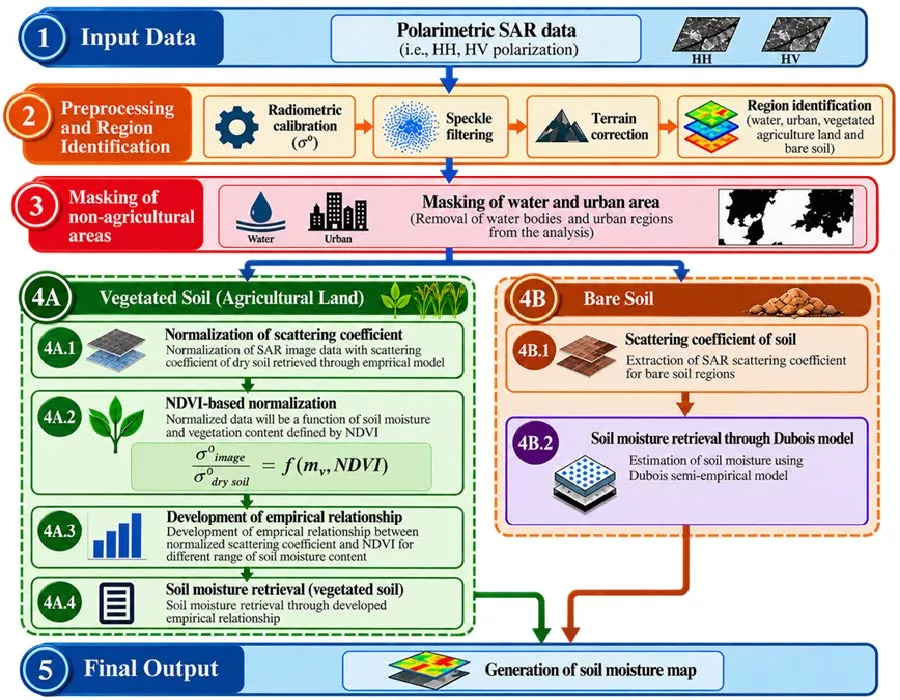
Surface soil moisture retrieval in vegetated environments remains a significant challenge because microwave backscattering is affected by soil dielectric properties, vegetation structure, and surface roughness. This study presents an integrated synthetic aperture radar (SAR) and optical framework for retrieving soil moisture by blending C-band Sentinel-1 SAR observations, along with Moderate Resolution Imaging Spectroradiometer (MODIS) derived normalized difference vegetation index (NDVI). The proposed framework normalizes SAR backscatter using the Dubois model and integrates MODIS-derived NDVI via empirical relationships to mitigate vegetation-induced uncertainty while minimizing the dependence on extensive field-based vegetation measurements for soil moisture retrieval. The backscattering coefficient over dry soil was computed using the Dubois empirical model, and it was used to normalize the measured SAR backscatter. Thereafter, empirical relationships were established between the normalized backscatter coefficient and MODIS derived NDVI for different soil moisture ranges using cubic regression models. The developed framework achieved coefficients of determination greater than 0.83 for all empirical relationships. The proposed algorithm for the test dataset and validation dataset resulted in root mean square errors of 0.037 cm3 cm-3 and 0.043 cm3 cm-3 respectively. The results of this study signifies the integration of SAR and optical data for soil moisture retrieval in the presence of vegetation.
2026-11-12
PIER M
Vol. 142, 1-11, 2026
download: 5
Soil Moisture Retrieval under Vegetation Cover Using SAR Backscatter and Optical Remote Sensing Observations
Shivangi Barthwal, Rishi Prakash and Anurag Vidyarthi
Surface soil moisture retrieval in vegetated environments remains a significant challenge because microwave backscattering is affected by soil dielectric properties, vegetation structure, and surface roughness. This study presents an integrated synthetic aperture radar (SAR) and optical framework for retrieving soil moisture by blending C-band Sentinel-1 SAR observations, along with Moderate Resolution Imaging Spectroradiometer (MODIS) derived normalized difference vegetation index (NDVI). The proposed framework normalizes SAR backscatter using the Dubois model and integrates MODIS-derived NDVI via empirical relationships to mitigate vegetation-induced uncertainty while minimizing the dependence on extensive field-based vegetation measurements for soil moisture retrieval. The backscattering coefficient over dry soil was computed using the Dubois empirical model, and it was used to normalize the measured SAR backscatter. Thereafter, empirical relationships were established between the normalized backscatter coefficient and MODIS derived NDVI for different soil moisture ranges using cubic regression models. The developed framework achieved coefficients of determination greater than 0.83 for all empirical relationships. The proposed algorithm for the test dataset and validation dataset resulted in root mean square errors of 0.037 cm3 cm-3 and 0.043 cm3 cm-3 respectively. The results of this study signifies the integration of SAR and optical data for soil moisture retrieval in the presence of vegetation.
Soil Moisture Retrieval under Vegetation Cover Using SAR Backscatter and Optical Remote Sensing Observations