2026-04-03 Latest Published
By Nour El Houda Sara Senasli
Bouhafs Bouras
Mohammed Chetioui
Lamia Senasli
Mehdi Damou
Progress In Electromagnetics Research C, Vol. 168, 82-88, 2026
Abstract
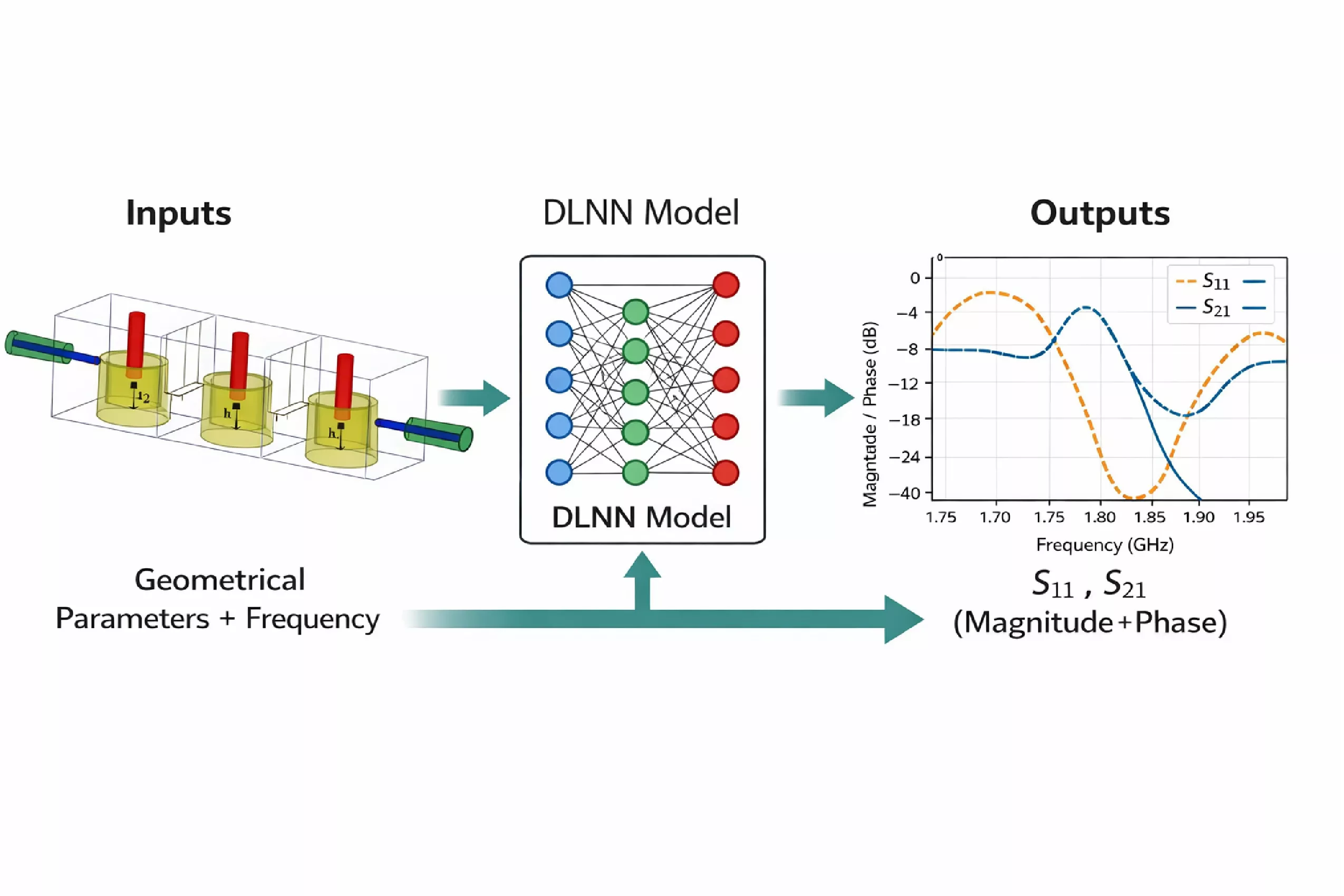
This study introduces a deep neural network architecture tailored for accurately modeling the parameters of microwave components, with a specific focus on waveguide filters. Unlike simpler neural networks, this architecture is designed to handle the complex relationships that are prevalent in microwave engineering. The model's inputs include the filter's geometric variables and frequency, whereas the S-parameters serve as outputs. To effectively capture these relationships, the Rectified Linear Unit (ReLU) activation function was employed, which is known for its efficiency in managing a significant number of training parameters. This choice allowed the model to better grasp the intricate connection between the S-parameters and geometric variables, and the relationship was found to be more complex than that with frequency. The primary goal is to reduce the overall count of training parameters within the deep neural network while maintaining a level of accuracy similar to that of fully connected neural networks. This study demonstrates the effectiveness of this approach through waveguide filter parametric modeling, highlighting its capacity to accurately model and optimize the electromagnetic response of the filter.