Vol. 139
Latest Volume
All Volumes
PIERM 139 [2026] PIERM 138 [2026] PIERM 137 [2026] PIERM 136 [2025] PIERM 135 [2025] PIERM 134 [2025] PIERM 133 [2025] PIERM 132 [2025] PIERM 131 [2025] PIERM 130 [2024] PIERM 129 [2024] PIERM 128 [2024] PIERM 127 [2024] PIERM 126 [2024] PIERM 125 [2024] PIERM 124 [2024] PIERM 123 [2024] PIERM 122 [2023] PIERM 121 [2023] PIERM 120 [2023] PIERM 119 [2023] PIERM 118 [2023] PIERM 117 [2023] PIERM 116 [2023] PIERM 115 [2023] PIERM 114 [2022] PIERM 113 [2022] PIERM 112 [2022] PIERM 111 [2022] PIERM 110 [2022] PIERM 109 [2022] PIERM 108 [2022] PIERM 107 [2022] PIERM 106 [2021] PIERM 105 [2021] PIERM 104 [2021] PIERM 103 [2021] PIERM 102 [2021] PIERM 101 [2021] PIERM 100 [2021] PIERM 99 [2021] PIERM 98 [2020] PIERM 97 [2020] PIERM 96 [2020] PIERM 95 [2020] PIERM 94 [2020] PIERM 93 [2020] PIERM 92 [2020] PIERM 91 [2020] PIERM 90 [2020] PIERM 89 [2020] PIERM 88 [2020] PIERM 87 [2019] PIERM 86 [2019] PIERM 85 [2019] PIERM 84 [2019] PIERM 83 [2019] PIERM 82 [2019] PIERM 81 [2019] PIERM 80 [2019] PIERM 79 [2019] PIERM 78 [2019] PIERM 77 [2019] PIERM 76 [2018] PIERM 75 [2018] PIERM 74 [2018] PIERM 73 [2018] PIERM 72 [2018] PIERM 71 [2018] PIERM 70 [2018] PIERM 69 [2018] PIERM 68 [2018] PIERM 67 [2018] PIERM 66 [2018] PIERM 65 [2018] PIERM 64 [2018] PIERM 63 [2018] PIERM 62 [2017] PIERM 61 [2017] PIERM 60 [2017] PIERM 59 [2017] PIERM 58 [2017] PIERM 57 [2017] PIERM 56 [2017] PIERM 55 [2017] PIERM 54 [2017] PIERM 53 [2017] PIERM 52 [2016] PIERM 51 [2016] PIERM 50 [2016] PIERM 49 [2016] PIERM 48 [2016] PIERM 47 [2016] PIERM 46 [2016] PIERM 45 [2016] PIERM 44 [2015] PIERM 43 [2015] PIERM 42 [2015] PIERM 41 [2015] PIERM 40 [2014] PIERM 39 [2014] PIERM 38 [2014] PIERM 37 [2014] PIERM 36 [2014] PIERM 35 [2014] PIERM 34 [2014] PIERM 33 [2013] PIERM 32 [2013] PIERM 31 [2013] PIERM 30 [2013] PIERM 29 [2013] PIERM 28 [2013] PIERM 27 [2012] PIERM 26 [2012] PIERM 25 [2012] PIERM 24 [2012] PIERM 23 [2012] PIERM 22 [2012] PIERM 21 [2011] PIERM 20 [2011] PIERM 19 [2011] PIERM 18 [2011] PIERM 17 [2011] PIERM 16 [2011] PIERM 14 [2010] PIERM 13 [2010] PIERM 12 [2010] PIERM 11 [2010] PIERM 10 [2009] PIERM 9 [2009] PIERM 8 [2009] PIERM 7 [2009] PIERM 6 [2009] PIERM 5 [2008] PIERM 4 [2008] PIERM 3 [2008] PIERM 2 [2008] PIERM 1 [2008]
2026-07-27 Latest Published
By Zhanying Guo Hui Li Yang An
Progress In Electromagnetics Research M, Vol. 139, 21-35, 2026
Abstract
Objective: This study aims to experimentally and numerically investigate the modulation of electromagnetic wave physical characteristics (transmittance, absorptance, impedance) by strongly an isotropic acoustic materialism in the 2-12 GHz frequency band, and to quantify the influence of material parameters (thickness, density, elastic modulus, an isotropic direction) on wave control performance. Methods: Three types of material units (metal composite, polymer, ceramic reinforced) with thicknesses of 1.5-3 mm and anisotropic directions along X, Y, Z axes were fabricated. Transmittance and absorbance were measured using a vector network analyzer with a WR-90 guideway system. Finite element simulations incorporating acoustic-electromagnetic coupling (strain-induced permittivity modulation) were conducted. Sensitivity analysis was performed by varying thickness (±10%), elastic modulus (±5 GPa), density (±500 kg/m3), and direction angle (±15°). Results: High-frequency absorbance reached 0.91 (metal composite at 9.5 GHz), while low-frequency transmittance remained above 0.70. Thickness and elastic modulus predominantly affected the amplitude and position of high-frequency absorption peaks, whereas density and direction angle primarily regulated low-frequency response, resulting in multi-peak broadband absorption. The deviation between experimental data and finite element simulation was less than 3%. Sensitivity analysis revealed that thickness (±10%) and elastic modulus (±5 GPa) produced the most significant changes in transmittance (0.60-0.91) and absorptance (0.70-0.91). Conclusion: Strongly an isotropic acoustic materialism offer mechanically t unable electromagnetic wave control, with thickness and elastic modulus as key design parameters. These findings provide experimental and theoretical references for high-frequency communication antennas, radar stealth coatings, and broadband absorption devices.
2026-07-27
PIER M
Vol. 139, 21-35, 2026
download: 6
Modulation of Electromagnetic Wave Physical Characteristics by Strongly Anisotropic Acoustic Metamaterials
Zhanying Guo, Hui Li and Yang An
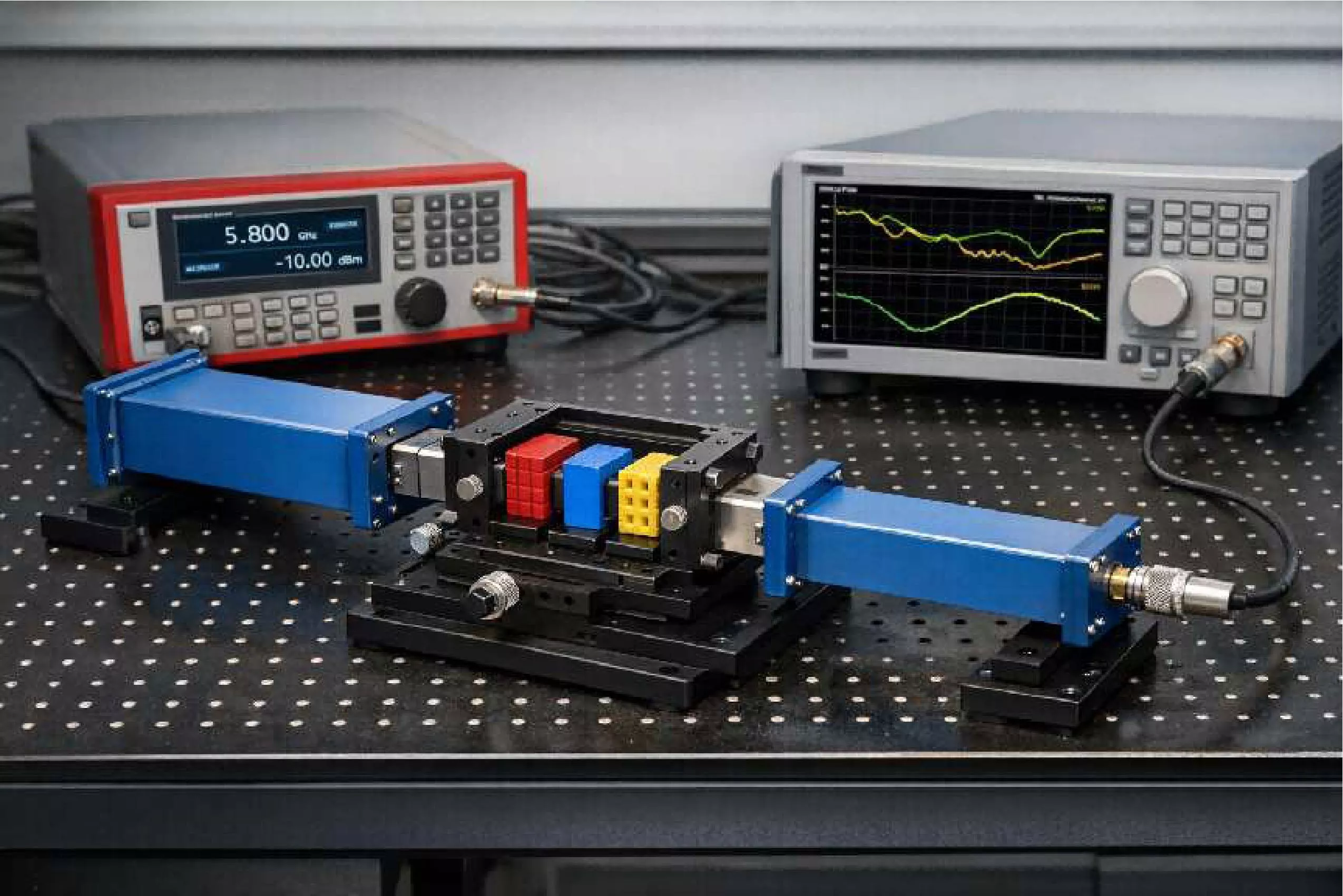
Objective: This study aims to experimentally and numerically investigate the modulation of electromagnetic wave physical characteristics (transmittance, absorptance, impedance) by strongly an isotropic acoustic materialism in the 2-12 GHz frequency band, and to quantify the influence of material parameters (thickness, density, elastic modulus, an isotropic direction) on wave control performance. Methods: Three types of material units (metal composite, polymer, ceramic reinforced) with thicknesses of 1.5-3 mm and anisotropic directions along X, Y, Z axes were fabricated. Transmittance and absorbance were measured using a vector network analyzer with a WR-90 guideway system. Finite element simulations incorporating acoustic-electromagnetic coupling (strain-induced permittivity modulation) were conducted. Sensitivity analysis was performed by varying thickness (±10%), elastic modulus (±5 GPa), density (±500 kg/m3), and direction angle (±15°). Results: High-frequency absorbance reached 0.91 (metal composite at 9.5 GHz), while low-frequency transmittance remained above 0.70. Thickness and elastic modulus predominantly affected the amplitude and position of high-frequency absorption peaks, whereas density and direction angle primarily regulated low-frequency response, resulting in multi-peak broadband absorption. The deviation between experimental data and finite element simulation was less than 3%. Sensitivity analysis revealed that thickness (±10%) and elastic modulus (±5 GPa) produced the most significant changes in transmittance (0.60-0.91) and absorptance (0.70-0.91). Conclusion: Strongly an isotropic acoustic materialism offer mechanically t unable electromagnetic wave control, with thickness and elastic modulus as key design parameters. These findings provide experimental and theoretical references for high-frequency communication antennas, radar stealth coatings, and broadband absorption devices.
Modulation of Electromagnetic Wave Physical Characteristics by Strongly Anisotropic Acoustic Metamaterials
2026-07-20
PIER M
Vol. 139, 11-20, 2026
download: 64
Using Reverberation Chambers as Test Environments for mmWave Wireless Systems
Alfredo De Leo, Luca Bastianelli, Valter Mariani Primiani, Davide Micheli, Renzo Lattanzi, Pietro Obino, Max Moccia, Thirumaran Muthiah, Riccardo Diamanti and Franco Moglie
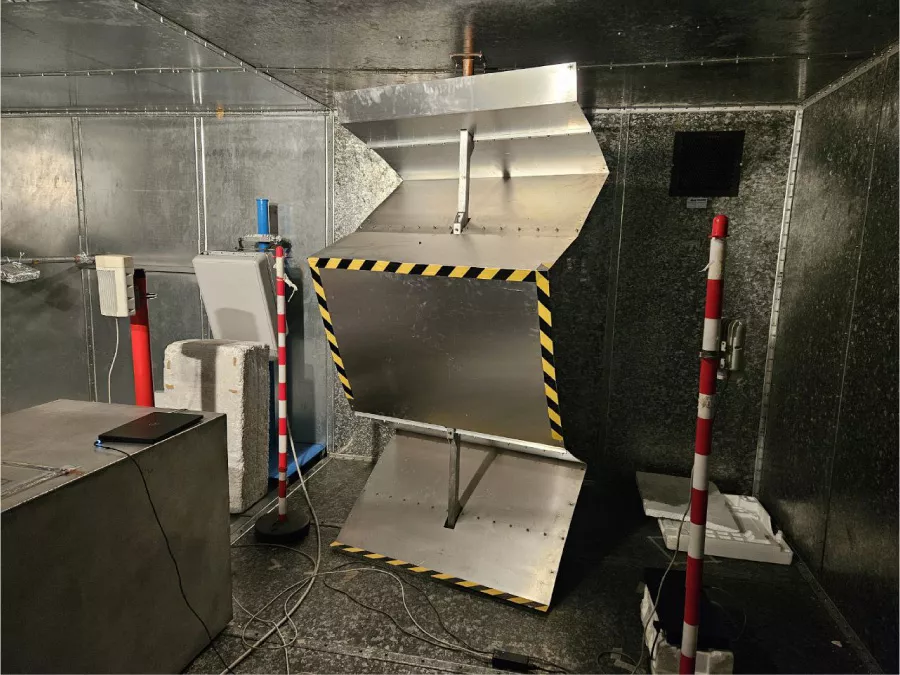
This study presents millimeter-wave propagation measurements at 60 GHz conducted in a reverberation chamber to emulate realistic multipath-rich indoor environments. Both line-of-sight (LOS) and non-line-of-sight (NLOS) scenarios are investigated using commercial off-the-shelf devices. The impact of stirring conditions and lossy environments is evaluated through key performance indicators, including Received Signal Strength Indicator (RSSI), Signal-to-Noise Ratio (SNR), Modulation and Coding Scheme (MCS), and throughput. Results show that mechanical stirring speed and the placement of absorbing materials significantly affect channel characteristics and system performance. In NLOS conditions, multipath propagation dominates, where dynamic beamforming demonstrates improved robustness. In contrast, LOS scenarios are highly sensitive to blockage, leading to notable performance degradation. Overall, the findings confirm that the reverberation chamber is an effective platform for over-the-air testing and characterization of 60 GHz wireless systems, offering valuable insights into system behavior under complex indoor propagation conditions relevant to future 5G and 6G deployments.
Using Reverberation Chambers as Test Environments for mmWave Wireless Systems
2026-07-09
PIER M
Vol. 139, 1-10, 2026
download: 100
A Miniaturized Circularly Polarized Antenna with Embedded Metasurface Patches
Xu Tan, Han Lin, Zhonggen Wang and Wenyan Nie
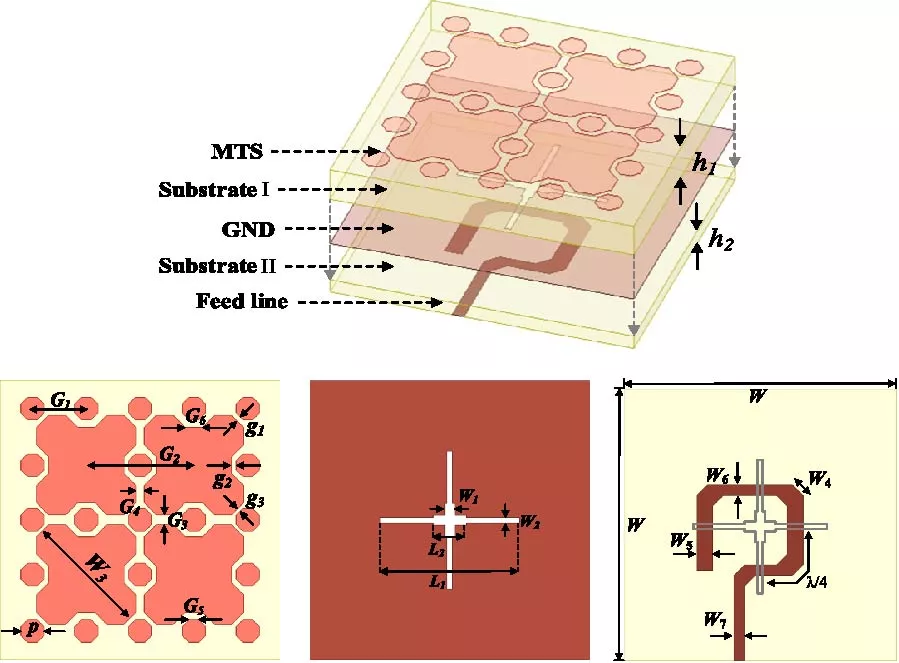
This study proposes a high-performance miniaturized wideband circularly polarized (CP) metasurface (MTS) antenna for WLAN and 5 GHz wireless communication systems. The design innovatively utilizes a hybrid embedded structure, where regular octagonal patches are incorporated into the gaps of modified X-shaped primary radiating elements to increase edge capacitance and lower resonant frequency, thereby achieving antenna miniaturization. To effectively excite the orthogonal degenerate modes required for CP radiation, a characteristic mode analysis (CMA) was employed to guide the design of the feed network. A feeding structure consisting of a hook-shaped microstrip line and a symmetrical stepped cross-slot is designed to achieve CP excitation via a 90˚ phase delay introduced by path length differences. Measured results demonstrate that the antenna achieves a -10 dB impedance bandwidth of 34.2% (4.38-6.19 GHz) and a 3 dB axial ratio (AR) bandwidth of 23.9% (4.68-5.95 GHz). Regarding radiation characteristics, the radiation efficiency remained stable above 75%, and the peak realized gain reached 5.26 dBic. The experimental results verified that the proposed design achieved stable CP and radiation performance within a miniaturized footprint.
A Miniaturized Circularly Polarized Antenna with Embedded Metasurface Patches