Vol. 169
Latest Volume
All Volumes
PIERC 169 [2026] PIERC 168 [2026] PIERC 167 [2026] PIERC 166 [2026] PIERC 165 [2026] PIERC 164 [2026] PIERC 163 [2026] PIERC 162 [2025] PIERC 161 [2025] PIERC 160 [2025] PIERC 159 [2025] PIERC 158 [2025] PIERC 157 [2025] PIERC 156 [2025] PIERC 155 [2025] PIERC 154 [2025] PIERC 153 [2025] PIERC 152 [2025] PIERC 151 [2025] PIERC 150 [2024] PIERC 149 [2024] PIERC 148 [2024] PIERC 147 [2024] PIERC 146 [2024] PIERC 145 [2024] PIERC 144 [2024] PIERC 143 [2024] PIERC 142 [2024] PIERC 141 [2024] PIERC 140 [2024] PIERC 139 [2024] PIERC 138 [2023] PIERC 137 [2023] PIERC 136 [2023] PIERC 135 [2023] PIERC 134 [2023] PIERC 133 [2023] PIERC 132 [2023] PIERC 131 [2023] PIERC 130 [2023] PIERC 129 [2023] PIERC 128 [2023] PIERC 127 [2022] PIERC 126 [2022] PIERC 125 [2022] PIERC 124 [2022] PIERC 123 [2022] PIERC 122 [2022] PIERC 121 [2022] PIERC 120 [2022] PIERC 119 [2022] PIERC 118 [2022] PIERC 117 [2021] PIERC 116 [2021] PIERC 115 [2021] PIERC 114 [2021] PIERC 113 [2021] PIERC 112 [2021] PIERC 111 [2021] PIERC 110 [2021] PIERC 109 [2021] PIERC 108 [2021] PIERC 107 [2021] PIERC 106 [2020] PIERC 105 [2020] PIERC 104 [2020] PIERC 103 [2020] PIERC 102 [2020] PIERC 101 [2020] PIERC 100 [2020] PIERC 99 [2020] PIERC 98 [2020] PIERC 97 [2019] PIERC 96 [2019] PIERC 95 [2019] PIERC 94 [2019] PIERC 93 [2019] PIERC 92 [2019] PIERC 91 [2019] PIERC 90 [2019] PIERC 89 [2019] PIERC 88 [2018] PIERC 87 [2018] PIERC 86 [2018] PIERC 85 [2018] PIERC 84 [2018] PIERC 83 [2018] PIERC 82 [2018] PIERC 81 [2018] PIERC 80 [2018] PIERC 79 [2017] PIERC 78 [2017] PIERC 77 [2017] PIERC 76 [2017] PIERC 75 [2017] PIERC 74 [2017] PIERC 73 [2017] PIERC 72 [2017] PIERC 71 [2017] PIERC 70 [2016] PIERC 69 [2016] PIERC 68 [2016] PIERC 67 [2016] PIERC 66 [2016] PIERC 65 [2016] PIERC 64 [2016] PIERC 63 [2016] PIERC 62 [2016] PIERC 61 [2016] PIERC 60 [2015] PIERC 59 [2015] PIERC 58 [2015] PIERC 57 [2015] PIERC 56 [2015] PIERC 55 [2014] PIERC 54 [2014] PIERC 53 [2014] PIERC 52 [2014] PIERC 51 [2014] PIERC 50 [2014] PIERC 49 [2014] PIERC 48 [2014] PIERC 47 [2014] PIERC 46 [2014] PIERC 45 [2013] PIERC 44 [2013] PIERC 43 [2013] PIERC 42 [2013] PIERC 41 [2013] PIERC 40 [2013] PIERC 39 [2013] PIERC 38 [2013] PIERC 37 [2013] PIERC 36 [2013] PIERC 35 [2013] PIERC 34 [2013] PIERC 33 [2012] PIERC 32 [2012] PIERC 31 [2012] PIERC 30 [2012] PIERC 29 [2012] PIERC 28 [2012] PIERC 27 [2012] PIERC 26 [2012] PIERC 25 [2012] PIERC 24 [2011] PIERC 23 [2011] PIERC 22 [2011] PIERC 21 [2011] PIERC 20 [2011] PIERC 19 [2011] PIERC 18 [2011] PIERC 17 [2010] PIERC 16 [2010] PIERC 15 [2010] PIERC 14 [2010] PIERC 13 [2010] PIERC 12 [2010] PIERC 11 [2009] PIERC 10 [2009] PIERC 9 [2009] PIERC 8 [2009] PIERC 7 [2009] PIERC 6 [2009] PIERC 5 [2008] PIERC 4 [2008] PIERC 3 [2008] PIERC 2 [2008] PIERC 1 [2008]
2026-04-22 Latest Published
By Deepika Verma Kiran Kumar Verma Chandan
Progress In Electromagnetics Research C, Vol. 169, 84-94, 2026
Abstract
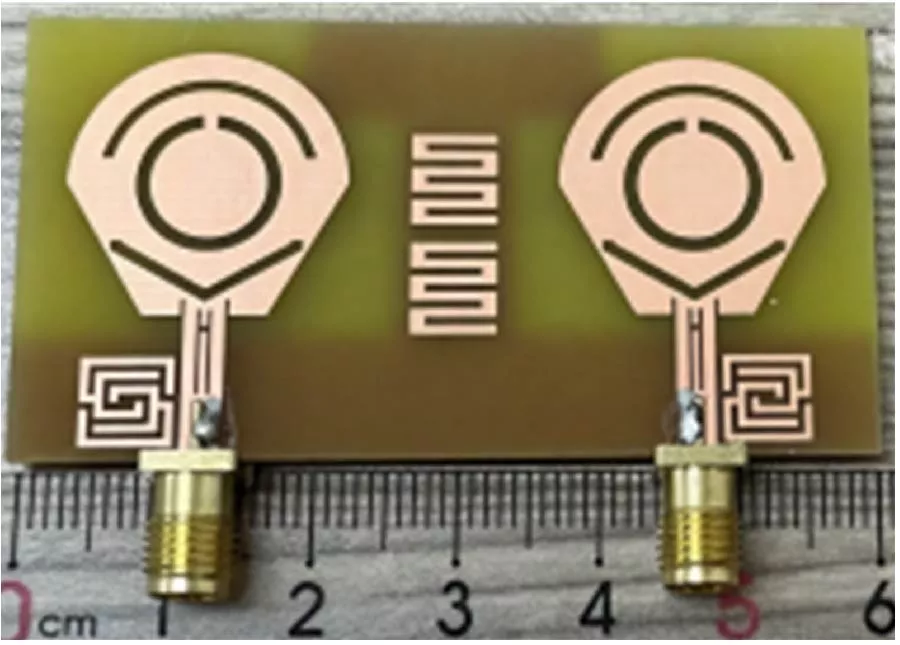
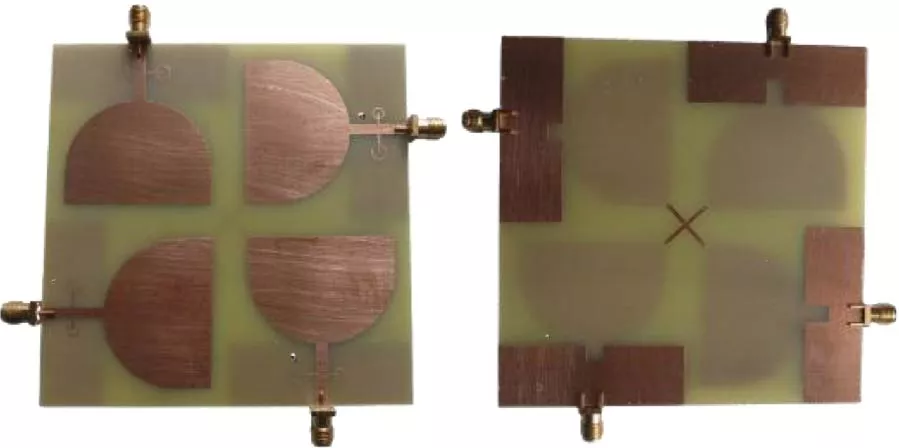
This paper presents the design of compact multi-band filtered MIMO antenna whereby the UWB antenna is converted into tri-band antenna by adding two stubs-loaded band-notch filters (SLBNFs). The notch structures tactfully quiet undesired frequency bands and permit three clean operating bands likely to be utilized in S-band and C-band wireless systems. A 2 × 2 MIMO system is proposed using a centrally located decoupling network to regulate the distribution of surface currents, which achieves over 25 dB of isolation in all operating bands. The fractional bandwidth of the antenna in the first band (2.0-2.6 GHz), second band (3.48-3.82 GHz), and third band (5.68-6.42 GHz) are 16%, 9.3%, and 12.23%, respectively. The peak gains in the corresponding operating bands are 2.8 dB, 4.1 dB, and 5 dB, respectively. The proposed design is suitable for the present-day S- and C-band communication systems and multi-standard wireless devices due to its selective multi-band response, better isolation, and compact structure.
2026-04-22
PIER C
Vol. 169, 84-94, 2026
download: 16
Design of Multi Band Filtering Antenna with Low Mutual Coupling Using Decoupling Network
Deepika Verma, Kiran Kumar Verma and Chandan
This paper presents the design of compact multi-band filtered MIMO antenna whereby the UWB antenna is converted into tri-band antenna by adding two stubs-loaded band-notch filters (SLBNFs). The notch structures tactfully quiet undesired frequency bands and permit three clean operating bands likely to be utilized in S-band and C-band wireless systems. A 2 × 2 MIMO system is proposed using a centrally located decoupling network to regulate the distribution of surface currents, which achieves over 25 dB of isolation in all operating bands. The fractional bandwidth of the antenna in the first band (2.0-2.6 GHz), second band (3.48-3.82 GHz), and third band (5.68-6.42 GHz) are 16%, 9.3%, and 12.23%, respectively. The peak gains in the corresponding operating bands are 2.8 dB, 4.1 dB, and 5 dB, respectively. The proposed design is suitable for the present-day S- and C-band communication systems and multi-standard wireless devices due to its selective multi-band response, better isolation, and compact structure.
Design of Multi Band Filtering Antenna with Low Mutual Coupling Using Decoupling Network
2026-04-21
PIER C
Vol. 169, 74-83, 2026
download: 26
Design and Implementation of a High Gain Compact IoT Wearable Antenna for Vital Signs Data Transmission Using ESP8266
Rama Krishna Merugumalli and Subba Rao Chalasani
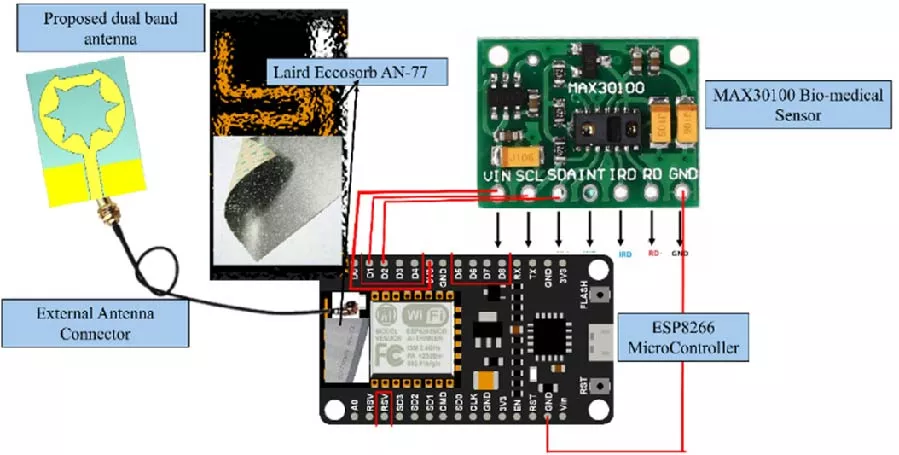
This study presents a compact patch antenna in the form of a circle, suitable for use in medical and wearable Internet of Things (IoT) devices. The recommended antenna has been proposed to operate on a polyamide material with a dielectric constant of 3.5 and loss tangent of 0.008, at 2.4 GHz and 5.8 GHz bands. The IoT wearable antenna has a specific absorption rate (SAR) obtained at 2.4 GHz that is 0.6 W/kg, while at 5.8 GHz it is 0.8 W/kg for 1 g of body tissue. Both values are significantly below the Federal Communications Commission (FCC) exposure limit, confirming the safe operation of the compact IoT-enabled wearable antenna. The antenna achieves simulated gains of 7.54 dBi and 7.96 dBi with radiation efficiencies of 85.45% and 87.55% at 2.4 GHz and 5.8 GHz, respectively. The proposed system integrates the proposed antenna with an ESP8266 microcontroller, which enables the transmission of vital signs data over an IoT platform. A Modbus protocol and Node-RED platform are utilized for data acquisition, processing, and visualization. This makes it a small, cheap, and reliable solution for IoT-enabled healthcare systems.
Design and Implementation of a High Gain Compact IoT Wearable Antenna for Vital Signs Data Transmission Using ESP8266
2026-04-21
PIER C
Vol. 169, 66-73, 2026
download: 16
A Low Mutual Coupling Dual-Band MIMO Antenna Based on Symmetrical Complementary Double-Split-Ring Resonators
Xuemei Zheng, Jiafu Xing and Tongchao Zhang
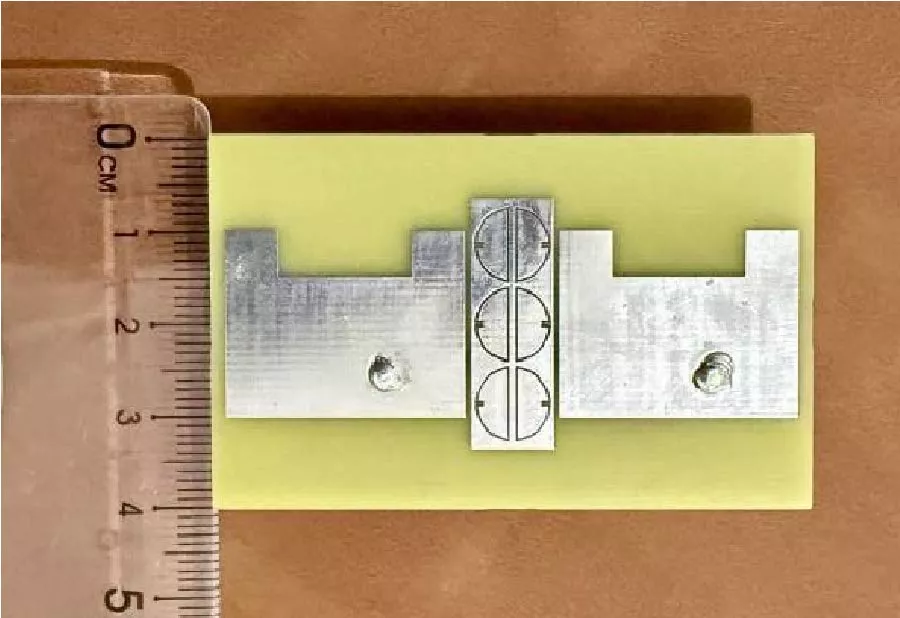
In this study, a novel symmetrical complementary double-split-ring resonator structure is proposed, operating in the frequency bands of 2.39-2.44 GHz (covering the core 2.4 GHz WLAN band) and 3.45-3.60 GHz (covering a key sub-band of n78 for 5G communications), to reduce the coupling of multiple-input multiple-output (MIMO) antennas within these two frequency bands. To align with the trend of antenna miniaturization, the inter-element spacing is only 0.08λ0. The measured results show that after loading the metamaterial, the antenna coupling in the operating bands is reduced by 0-10 dB and 8-23 dB, respectively, and the coupling in the two bands is below -17 dB and -27 dB, respectively. The peak gains achieved are 3.12 dBi and 4.51 dBi in the two bands. The ECC is less than 0.02, indicating excellent gain performance and effective decoupling capability of the MIMO antenna.
A Low Mutual Coupling Dual-Band MIMO Antenna Based on Symmetrical Complementary Double-Split-Ring Resonators
2026-04-21
PIER C
Vol. 169, 55-65, 2026
download: 27
High Isolation UWB MIMO Notch Antenna Based on Metamaterials
Xuemei Zheng, Yunan Zhang and Linfei Yue
This paper proposes a compact UWB MIMO antenna with band-notched characteristics and high isolation. With a miniaturized footprint of 60 × 32 mm, the antenna covers the full UWB spectrum of 3.1-13 GHz. A core structural innovation lies in the design of a novel SRR metamaterial unit, which exhibits superior high-frequency decoupling capability by regulating electromagnetic wave propagation; combined with the synergistic decoupling mechanism of a meandered-line radiating patch and an I-shaped DGS for low-frequency isolation enhancement, the antenna achieves an excellent measured isolation (S21) of better than -21 dB across the entire operating band. Additionally, four precise notched bands (3.3-3.4 GHz WiMAX, 4.4-5.0 GHz n79, 5.15-5.825 GHz WLAN, 7.9-8.4 GHz) are realized via strategically etched slots on radiating elements to suppress interference. Verified by measurements, the measured ECC is as low as below 0.018, and the diversity gain maintains stability near the ideal 10 dBi. The antenna exhibits stable radiation patterns throughout the impedance bandwidth, accompanied by outstanding diversity performance.
High Isolation UWB MIMO Notch Antenna Based on Metamaterials
2026-04-20
PIER C
Vol. 169, 48-54, 2026
download: 15
Wide Stopband Filtering Power Divider Based on Stepped-Impedance Stub and Three-Line Coupled Structures
Chuanyun Wang, Qian Cao and Pin Wen
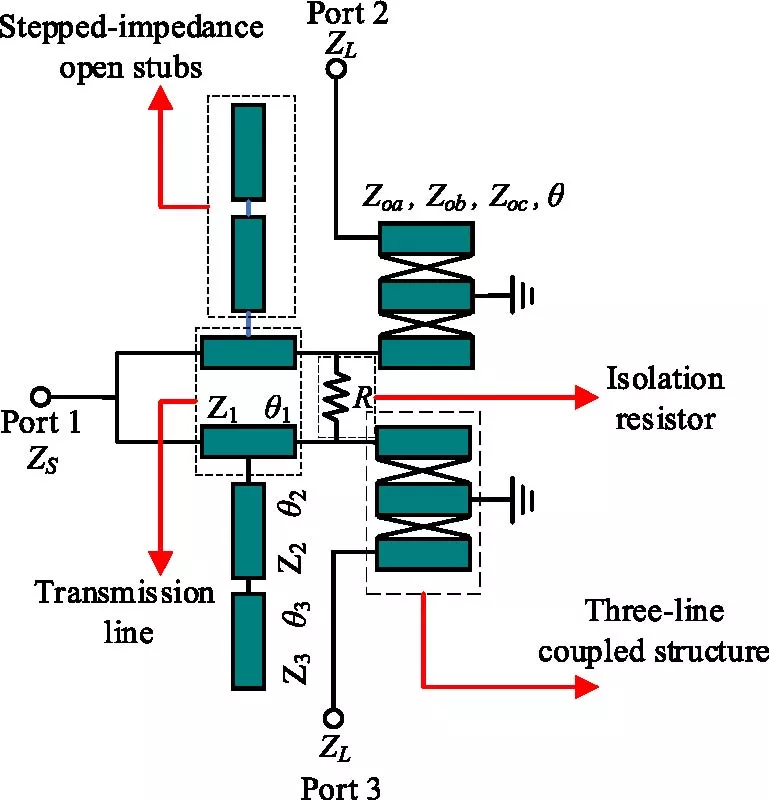
A novel wide-stopband filtering power divider (FPD) is proposed in this paper. The proposed wide stopband FPD integrates a pair of three-line coupled structures (TLCSs)-based bandpass filters (BPFs) and stepped-impedance open stubs. This topology achieves a wide stopband through harmonic suppression and enhanced filtering simultaneously. Specifically, the stepped-impedance open stubs effectively suppress harmonics to extend the stopband while also improving in-band impedance matching. Concurrently, the TLCS-based BPFs generate multiple transmission zeros (TZs) on both sides of the passband, improving frequency selectivity. A prototype wide stopband FPD operating at 3.5 GHz is fabricated and measured. There is a favorable agreement between the measured and simulated results, displaying a stopband up to 15 GHz (4.3f0), which features a rejection level of -15.8 dB and -10 dB fractional bandwidths of 44.8%.
Wide Stopband Filtering Power Divider Based on Stepped-Impedance Stub and Three-Line Coupled Structures
2026-04-20
PIER C
Vol. 169, 39-47, 2026
download: 24
Nested-Level Optimization of a Permanent Magnet Synchronous Motor Embedded in Energy Management for Hybrid Electric Vehicles
Zhijia Jin, Cong Liang, Xin Lu and Jian Chen
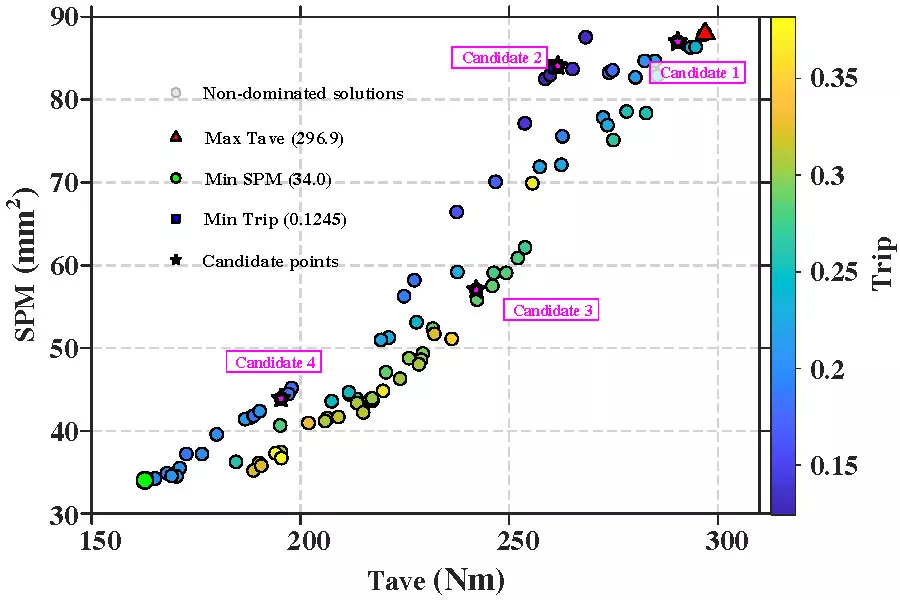
In addition to considering the electromagnetic performance of the motor itself, the optimal design of an onboard permanent magnet synchronous motor (PMSM) must also account for its compatibility with a vehicle and the impact of driving cycles. To address this problem, in this study, we propose a nested optimization design approach for PMSMs to achieve an optimal rotor design for vehicular applications. First, Morris sensitivity analysis is employed to classify the parameters to be optimized into highly and generally sensitive parameters. Subsequently, the Kriging model and NSGA-III algorithm are successively applied to perform hierarchical optimization for the highly sensitive parameters, followed by the generally sensitive parameters. To select the motor structure that best adapts to the vehicle and driving cycle, the efficiency maps of candidate solutions are solved and nested into the vehicle energy management model for optimization. The results demonstrate that the proposed method enables the identification of PMSM structures on the Pareto front that better match the vehicle and driving cycle. Compared with other high-performance solutions, the final optimal point achieves fuel consumption savings of up to 19.1%.
Nested-Level Optimization of a Permanent Magnet Synchronous Motor Embedded in Energy Management for Hybrid Electric Vehicles
2026-04-20
PIER C
Vol. 169, 31-38, 2026
download: 20
Design of a 200-W High-Efficiency Cascaded LDMOS Microwave Source with Digital Power Control
Zhiqi Li, Dan Zhang and Yan Sun
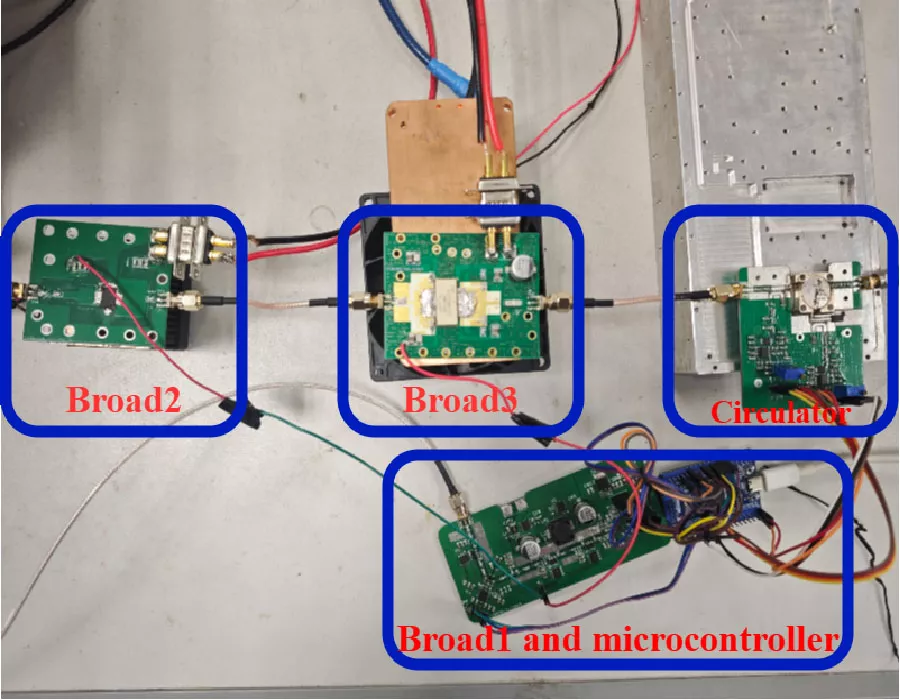
This study designs and experimentally validates a digitally controlled 2.45 GHz solid-state microwave power source for industrial continuous-wave operation. The source employs a cascaded laterally diffused metal oxide semiconductor (LDMOS) architecture integrating a phase-locked loop frequency synthesizer, a multi-stage driver chain, and a closed-loop digital power-control network with 0.5-dB resolution. The final-stage power amplifier (PA) is biased in deep class-AB, and a lumped-element matching network is synthesized - guided by load-pull and harmonic-impedance analysis - to realize a near-short termination at the second harmonic and reduce voltage-current overlap energy. Nonlinear device modelling and system-level analysis are used to predict efficiency and stability. Measurements show a saturated output power of 54.09 dBm, gain of 18.14 dB, and peak power-added efficiency of 61.89% under a 28-V supply. The source achieves accurate continuous-wave (CW) power regulation from 35 to 53 dBm with good thermal stability. These results indicate that combining deep class-AB biasing with second-harmonic near-short termination enables high-efficiency operation in L/S-band industrial microwave sources, and the cascaded digitally controlled architecture provides robust power management for microwave heating and plasma excitation systems.
Design of a 200-W High-Efficiency Cascaded LDMOS Microwave Source with Digital Power Control
2026-04-20
PIER C
Vol. 169, 21-30, 2026
download: 42
Design of a Compact Wave-Absorbing Plate for Suppressing Ground Reflection in MWPT Field Experiments
Hehui Zhang, Xiaoqin Zhu, Dapeng Guo and Enze Zhang
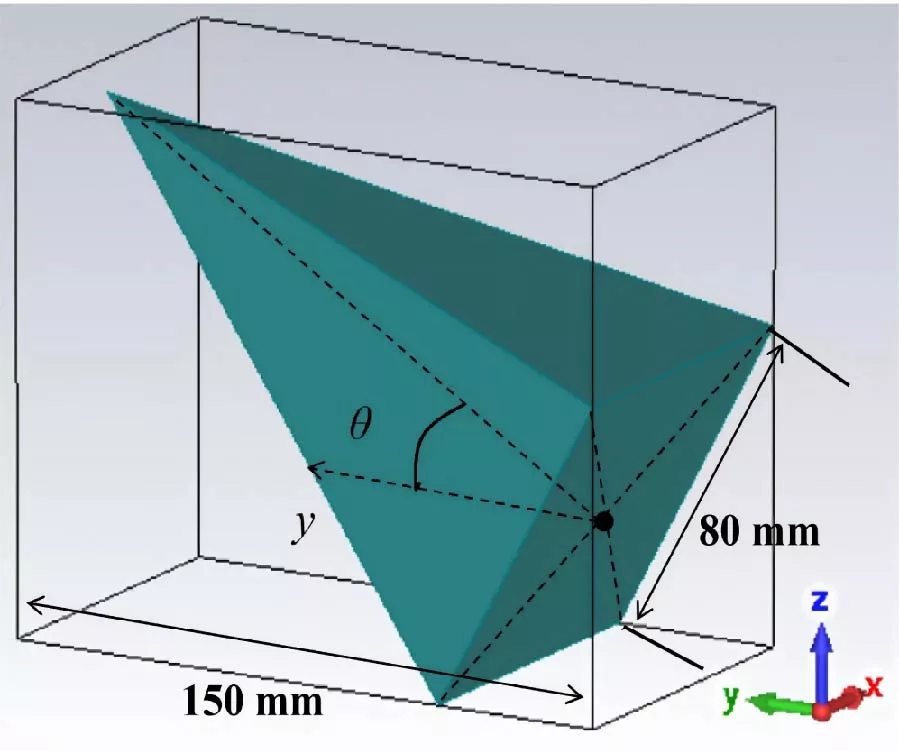
Microwave wireless power transfer (MWPT) offers significant advantages for charging unmanned vehicles over distances on the order of 100 m in atmospheric environments. To accurately measure the beam efficiency in field experiments, it is critical to suppress the impact of ground reflection on the field distribution generated by the beam. This paper presents the design of a compact wave-absorbing plate. The plate is composed of two dielectric waveguides arranged in an alternating side-by-side configuration. One waveguide is periodically loaded with metal patches along the propagation direction to absorb horizontally polarized incident waves, while the other is designed to absorb vertically polarized waves. Slots on the top surface are employed to couple the incident wave energy into the waveguides. Simulation results indicate that at 10 GHz, the reflection coefficients for both horizontal and vertical polarizations remain below -20 dB for incident angles ranging from 60° to 75°. In terms of volume, the proposed absorber achieves an 85% reduction in absorbing material consumption compared with conventional structures. It can be obliquely deployed on the ground as an array along the propagation path of the microwave beam to effectively attenuate ground reflection.
Design of a Compact Wave-Absorbing Plate for Suppressing Ground Reflection in MWPT Field Experiments
2020-04-19
PIER C
Vol. 169, 11-20, 2026
download: 35
Cluster Driven Subarray Setup for Reinforcing Phased Beam Pattern: A Comparative Analysis for Four Array Grids
Randa Yahya Hussein and Ahmed Jameel Abdulqader
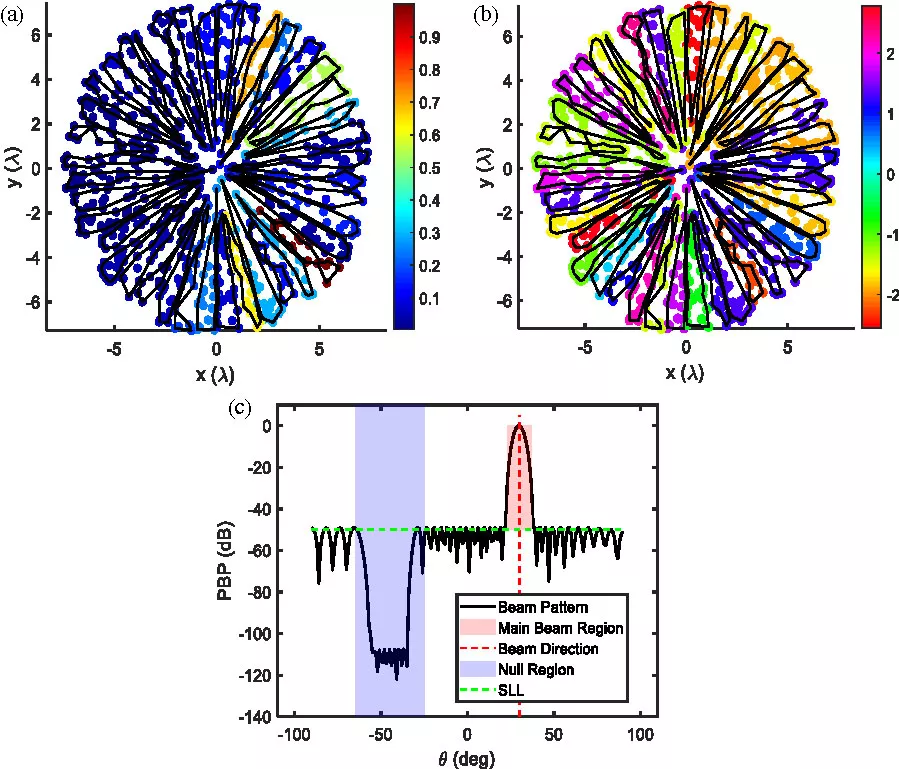
This paper aims to propose efficient scenarios for constructing subarray structures based on innovative cluster configurations for high-performance beamforming. Two efficient methods, spatial assembly clustered subarray (SACS) and radial section clustered subarray (RSCS), are proposed for constructing multiple planar antenna arrays. Several array grid shapes were selected, including the rectangular array (RA), uniformly circular area randomly filling (UCARF), polycycle concentric array (PCA), and circular rectangle lattice array (CRLA). Synthesizing large arrays requires a high-performance algorithm to ensure error-free tuning. Therefore, the optimization process was assigned to the convex optimization (CO) algorithm. A set of radiation constraints was incorporated to generate a strong phased beam pattern (PBP) based on the innovative cluster structures, including steering and null steering, and a significant reduction in the sidelobe levels (SLLs). Complex excitation optimization of the subarray elements was used to meet the requirements of electromagnetic radiation. Simulation results show that the four topologies using the RSCS method offer better control than the SACS method in terms of reducing the SLL. The CRLA-RSCS method achieved -82.6 dB, the CRLA-SACS of -60 dB, the UCARF-RSCS of -45 dB, the PCA-RSCS of -39 dB, and the RA-RSCS method of -35 dB, with the other subarrayed array methods achieving -30 dB. Regarding the null steering characteristic, the CRLA-SACS method achieved a better depth, reaching -150 dB, than the other clustered array tiling methods. In all the sternification configurations, the main beam was steered at a 30-degree angle and could be reconfigured as required. Therefore, the design of such antenna arrays makes them suitable for modern and future communication applications.
Cluster Driven Subarray Setup for Reinforcing Phased Beam Pattern: A Comparative Analysis for Four Array Grids
2026-04-19
PIER C
Vol. 169, 1-10, 2026
download: 29
Small-Scale Fading Analysis Under Human-Induced Blockage in Indoor Millimeter Wave Channels
Miguel Riobó Prieto, Manuel García Sánchez and Inigo Cuinas
Millimeter-wave (mmWave) radio communication systems, essential to the advancement of future networks, are highly susceptible to link degradation caused by human body obstruction. This paper presents a comprehensive experimental study of fast fading phenomena induced by pedestrians crossing indoor mmWave links, specifically at 40 GHz and 60 GHz. The measurement campaign was conducted in a realistic access point to user equipment configuration, involving over 150 participants and yielding 604 fading events, of which 431 involved full line-of-sight (LOS) blockage. The analysis focuses on the statistical characterization of the deep-fade regions within these events. Results are compared with simulations based on the Knife-Edge Diffraction (KED) model to evaluate its accuracy under dynamic blockage conditions. The statistical analysis reveals that the Weibull distribution most effectively models the fast fading observed during human-induced blockage, outperforming Rician, Rayleigh, Nakagami-m, and Normal distributions - particularly at 60 GHz, where 89% of fades aligned with the Weibull model. Simulated fades using the KED model, however, did not show a strong fit with a single distribution yielding similar results to the Rician, Weibull, and Nakagami-m. These findings underscore the influence of diffracted multipath components in determining the statistical behavior of fast fading. The study confirms the limitations of existing diffraction models in capturing the full complexity of dynamic human blockage and highlights the need for refined modeling approaches. This work contributes critical insights toward the robust design and performance prediction of future indoor mmWave communication systems.
Small-Scale Fading Analysis under Human-Induced Blockage in Indoor Millimeter Wave Channels