Vol. 165
Latest Volume
All Volumes
PIERC 165 [2026] PIERC 164 [2026] PIERC 163 [2026] PIERC 162 [2025] PIERC 161 [2025] PIERC 160 [2025] PIERC 159 [2025] PIERC 158 [2025] PIERC 157 [2025] PIERC 156 [2025] PIERC 155 [2025] PIERC 154 [2025] PIERC 153 [2025] PIERC 152 [2025] PIERC 151 [2025] PIERC 150 [2024] PIERC 149 [2024] PIERC 148 [2024] PIERC 147 [2024] PIERC 146 [2024] PIERC 145 [2024] PIERC 144 [2024] PIERC 143 [2024] PIERC 142 [2024] PIERC 141 [2024] PIERC 140 [2024] PIERC 139 [2024] PIERC 138 [2023] PIERC 137 [2023] PIERC 136 [2023] PIERC 135 [2023] PIERC 134 [2023] PIERC 133 [2023] PIERC 132 [2023] PIERC 131 [2023] PIERC 130 [2023] PIERC 129 [2023] PIERC 128 [2023] PIERC 127 [2022] PIERC 126 [2022] PIERC 125 [2022] PIERC 124 [2022] PIERC 123 [2022] PIERC 122 [2022] PIERC 121 [2022] PIERC 120 [2022] PIERC 119 [2022] PIERC 118 [2022] PIERC 117 [2021] PIERC 116 [2021] PIERC 115 [2021] PIERC 114 [2021] PIERC 113 [2021] PIERC 112 [2021] PIERC 111 [2021] PIERC 110 [2021] PIERC 109 [2021] PIERC 108 [2021] PIERC 107 [2021] PIERC 106 [2020] PIERC 105 [2020] PIERC 104 [2020] PIERC 103 [2020] PIERC 102 [2020] PIERC 101 [2020] PIERC 100 [2020] PIERC 99 [2020] PIERC 98 [2020] PIERC 97 [2019] PIERC 96 [2019] PIERC 95 [2019] PIERC 94 [2019] PIERC 93 [2019] PIERC 92 [2019] PIERC 91 [2019] PIERC 90 [2019] PIERC 89 [2019] PIERC 88 [2018] PIERC 87 [2018] PIERC 86 [2018] PIERC 85 [2018] PIERC 84 [2018] PIERC 83 [2018] PIERC 82 [2018] PIERC 81 [2018] PIERC 80 [2018] PIERC 79 [2017] PIERC 78 [2017] PIERC 77 [2017] PIERC 76 [2017] PIERC 75 [2017] PIERC 74 [2017] PIERC 73 [2017] PIERC 72 [2017] PIERC 71 [2017] PIERC 70 [2016] PIERC 69 [2016] PIERC 68 [2016] PIERC 67 [2016] PIERC 66 [2016] PIERC 65 [2016] PIERC 64 [2016] PIERC 63 [2016] PIERC 62 [2016] PIERC 61 [2016] PIERC 60 [2015] PIERC 59 [2015] PIERC 58 [2015] PIERC 57 [2015] PIERC 56 [2015] PIERC 55 [2014] PIERC 54 [2014] PIERC 53 [2014] PIERC 52 [2014] PIERC 51 [2014] PIERC 50 [2014] PIERC 49 [2014] PIERC 48 [2014] PIERC 47 [2014] PIERC 46 [2014] PIERC 45 [2013] PIERC 44 [2013] PIERC 43 [2013] PIERC 42 [2013] PIERC 41 [2013] PIERC 40 [2013] PIERC 39 [2013] PIERC 38 [2013] PIERC 37 [2013] PIERC 36 [2013] PIERC 35 [2013] PIERC 34 [2013] PIERC 33 [2012] PIERC 32 [2012] PIERC 31 [2012] PIERC 30 [2012] PIERC 29 [2012] PIERC 28 [2012] PIERC 27 [2012] PIERC 26 [2012] PIERC 25 [2012] PIERC 24 [2011] PIERC 23 [2011] PIERC 22 [2011] PIERC 21 [2011] PIERC 20 [2011] PIERC 19 [2011] PIERC 18 [2011] PIERC 17 [2010] PIERC 16 [2010] PIERC 15 [2010] PIERC 14 [2010] PIERC 13 [2010] PIERC 12 [2010] PIERC 11 [2009] PIERC 10 [2009] PIERC 9 [2009] PIERC 8 [2009] PIERC 7 [2009] PIERC 6 [2009] PIERC 5 [2008] PIERC 4 [2008] PIERC 3 [2008] PIERC 2 [2008] PIERC 1 [2008]
2026-01-21 Latest Published
By Qiang Guo Peng-Ju Yang Rui Wu Yuqiang Zhang
Progress In Electromagnetics Research C, Vol. 165, 61-67, 2026
Abstract
An adaptive threshold enhanced-Cross-correlation Back Projection (CBP) imaging algorithm is presented for artifacts suppression and accuracy improvement of Synthetic Aperture Radar (SAR) imaging in Ground Penetrating Radar (GPR) applications. B-Scan profiles of underground pipelines are obtained by using the open-source GprMax simulator, and they are then preprocessed with the method of background subtraction to remove direct waves. Adaptive threshold scheme using Hilbert transform is adopted to obtain the envelopes of B-Scan profiles after removing direct waves. GPR-SAR imaging of underground pipelines is simulated and discussed in detail for different pipe parameters and soil environment. The simulated results demonstrate that the adaptive threshold enhanced-CBP algorithm achieves focused pipeline images with sub-wavelength localization accuracy, enabling geometric contour reconstruction for non-metallic pipelines with strong robustness in Peplinski's soil and multiple target scenarios.
2026-01-21
PIER C
Vol. 165, 61-67, 2026
download: 31
GPR-SAR Imaging of Underground Pipelines Using Adaptive Threshold-Enhanced CBP Algorithm
Qiang Guo, Peng-Ju Yang, Rui Wu and Yuqiang Zhang
An adaptive threshold enhanced-Cross-correlation Back Projection (CBP) imaging algorithm is presented for artifacts suppression and accuracy improvement of Synthetic Aperture Radar (SAR) imaging in Ground Penetrating Radar (GPR) applications. B-Scan profiles of underground pipelines are obtained by using the open-source GprMax simulator, and they are then preprocessed with the method of background subtraction to remove direct waves. Adaptive threshold scheme using Hilbert transform is adopted to obtain the envelopes of B-Scan profiles after removing direct waves. GPR-SAR imaging of underground pipelines is simulated and discussed in detail for different pipe parameters and soil environment. The simulated results demonstrate that the adaptive threshold enhanced-CBP algorithm achieves focused pipeline images with sub-wavelength localization accuracy, enabling geometric contour reconstruction for non-metallic pipelines with strong robustness in Peplinski's soil and multiple target scenarios.
GPR-SAR Imaging of Underground Pipelines Using Adaptive Threshold-Enhanced CBP Algorithm
2026-01-20
PIER C
Vol. 165, 48-60, 2026
download: 35
Design and Fabrication of a New Triple-Band Bandpass Filter with Adjustable Bandwidth Passbands Depending on Coupling
Obaida Oulad Haddar, Mohammed Boulesbaa and Tarek Djerafi
In this research, a simple design with a compact size of a triple-band bandpass filter (BPF) based on SIW is proposed. The proposed design consists of a main SIW cavity combined with two others-secondary SIW cavities. The three passbands of the proposed BPF are formed based on the center frequencies (CFs) of the four modes given by the main SIW cavity and two transmission poles (TP1 and TP2) achieved with the secondary SIW cavity. The SIW modes achieved with the main SIW cavity are TE101, TE201, and TE301 addition to the suppressed mode, and those modes are realized by the perturbation of seven metallic vias. The coupling of the TP1 with the suppressed mode realizes the first passband of the filter proposed with a bandwidth of 0.53 GHz. Vertical CPW slots are etched at the main SIW cavity for coupling TE101 and TE201 to form the second passband with a bandwidth of 1.3 GHz. Horizontal CPW slots are etched in the two rectangular secondary SIW cavities to join the TP2 with TE301 mode for realizing the third passband with a bandwidth of 1.2 GHz. Finally, an adjustable bandwidth filter with CFs of 6.9/10.1/13.3 GHz, respectively, has been achieved. Also, six transmission zeros (TZs) are achieved in the operation frequency range (6-16 GHz), which improves the selectivity of the filter. The proposed filter is modeled with an approximate equivalent circuit, and the prototype of the filter is fabricated and tested to demonstrate its excellent performance. A good agreement was realized among simulation, equivalent circuit LC model, and measurement S-parameters, which proves and validates the operation of the proposed triple-band BPF. The multiple advantages of the proposed filter, such as a simple structure, compactness (1.29λg × 1.62λg), selectivity, and high performance, make it a promising candidate for multi-tasking communication systems.
Design and Fabrication of a New Triple-Band Bandpass Filter with Adjustable Bandwidth Passbands Depending on Coupling
2026-01-20
PIER C
Vol. 165, 35-47, 2026
download: 39
Corporate-Fed Inclined Patch Arrays for Meteorological Direct Broadcast Reception
Paramasivam Jothilakshmi and Rajendran Mohanasundaram
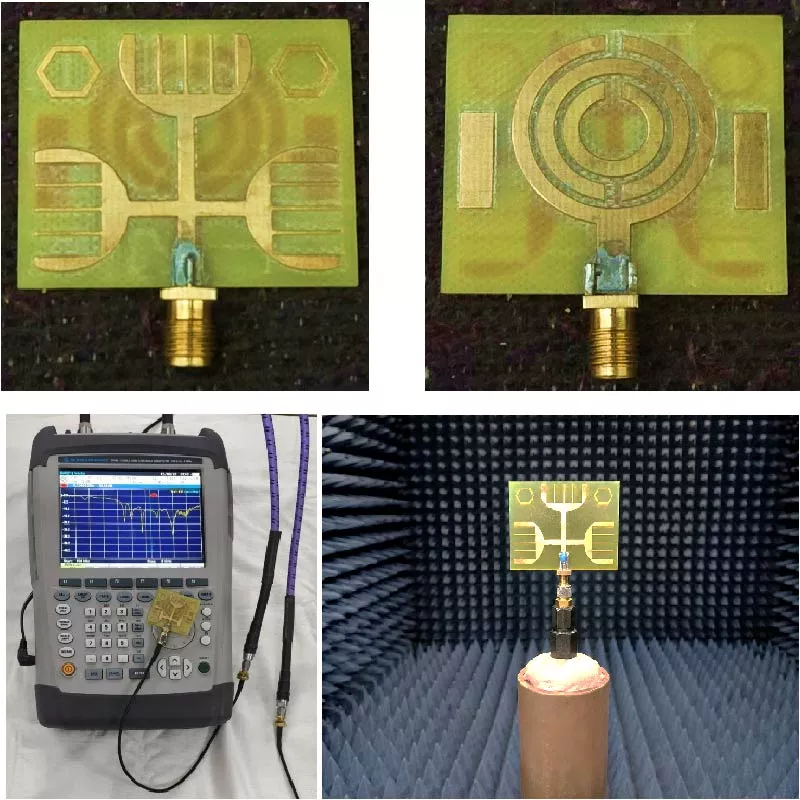
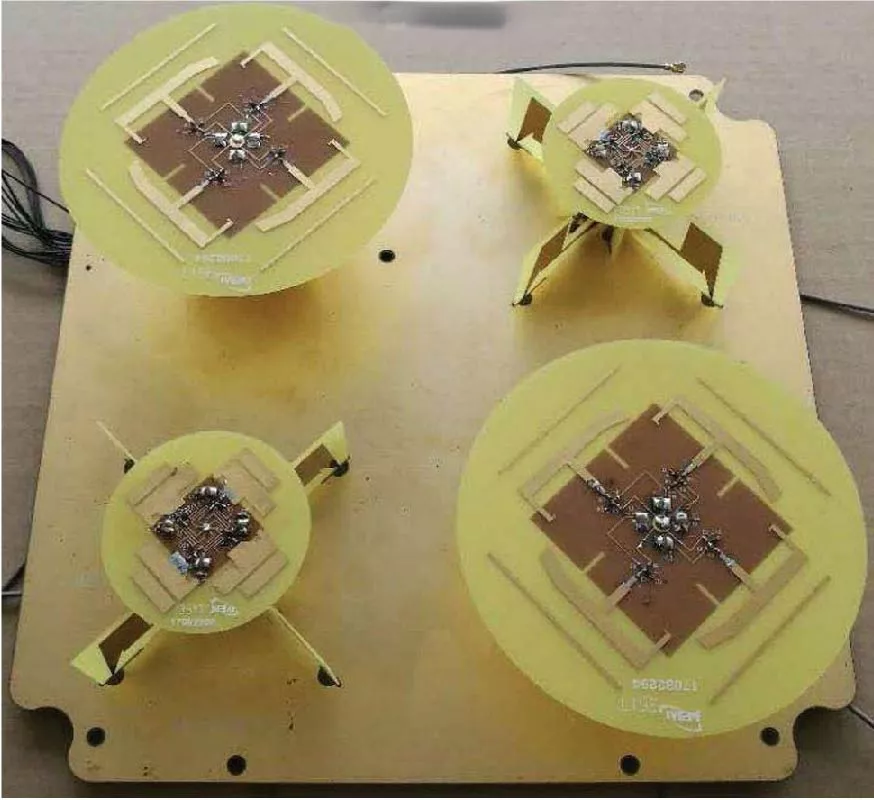
This work codesigns and validates a compact microstrip patch array with a corporate feed for meteorological direct broadcast at 7.5 GHz, comparing 1×4 to 1×64 arrays. Square patches with rounded corners are rotated 45° to suppress modes, reduce coupling, and preserve broadside radiation. The feed network delivers equal amplitude to four ports. A neural network surrogate trained on full-wave samples accelerates exploration of edge length, corner radius, spacing, rotation, and feed-line dimensions while enforcing limits on S11 and coupling. The 1×4 prototype uses Rogers RT Duroid 5880, εr 2.2, thickness 0.787 mm, with a substrate size of 120 mm by 75 mm. Photolithography and anechoic measurements confirm a 7.5 GHz center frequency, broadside radiation, peak gain above 14 dBi, and a 450 MHz bandwidth. Scaling to 1×64 shows 3 dB gain per doubling, reduced beamwidth, stable bandwidth, and coupling; sensitivity studies verify robustness.
Corporate-fed Inclined Patch Arrays for Meteorological Direct Broadcast Reception
2026-01-18
PIER C
Vol. 165, 25-34, 2026
download: 40
Optimized NCP MIMO Antenna with Dual Diamond Slots for Enhanced Isolation in 5G Applications
Rama Lakshmi Gali and Madhavi Tatineni
This research paper presents a novel two-element Notched Circular Patch (NCP) antenna tailored for n78 5G NR band communication, resonating at a frequency of 3.5 GHz. The primary focus of this study is to enhance isolation using a simple antenna design with advanced optimization techniques. The proposed NCP antenna incorporates two diamond-shaped slots within a circular patch, designed to operate at n78 band or C-band. Through meticulous design and fabrication processes, the antenna achieves an inter-element spacing that is optimized with GA algorithm, and 1/4 of the ground structure is considered at the center of the patch, significantly improving its performance at 3.5 GHz, maintaining a VSWR of 1.1. The proposed 60 × 30 mm2 NCP antenna exhibits remarkable characteristics, including > -30 dB isolation, a reflection coefficient of -27 dB, and a gain of 4 dBi. These results underscore the effectiveness of the antenna design in reducing mutual coupling and enhancing isolation, which are essential for achieving reliable and efficient communication in 5G. The NCP MIMO antenna is thoroughly analyzed using characteristic mode analysis (CMA), and CMA parameters' influence on antenna performance is discussed. The design further highlights its practicality and potential for implementation in various wireless communication systems.
Optimized NCP MIMO Antenna with Dual Diamond Slots for Enhanced Isolation in 5G Applications
2026-01-18
PIER C
Vol. 165, 18-24, 2026
download: 29
Transmission-Line Dual-Band Absorptive Bandstop Filter with Two Input Lossy Step-Impedance Stubs
Jiapei Dong, Xiaoying Zuo, Mengxin He, Yajian Li, Juntao Cao and Zelin Sun
In this paper, a novel planar dual-band absorptive bandstop filter (ABSF) based on transmission lines is proposed. The filter structure is composed of multiple transmission lines and two chip resistors, which endows it with distinct advantages including multiple transmission zeros, high-selectivity dual-bandstop performance. Through formula derivations, the specific positions of the four transmission zeros within the operating frequency are precisely determined. Experimental measurement results demonstrate that the -10 dB fractional bandwidth of the first stopband is 50.27% (from 0.7 GHz to 1.17 GHz), while that of the second stopband reaches 13.18% (from 3.33 GHz to 3.8 GHz). Across the entire frequency, the insertion loss S21 achieves a minimum of -45.20 dB at 1 GHz, and the return loss S11 attains a maximum of -10.27 dB at 3.94 GHz. The physical dimensions of the filter are 102 mm × 26 mm (0.77λ0 × 0.20λ0).
Transmission-line Dual-band Absorptive Bandstop Filter with Two Input Lossy Step-impedance Stubs
2026-01-16
PIER C
Vol. 165, 11-17, 2026
download: 47
An Asymmetric Miniaturized Single-Layer Bandpass Filter Based on Interdigital Capacitors and Microstrip Inductors
Juntao Cao, Xiaoying Zuo, Mengxin He, Yajian Li and Jiapei Dong
This paper proposes an asymmetric miniaturized single-layer bandpass filter based on interdigital capacitors and microstrip inductors with miniaturization and a wide bandwidth. It is composed of three series of LC resonator pairs and two parallel LC resonator pairs, and this asymmetric structure enhances design flexibility. The measured results indicate that the center frequency is 1.48 GHz, and the passband covers 0.88~2.08 GHz, with a return loss better than 12.6 dB, whereas the insertion loss is less than 0.58 dB. The physical size is 31 mm × 13 mm, which is smaller than that of traditional LC filters.
An Asymmetric Miniaturized Single-Layer Bandpass Filter Based on Interdigital Capacitors and Microstrip Inductors
2026-01-16
PIER C
Vol. 165, 1-10, 2026
download: 42
Design and Experimental Evaluation of a Compact Half-Shaped Printed-Monopole Antenna with Short Stub for UWB Systems
Nobuyasu Takemura
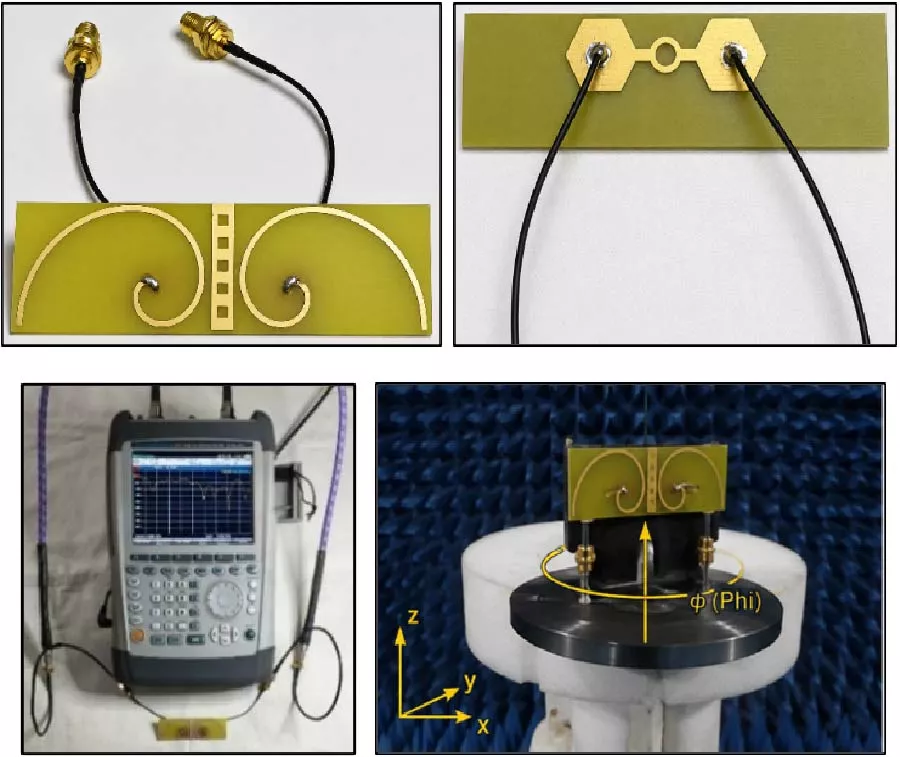
A compact, half-shaped, planar-monopole antenna optimized for ultra-wideband (UWB) communication systems was proposed, numerically analyzed, and experimentally validated. The proposed antenna is configured as a bell-shaped monopole structure fabricated on an FR-4 dielectric substrate, which is bisected along its axis of symmetry to achieve a reduced footprint. To ensure broadband impedance matching, a short-circuited stub is integrated between the monopole and the ground conductor through a plated via. The antenna dimensions are 30 × 12 × 1.6 mm3, which represent a significant reduction compared with those of conventional UWB monopole antennas. Full-wave electromagnetic simulations demonstrate that the antenna covers the FCC-authorized UWB band of 3.1-10.6 GHz with a voltage standing-wave ratio (VSWR) of ≤ 2. Experimental measurements of properties of a fabricated prototype of the proposed antenna agree well with the simulation results. In addition to the analysis of frequency-domain performance, time-domain analysis is conducted using two identical antennas in both face-to-face and side-by-side arrangements. According to the results of the time-domain analysis, the calculated correlation coefficient between signals received by the proposed antenna is 0.986, which confirms high waveform fidelity. Group-delay analysis of the proposed antenna verified stable temporal characteristics with an average delay of approximately 0.2 ns across the UWB range. These results demonstrate that the proposed antenna is a promising candidate for compact and high-performance integration in short-range, high-speed, wireless-communication devices.
Design and Experimental Evaluation of a Compact Half-shaped Printed-monopole Antenna with Short Stub for UWB Systems