High Q-Factor Permittivity Sensor with Dual-Band and Independent Performance for Solid Material Characterization
Leni Devera Asrar,
Zahriladha Zakaria,
Syah Alam,
Iwan Setyadi and
Maizatul Alice Meor Said
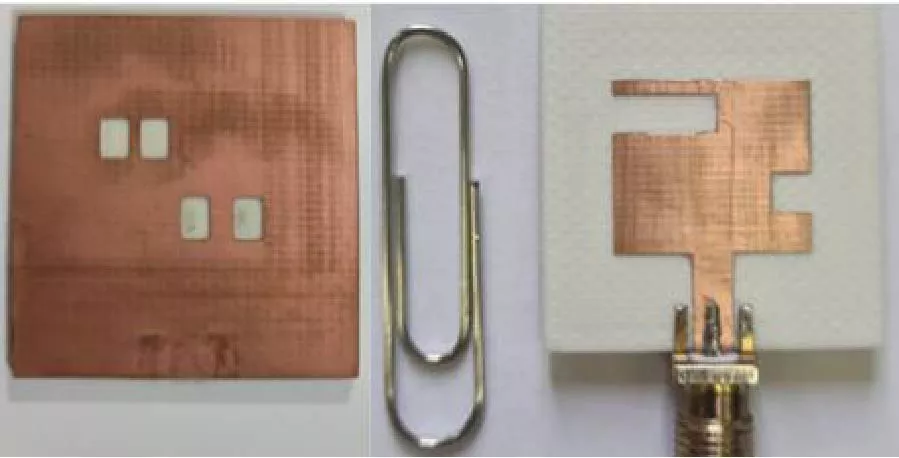
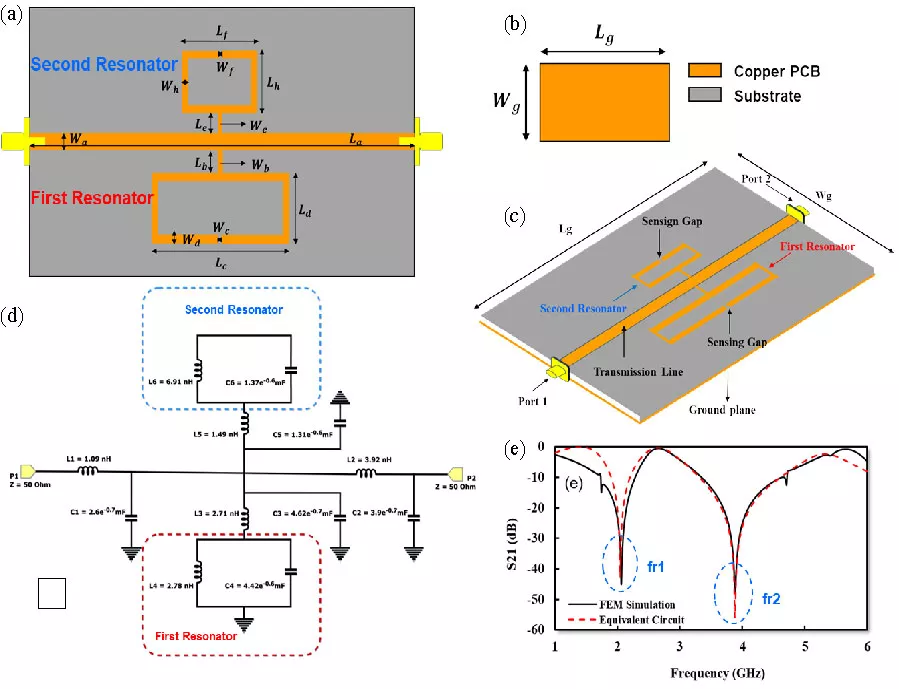
This study proposes a two-port dual-band microwave sensor designed for the independent and simultaneous detection of solid material characteristics. The sensor consists of a pair of non-identical rectangle-shaped resonators arranged symmetrically, with two distinct sensing areas connected by a power divider and a microstrip feed line with an impedance of 50 Ohms. It operates at resonant frequencies of fr1 = 2.16 GHz and fr2 = 4.03 GHz, utilizing a Rogers 5880 substrate with εr = 2.2, tanδ = 0.0009, and a thickness of 0.79 mm. The tested materials include RO5880, RO4350, and FR4, with dimensions of 16 mm × 5 mm on the first resonator and 5 mm × 5 mm on the second resonator. The rectangular resonators successfully detect and measure the dielectric properties of solid materials while maintaining independent operation, ensuring that MUT loading does not interfere with each resonator. The measurement results indicate that fr1 and fr2 achieve average accuracies of 90.51% and 95.16%, respectively, for a permittivity range of 1-4.4, while the average normalized sensitivities are 2.42% and 1.36%. In addition, the Q-factors of resonators are 308 and 537, respectively. The proposed microwave sensor offers a promising solution for accurately detecting different characteristics of solid materials independently and simultaneously, with potential applications in the food industry, material quality control, and biomedical fields.