2025-12-20 Latest Published
By Suwat Sakulchat
Sommart Promput
Watcharaphon Naktong
Panuwit Thongbor
Progress In Electromagnetics Research C, Vol. 163, 210-221, 2026
Abstract
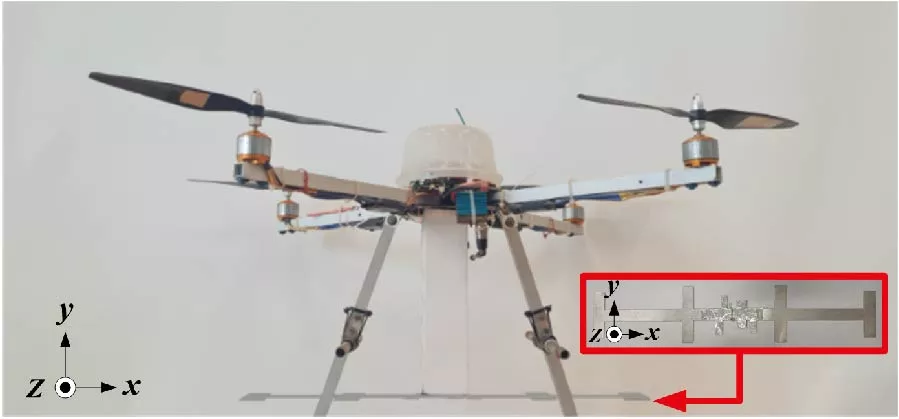
This research presents a quad-band dipole antenna for use with a surveying drone. The dipole antenna structure design employs the technique of adding I-shaped stubs and V-shaped etching, using aluminum plates with a strong and lightweight structure, with a thickness of 2 mm, a width of 1,325 mm, and a length of 190 mm. The antenna is designed to support frequency bands according to standards (VOR: Very High Frequency Omnidirectional Range) at 118 MHz, (GS: Glide Slope) at 336 MHz, (DME: Distance Measuring Equipment) at 1231 MHz, and WiFi at 2.45 GHz. From the calculations and simulations using the CST program, optimal parameter values were obtained, leading to the fabrication of a prototype antenna and the testing of its antenna properties. The results showed reflection coefficient values of -21.87 dB (108-118 MHz), -12.76 dB (328-336 MHz), -11.99 dB (962-1231 MHz), and -21.79 dB (2400-2480 MHz), which covers the VOR/GS/DME/ IEEE 802.11b/g/n standards. The antenna gain values are 1.12, 2.38, 3.76, and 4.00 dBi, respectively, with an omnidirectional radiation pattern, and the prototype dipole antenna tested with a drone was found to operate normally in the low frequency range of 108-118 MHz, the first mid frequency range of 328-336 MHz, the second mid frequency range of 962-1231 MHz, and the high frequency range of 2400-2480 MHz.