Thermal and Power Stress Equivalence Between Stratospheric Balloon and Low Earth Orbit Environments for CubeSat
Subsystem Screening
Aryan Takalkar,
Raj Devalkar,
Shubhangi Kharche and
Kondaka LakshmiSudha
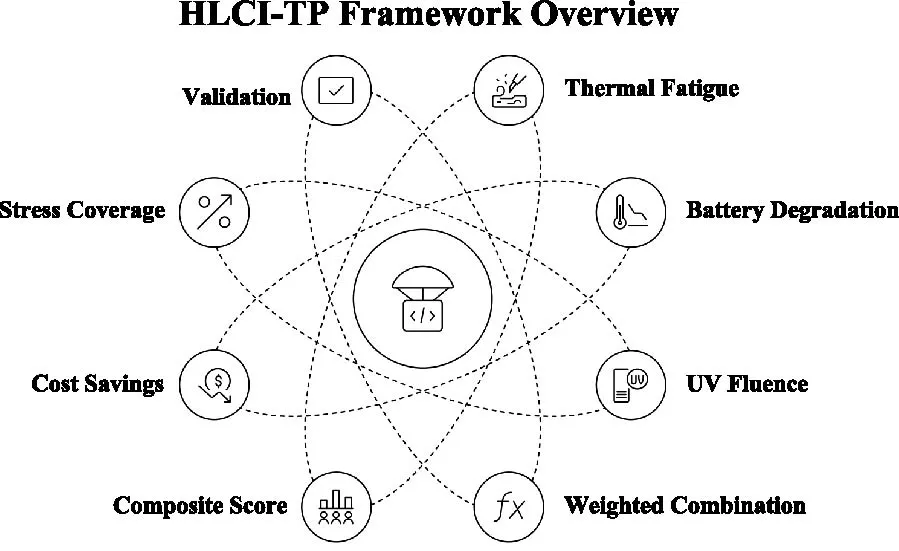
CubeSats deployed into Low-Earth Orbit (LEO) are continuously subjected to cyclic thermal loads and power-system degradation. Replicating these stresses through traditional space qualification is resource-intensive, placing it beyond the reach of most academic teams. Stratospheric High-Altitude Balloon (HAB) platforms offer a cost-effective pre-qualification pathway; however, no previous work has provided a rigorous, analytical method for mapping the stress accumulated during a balloon flight to an equivalent fraction of LEO stress. This gap prevents defensible claims of environmental fidelity. This paper introduces the High Altitude to Low Earth Orbit Correlation Index - Thermal and Power (HLCI-TP), a physics-based composite metric comprising three independently computed sub-indices: thermal fatigue (Coffin-Manson model), electrochemical battery degradation (Arrhenius model), and Ultraviolet (UV) fluence (Beer-Lambert model). Each sub-index quantifies the fraction of a 30-day LEO reference stress budget reproduced during a balloon mission, and the three are combined via a weighted linear sum. The UV sub-index is grounded in the Beer-Lambert electromagnetic attenuation law, directly connecting the framework to the quantification of solar ultraviolet irradiance - a component of the electromagnetic spectrum - at stratospheric altitudes. For a 24-hour reference mission at 35 km, the computed sub-index values are RT ≈ 1.63 × 10⁻⁴ (thermal), RP ≈ 2.0 × 10⁻⁶ (electrochemical), and RU ≈ 9.92 × 10⁻³ (UV), yielding a composite HLCI-TP score of 2.07 × 10⁻³, which falls within the ``minimal screening'' band. This result is robust across three distinct weighting configurations (factor-of-three spread), a 10,000-sample Monte Carlo uncertainty analysis, and across the full practical range of mission durations (6-48 hours). The framework is further corroborated by applying Rainflow cycle counting to real GPS altitude data from the PMC-Turbo stratospheric balloon mission (35.7-39.5 km, 134.8 hours), which confirms the minimal-screening classification across all tested durations. These results quantify, for the first time through an analytical framework, that a 24-hour stratospheric flight reproduces approximately 0.016% of the LEO thermal fatigue budget and approximately 1% of the LEO UV-A/UV-B fluence budget. The cost savings relative to full Thermal Vacuum Chamber (TVAC) testing are one to two orders of magnitude. Future work will target orbital calibration, a vibration sub-index, and an open-source web calculator.