2026-11-16 Latest Published
By Yang Su
Yu Mao Wu
Hongxia Ye
Progress In Electromagnetics Research, Vol. 187, 1-17, 2026
Abstract
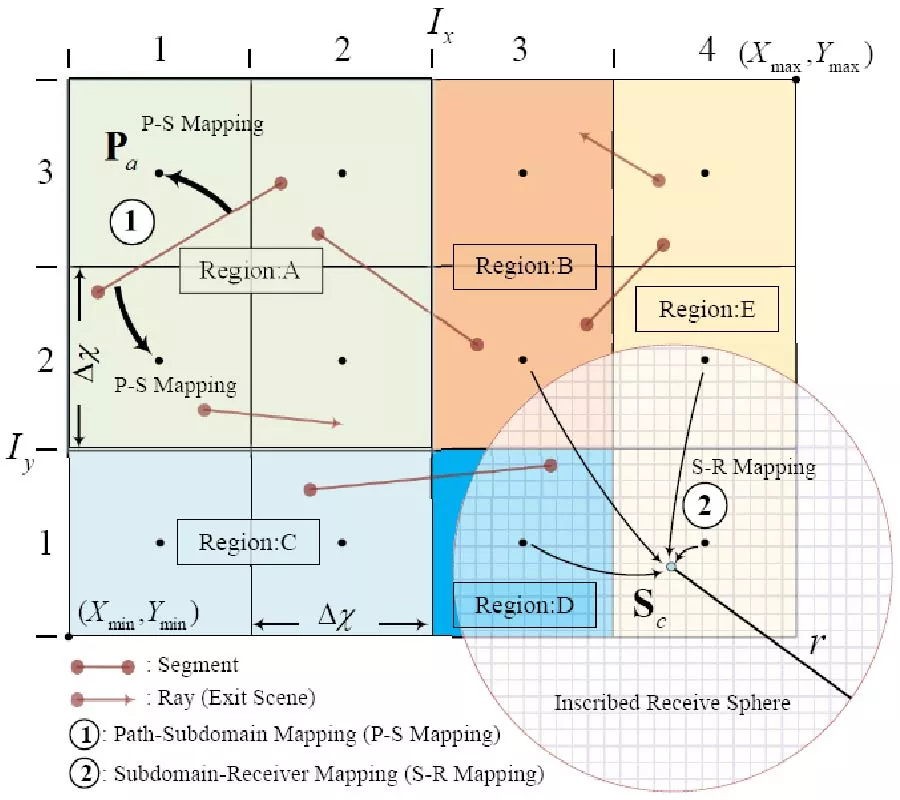
Ray-based propagation modeling in large, complex environments remains computationally demanding, particularly because high-order paths incur prohibitive computational cost. To address this bottleneck, this paper presents an integrated framework that unifies ray generation, two-stage path-receiver mapping, and three-level path filtering. Specifically, at the transmitter side, the framework combines two complementary ray-generation mechanisms. For near-region path coverage, a Fibonacci sphere sampling strategy is employed to avoid the uneven energy distribution inherent in the iterative icosahedral subdivision. For far-region path coverage, an environment-driven path generation method reduces redundant rays. At the receiver side, a two-stage path-receiver mapping architecture based on grid traversal and parent-child candidate mapping is developed to reduce mapping complexity between the path pool and receivers. Additionally, an efficient three-level path-filtering procedure is constructed to identify valid paths with minimal computational cost, while preventing double counting. Numerical examples demonstrate that the proposed method achieves a speedup of more than two orders of magnitude over WinProp at a maximum reflection order of 8 in a 3.5-km Massif Central tunnel, while supporting reflection orders up to 40. In the Hangzhou urban scenario with 27,331 receivers (Rx), the runtime speedup relative to WinProp exceeds 26.85× at a maximum mixed R-T interaction order of 10. The proposed solver is further evaluated up to a maximum mixed R-T path order of 14. For the shared interaction order of 8, the MAE and RMSE relative to WinProp are 0.69 and 1.62 dB, respectively.