School of Electrical and Electronic Engineering
Nanyang Technological University
Singapore
Homepage1. Taflove, A. and S. C. Hagness, Computational Electrodynamics: The Finite-Difference Time-Domain Method, Artech House, 2005.
2. Yee, K. S., "Numerical solution of initial boundary value problems involving Maxwell's equations in isotropic media," IEEE Trans. Antennas Propag., Vol. 14, No. 3, 302-307, 1966. Google Scholar
3. Zheng, F., Z. Chen, and J. Zhang, "Toward the development of a three-dimensional unconditionally stable finite-difference time-domain method," IEEE Trans. Microw. Theory Tech., Vol. 48, No. 9, 1550-1558, 2000. Google Scholar
4. Namiki, T., "3-D ADI-FDTD method --- Unconditionally stable time-domain algorithm for solving full vector Maxwell's equations," IEEE Trans. Microw. Theory Tech., Vol. 48, 1743-1748, 2000. Google Scholar
5. Fu, W. and E. L. Tan, "Development of split-step FDTD method with higher order spatial accuracy," Electron. Lett., Vol. 40, No. 20, 1252-1254, 2004. Google Scholar
6. Fu, W. and E. L. Tan, "Compact higher-order split-step FDTD method," Electron. Lett., Vol. 41, No. 7, 397-399, 2005. Google Scholar
7. Tan, E. L., "Unconditionally stable LOD-FDTD method for 3-D Maxwell's equations," IEEE Microw. Wireless Compon. Lett., Vol. 17, No. 2, 85-87, 2007. Google Scholar
8. Tan, E. L., "Fundamental schemes for e±cient unconditionally stable implicit finite-difference time-domain methods," IEEE Trans. Antennas Propag., Vol. 56, No. 1, 170-177, 2008. Google Scholar
9. Yang, Z. and E. L. Tan, "A microstrip circuit tool kit app with FDTD analysis including lumped elements," IEEE Microw. Mag., Vol. 16, No. 1, 74-80, 2015. Google Scholar
10. Yang, Z. and E. L. Tan, "A microwave transmission line courseware based on multiple 1-D FDTD method on mobile devices," Asia-Pacific Conf. Antennas Propag., 251-252, Bali, 2015. Google Scholar
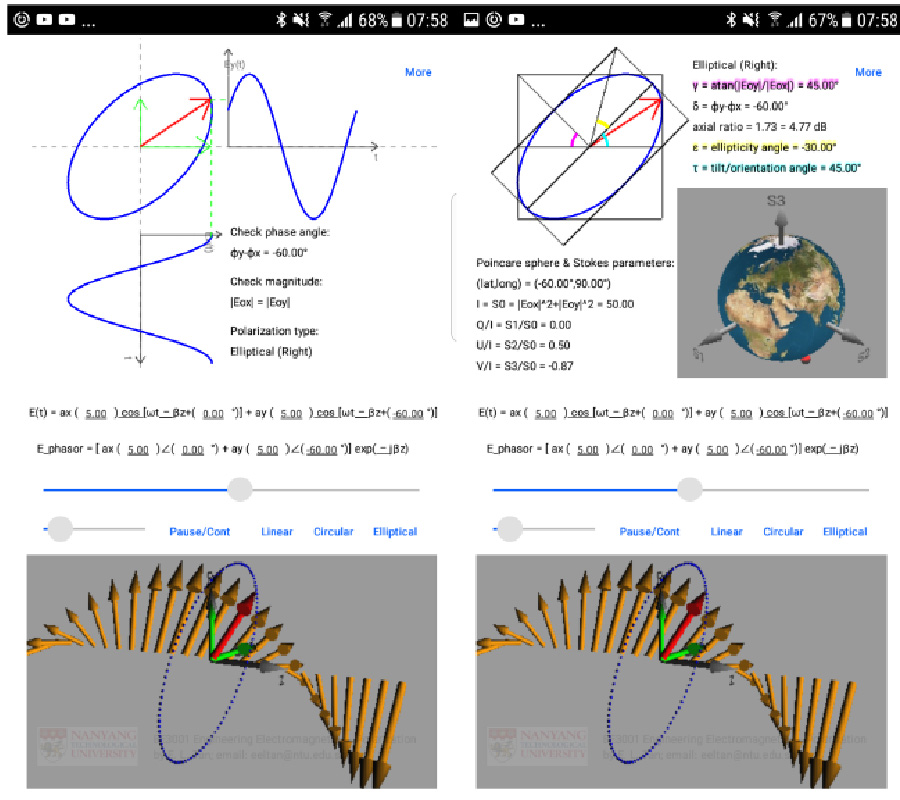
11. Tan, E. L. and D. Y. Heh, "Demonstration of electromagnetic polarization app on iPad," IEEE Int. Conf. Comput. Electromagn., 196-197, Kumamoto, 2017. Google Scholar
12. Tan, E. L. and D. Y. Heh, "Mobile device aided teaching and learning of electromagnetic polarization," IEEE Int. Conf. Teaching, Assessment, and Learning for Engineering, 52-55, Hong Kong, 2017. Google Scholar
13. Tan, E. L. and D. Y. Heh, "Teaching and learning electromagnetic polarization using mobile devices," IEEE Antennas Propag. Mag., Vol. 60, No. 4, 112-121, 2018. Google Scholar
14. Tan, E. L. and D. Y. Heh, "Teaching and learning electromagnetic plane wave reflection and transmission using 3-D TV," IEEE Antennas Propag. Mag., Vol. 61, No. 2, 101-108, 2019. Google Scholar
15. Peaceman, D., H. Rachford, and Jr., "The numerical solution of parabolic and elliptic differential equations," J. Soc. Ind. Appl. Math., Vol. 3, No. 1, 28-41, 1955. Google Scholar
16. Mitchell, A. R. and D. F. Griffths, The Finite-Difference Method in Partial Differential Equations, Wiley, 1980.
17. Thomas, J. W., Numerical Partial Differential Equations: Finite Difference Methods, Springer-Verlag, 1998.
18. Tan, E. L., "Efficient algorithm for the unconditionally stable 3-D ADI-FDTD method," IEEE Microw. Wireless Compon. Lett., Vol. 17, No. 1, 7-9, 2007. Google Scholar
19. Tan, E. L., "Concise current source implementation for efficient 3-D ADI-FDTD method," IEEE Microw. Wireless Compon. Lett., Vol. 17, No. 11, 748-750, 2007. Google Scholar
20. Douglas, J., "Alternating direction methods for three space variables," Numerische Mathematik, Vol. 4, No. 1, 94-102, 1962. Google Scholar
21. Sun, G. and C. W. Trueman, "Efficient implementations of the Crank-Nicolson scheme for the finite-difference time-domain method," IEEE Trans. Microw. Theory Tech., Vol. 54, No. 5, 2275-2284, 2006. Google Scholar
22. Tan, E. L., "Efficient algorithms for Crank-Nicolson-based finite-difference time-domain methods," IEEE Trans. Microw. Theory Tech., Vol. 56, No. 2, 408-413, 2008. Google Scholar
23. Fu, W. and E. L. Tan, "Stability and dispersion analysis for higher order 3-D ADI-FDTD method," IEEE Trans. Antennas Propag., Vol. 53, No. 11, 3691-3696, 2005. Google Scholar
24. Fu, W. and E. L. Tan, "A compact higher-order ADI-FDTD method," Microwave Opt. Technol. Lett., Vol. 44, No. 3, 273-275, 2005. Google Scholar
25. Fu, W. and E. L. Tan, "A parameter optimized ADI-FDTD method based on the (2,4) stencil," IEEE Trans. Antennas Propag., Vol. 54, No. 6, 1836-1842, 2006. Google Scholar
26. Fu, W. and E. L. Tan, "Stability and dispersion analysis for ADI-FDTD method in lossy media," IEEE Trans. Antennas Propag., Vol. 55, No. 4, 1095-1102, 2007. Google Scholar
27. Singh, G., E. L. Tan, and Z. N. Chen, "Efficient tensor based FDTD scheme for modeling sloped interfaces in lossy media," Microwave Opt. Technol. Lett., Vol. 51, No. 6, 1530-1537, 2009. Google Scholar
28. Heh, D. Y. and E. L. Tan, "Dispersion analysis of FDTD schemes for doubly lossy media," Progress In Electromagnetics Research B, Vol. 17, 327-342, 2009. Google Scholar
29. Heh, D. Y. and E. L. Tan, "Generalized stability criterion of 3-D FDTD schemes for doubly lossy media," IEEE Trans. Antennas Propag., Vol. 58, No. 4, 1421-1425, 2010. Google Scholar
30. Heh, D. Y. and E. L. Tan, "Lyapunov and matrix norm stability analysis of ADI-FDTD schemes for doubly lossy media," IEEE Trans. Antennas Propag., Vol. 59, No. 3, 979-986, 2011. Google Scholar
31. Heh, D. Y. and E. L. Tan, "Efficient implementation of 3-D ADI-FDTD method for lossy media," IEEE MTT-S Int. Microwave Symp., 313-316, Boston, Massachusetts, 2009. Google Scholar
32. Heh, D. Y. and E. L. Tan, "Unified efficient fundamental ADI-FDTD schemes for lossy media," Progress In Electromagnetics Research B, Vol. 32, 217-242, 2011. Google Scholar
33. Fu, W. and E. L. Tan, "Effective permittivity scheme for ADI-FDTD method at the interface of dispersive media," Appl. Comput. Electromag. Soc. J., Vol. 23, No. 2, 120-125, 2008. Google Scholar
34. Heh, D. Y. and E. L. Tan, "Modeling Lorentz dispersive media in FDTD using the exponential time differencing method," Asia-Pacific Microwave Conf., Hong Kong, 2008. Google Scholar
35. Heh, D. Y. and E. L. Tan, "FDTD modeling for dispersive media using matrix exponential method," IEEE Microw. Wireless Compon. Lett., Vol. 19, No. 2, 53-55, 2009. Google Scholar
36. Tan, E. L. and D. Y. Heh, "Corrected impulse invariance method for dispersive media using FDTD," Asia-Pacific Symp. Electromag. Compat., 56-59, Singapore, 2008. Google Scholar
37. Heh, D. Y. and E. L. Tan, "Corrected impulse invariance method in Z-transform theory for frequency-dependent FDTD methods," IEEE Trans. Antennas Propag., Vol. 57, No. 9, 2683-2690, 2009. Google Scholar
38. Heh, D. Y. and E. L. Tan, "Modeling Debye dispersive media using efficient ADI-FDTD method," IEEE AP-S Int. Symp. Antennas Propag., Charleston, 2009. Google Scholar
39. Heh, D. Y. and E. L. Tan, "Fundamental ADI-FDTD method for multiple-pole Debye dispersive media," Asia-Pacific Conf. Antennas Propag., 9-10, Singapore, 2012. Google Scholar
40. Heh, D. Y. and E. L. Tan, "Stable formulation of FADI-FDTD method for multiterm, doubly, second-order dispersive media," IEEE Trans. Antennas Propag., Vol. 61, No. 8, 4167-4175, 2013. Google Scholar
41. Heh, D. Y. and E. L. Tan, "Unconditionally stable fundamental alternating direction implicit FDTD method for dispersive media," Computational Electromagnetics --- Retrospective and Outlook, Chapter 4, 85-116, Springer, 2015. Google Scholar
42. Heh, D. Y. and E. L. Tan, "Modeling hemoglobin at optical frequency using the unconditionally stable fundamental ADI-FDTD method," Biomedical Opt. Expr., Vol. 2, No. 5, 1169-1183, 2011. Google Scholar
43. Heh, D. Y. and E. L. Tan, "Modeling the interaction of terahertz pulse with healthy skin and basal cell carcinoma using the unconditionally stable fundamental ADI-FDTD method," Progress In Electromagnetics Research B, Vol. 37, 365-386, 2012. Google Scholar
44. Fu, W. and E. L. Tan, "ADI-FDTD method including linear lumped networks," Electron. Lett., Vol. 42, No. 13, 728-729, 2006. Google Scholar
45. Fu, W. and E. L. Tan, "Unconditionally stable FDTD technique including passive lumped elements," 2006 Int. RF Microwave Conf., Putrajaya, Malaysia, 2006. Google Scholar
46. Fu, W. and E. L. Tan, "Unconditionally stable ADI-FDTD method including passive lumped elements," IEEE Trans. Electromagn. Compat., Vol. 48, No. 4, 661-668, 2006. Google Scholar
47. Gan, T. H., Z. Yang, and E. L. Tan, "A polarization-reconfigurable filtering antenna system," IEEE Antennas Propag. Mag., Vol. 55, No. 6, 198-219, 2013. Google Scholar
48. Yang, Z. and E. L. Tan, "A de-embedding technique for diode-incorporated reconfigurable antenna simulation," IEEE AP-S Int. Symp. Antennas Propag., 1437-1438, Farjardo, Puerto Rico, 2016. Google Scholar
49. Yang, Z. and E. L. Tan, "A fundamental ADI-FDTD method with implicit update for magnetic fields in the second procedure," Asia-Pacific Conf. Antennas Propag., 6-7, Bali, 2015. Google Scholar
50. Tay, W. C. and E. L. Tan, "Implementation of Mur first order absorbing boundary condition in efficient 3-D ADI-FDTD," IEEE AP-S Int. Symp. Antennas Propag., Charleston, 2009. Google Scholar
51. Tay, W. C. and E. L. Tan, "Split-field PML implementation for the efficient fundamental ADI-FDTD method," Asia-Pacific Microwave Conf., 1553-1556, Singapore, 2009. Google Scholar
52. Singh, G., E. L. Tan, and Z. N. Chen, "Analytic fields of a focused beam with higher-order compensations for FDTD TF/SF formulation," IEEE AP-S Int. Symp. Antennas Propag., 2278-2281, Spokane, 2011. Google Scholar
53. Singh, G., E. L. Tan, and Z. N. Chen, "Analytic fields with higher-order compensations for 3-D FDTD TF/SF formulation with application to beam excitations," IEEE Trans. Antennas Propag., Vol. 59, No. 7, 2588-2598, 2011. Google Scholar
54. Gan, T. H. and E. L. Tan, "An efficient total-field/scattered-field technique for the fundamental ADI-FDTD method," IEEE AP-S Int. Symp. Antennas Propag., 159-160, Memphis, 2014. Google Scholar
55. Singh, G., E. L. Tan, and Z. N. Chen, "Efficient complex envelope ADI-FDTD method for the analysis of anisotropic photonic crystals," IEEE Photon. Technol. Lett., Vol. 23, No. 12, 801-803, 2011. Google Scholar
56. Singh, G., E. L. Tan, and Z. N. Chen, "Modeling magnetic photonic crystals with lossy ferrites using efficient complex envelope ADI-FDTD method," Opt. Lett., Vol. 36, No. 8, 1494-1496, 2011. Google Scholar
57. D'Yakonov, Ye. G., "On some difference schemes for solutions of boundary problems," U.S.S.R. Comput. Math. and Math. Phys., Vol. 2, 55-77, 1962. Google Scholar
58. Shibayama, J., T. Hirano, J. Yamauchi, and H. Nakano, "Efficient implementation of frequency-dependent 3D LOD-FDTD method using fundamental scheme," Electron. Lett., Vol. 48, No. 13, 774-775, 2012. Google Scholar
59. Yang, Z., E. L. Tan, and L. Wang, "Upgrading LOD-FDTD method to efficient method with second-order accuracy," Asia-Pacific Microwave Conf., Nanjing, 2015. Google Scholar
60. Gan, T. H. and E. L. Tan, "Unconditionally stable fundamental LOD-FDTD method with second-order temporal accuracy and complying divergence," IEEE Trans. Antennas Propag., Vol. 61, No. 5, 2630-2638, 2013. Google Scholar
61. Gan, T. H. and E. L. Tan, "Convolutional perfectly matched layer (CPML) for fundamental LOD-FDTD method with 2nd order temporal accuracy and complying divergence," Asia-Pacific Microwave Conf., 839-841, Seoul, Korea, 2013. Google Scholar
62. Gan, T. H. and E. L. Tan, "Application of the fundamental LOD2-CD-FDTD method for antenna modeling," Asia-Pacific Conf. Antennas Propag., 445-446, Bali, 2015. Google Scholar
63. Gan, T. H. and E. L. Tan, "Current source implementations for fundamental SS2-FDTD method," Asia-Pacific Microwave Conf., 1292-1294, Kaohsiung, 2012. Google Scholar
64. Heh, D. Y. and E. L. Tan, "Split-step finite-difference time-domain method with fourth order accuracy in time," Asia-Pacific Symp. Electromag. Compat., 68-71, Singapore, 2008. Google Scholar
65. Tan, E. L. and D. Y. Heh, "ADI-FDTD method with fourth order accuracy in time," IEEE Microw. Wireless Compon. Lett., Vol. 18, No. 5, 296-298, 2008. Google Scholar
66. Heh, D. Y. and E. L. Tan, "Further reinterpretation of multi-stage implicit FDTD schemes," IEEE Trans. Antennas Propag., Vol. 62, No. 8, 4407-4411, 2014. Google Scholar
67. Garcia, S. G., T. W. Lee, and S. C. Hagness, "On the accuracy of the ADI-FDTD method," IEEE Antennas Wireless Propag. Lett., Vol. 1, 31-34, 2002. Google Scholar
68. Kong, Y. and Q. Chu, "High-order split-step unconditionally-stable FDTD methods and numerical analysis," IEEE Trans. Antennas Propag., Vol. 59, No. 9, 3280-3289, 2011. Google Scholar
69. Tan, E. L., "Acceleration of LOD-FDTD method using fundamental scheme on graphics processor units," IEEE Microw. Wireless Compon. Lett., Vol. 20, No. 12, 648-650, 2010. Google Scholar
70. Tay, W. C., D. Y. Heh, and E. L. Tan, "GPU-accelerated fundamental ADI-FDTD with complex frequency shifted convolutional perfectly matched layer," Progress In Electromagnetics Research M, Vol. 14, 177-192, 2010. Google Scholar
71. Tay, W. C. and E. L. Tan, "Mur absorbing condition for efficient fundamental 3D LOD-FDTD," IEEE Microw. Wireless Compon. Lett., Vol. 20, No. 2, 61-63, 2010. Google Scholar
72. Tay, W. C. and E. L. Tan, "Implementations of PMC and PEC boundary conditions for efficient fundamental ADI and LOD-FDTD," Journal of Electromagnetic Waves and Applications, Vol. 24, No. 4, 565-573, 2010. Google Scholar
73. Singh, G., E. L. Tan, and Z. N. Chen, "Implementation of total-field/scattered-field technique in the 2-D LOD-FDTD method," Asia-Pacific Microwave Conf., 1505-1508, Singapore, 2009. Google Scholar
74. Singh, G., E. L. Tan, and Z. N. Chen, "A split-step FDTD method for 3-D Maxwell's equations in general anisotropic media," IEEE Trans. Antennas Propag., Vol. 58, No. 11, 3647-3657, 2010. Google Scholar
75. Heh, D. Y. and E. L. Tan, "Complex-envelope LOD-FDTD method for ionospheric propagation," IEEE AP-S Int. Symp. Antennas Propag., 2027-2028, Farjardo, Puerto Rico, 2016. Google Scholar
76. Yang, Z. and E. L. Tan, "Efficient 3-D fundamental LOD-FDTD method with lumped elements," IEEE MTT-S Int. Microwave Symp., Tampa, 2014. Google Scholar
77. Yang, Z. and E. L. Tan, "3-D unified FLOD-FDTD method incorporated with lumped elements," IEEE AP-S Int. Symp. Antennas Propag., San Diego, 2017. Google Scholar
78. Yang, Z. and E. L. Tan, "Two finite-difference time-domain methods incorporated with memristor," Progress In Electromagnetics Research M, Vol. 42, 153-158, 2015. Google Scholar
79. Yang, Z. and E. L. Tan, "Efficient 3-D fundamental LOD-FDTD method incorporated with memristor," IEICE Trans. Electronics, Vol. E99-C, No. 7, 788-792, 2016. Google Scholar
80. Yang, Z. and E. L. Tan, "3-D non-uniform time step locally onedimensional FDTD method," Electron. Lett., Vol. 52, No. 12, 993-994, 2016. Google Scholar
81. Yang, Z. and E. L. Tan, "Stability analyses of non-uniform time-step schemes for ADI- and LOD-FDTD methods," IEEE Int. Conf. Comput. Electromagn., 312-313, Kumamoto, 2017. Google Scholar
82. Tan, E. L. and D. Y. Heh, "Stability analyses of nonuniform time-step LOD-FDTD methods for electromagnetic and thermal simulations," IEEE J. Multiscale Multiphys. Comput. Tech., Vol. 2, 183-193, 2017. Google Scholar
83. Heh, D. Y. and E. L. Tan, "Some recent developments in fundamental implicit FDTD schemes," Asia-Pacific Symp. Electromag. Compat., 153-156, Singapore, 2012. Google Scholar
84. Tay, W. C. and E. L. Tan, "Efficient algorithm for 3-D thermal alternating-direction-implicit method," IEEE Electrical Design Adv. Packag. Syst. Symp., 177-180, Taipei, 2012. Google Scholar
85. Tay, W. C., E. L. Tan, and D. Y. Heh, "Fundamental locally one-dimensional method for 3-D thermal simulation," IEICE Trans. Electronics, Vol. E97-C, No. 7, 636-644, 2014. Google Scholar
86. Heh, D. Y., E. L. Tan, and W. C. Tay, "Fast alternating direction implicit method for e±cient transient thermal simulation of integrated circuits," Int. J. Numer. Model. Electron. Networks Devices Fields, Vol. 29, No. 1, 93-108, 2016. Google Scholar
87. Tay, W. C. and E. L. Tan, "Pentadiagonal alternating-direction-implicit finite-difference time-domain method for two-dimensional Schrodinger equation," Computer Phys. Comm., Vol. 185, No. 7, 1886-1892, 2014. Google Scholar
88. Cooke, S. J., M. Botton, T. M. Antonsen, and B. Levush, "A leapfrog formulation of the 3D ADI-FDTD algorithm," Int. J. Numer. Model, Vol. 22, No. 2, 187-200, 2009. Google Scholar
89. Gan, T. H. and E. L. Tan, "Stability and dispersion analysis for three-dimensional (3-D) leapfrog ADI-FDTD method," Progress In Electromagnetics Research M, Vol. 23, 1-12, 2012. Google Scholar
90. Gan, T. H. and E. L. Tan, "Divergence of electric field for the two-dimensional (2-D) leapfrog ADI-FDTD method," IEEE AP-S Int. Symp. Antennas Propag., Chicago, 2012. Google Scholar
91. Gan, T. H. and E. L. Tan, "Analysis of the divergence properties for the three-dimensional leapfrog ADI-FDTD method," IEEE Trans. Antennas Propag., Vol. 60, No. 12, 5801-5808, 2012. Google Scholar
92. Gan, T. H. and E. L. Tan, "Unconditionally stable leapfrog ADI-FDTD method for lossy media," Progress In Electromagnetics Research M, Vol. 26, 173-186, 2012. Google Scholar
93. Gan, T. H. and E. L. Tan, "On the field leakage of the leapfrog ADI-FDTD method for nonpenetrable targets," Microwave Opt. Technol. Lett., Vol. 56, No. 6, 1401-1405, 2014. Google Scholar
94. Heh, D. Y. and E. L. Tan, "Divergence-preserving alternating direction implicit scheme for multi-pole Debye dispersive media," IEEE Microw. Wireless Compon. Lett., Vol. 24, No. 2, 69-71, 2014. Google Scholar
95. Ahmed, I., E. K. Chua, E. P. Li, and Z. Chen, "Development of the three-dimensional unconditionally stable LOD-FDTD method," IEEE Trans. Antennas Propag., Vol. 56, No. 11, 3596-3600, 2008. Google Scholar
96. Saxena, A. K. and K. V. Srivastava, "A three-dimensional unconditionally stable five-step LOD-FDTD method," IEEE Trans. Antennas Propag., Vol. 62, No. 3, 1321-1329, 2014. Google Scholar
97. Yang, Z., E. L. Tan, and D. Y. Heh, "Second-order temporal-accurate scheme for 3-D LOD-FDTD method with three split matrices," IEEE Antennas Wireless Propag. Lett., Vol. 14, 1105-1108, 2015. Google Scholar
98. Yang, Z., E. L. Tan, and D. Y. Heh, "Variants of second-order temporal-accurate 3-D FLOD-FDTD schemes with three split matrices," IEEE Int. Conf. Comput. Electromagn., 265-267, Guangzhou, 2016. Google Scholar
99. Tan, E. L. and D. Y. Heh, "M1-D FDTD methods for mobile interactive teaching and learning of wave propagation in transmission lines," IEEE Antennas Propag. Mag., Vol. 61, No. 5, 119-126, 2019. Google Scholar
100. Yang, Z. and E. L. Tan, "Interconnected multi-1-D FADI- and FLOD-FDTD methods for transmission lines with interjunctions," IEEE Trans. Microw. Theory Tech., Vol. 65, No. 3, 684-692, 2017. Google Scholar
101. Tan, E. L. and D. Y. Heh, "Demonstration of electromagnetic waves propagation along transmission lines on iPad," 2018 Joint IEEE Int. Symp. Electromag. Compat. and Asia-Pacific Symp. Electromag. Compat., 599-601, Singapore, 2018. Google Scholar
102. Yang, Z. and E. L. Tan, "Non-uniform time-step FLOD-FDTD method for multiconductor transmission lines including lumped elements," IEEE Trans. Electromagn. Compat., Vol. 59, No. 6, 1983-1992, 2017. Google Scholar
103. Yang, Z. and E. L. Tan, "Multiple one-dimensional FDTD method for coupled transmission lines and stability condition," IEEE Microw. Wireless Compon. Lett., Vol. 26, No. 11, 864-866, 2016. Google Scholar
104. Yang, Z. and E. L. Tan, "Multiple one-dimensional finite-difference time-domain method for asymmetric coupled transmission lines," IEEE Int. Conf. Comput. Electromagn., Chengdu, 2018. Google Scholar
105. Paul, C. R., Analysis of Multiconductor Transmission Lines, 2nd Ed., Wiley, 2008.
106. Mongia, R. K., I. J. Bahl, P. Bhartia, and J. Hong, RF and Microwave Coupled-line Circuits, 2nd Ed., Artech House, 2007.
107. Pozar, D. M., Microwave Engineering, 4th Ed., Wiley, 2011.
108. Heh, D. Y. and E. L. Tan, "Unconditionally stable multiple one-dimensional ADI-FDTD method for coupled transmission lines," IEEE Trans. Antennas Propag., Vol. 66, No. 12, 7488-7492, 2018. Google Scholar
109. Heh, D. Y. and E. L. Tan, "Numerical stability analysis of M1-D ADI-FDTD method for coupled transmission lines," IEEE Int. Conf. Comput. Electromagn., Shanghai, 2019. Google Scholar
110. Tan, E. L. and D. Y. Heh, "Source-incorporated M1-D FADI-FDTD method for coupled transmission lines," 11th Int. Conf. Microw. Millimeter Wave Techn., Guangzhou, 2019. Google Scholar
111. Tan, E. L. and D. Y. Heh, "Multiple 1-D fundamental ADI-FDTD method for coupled transmission lines on mobile devices," IEEE J. Multiscale Multiphys. Comput. Tech., Vol. 4, 198-206, 2019. Google Scholar
112. Tan, E. L. and D. Y. Heh, "Mobile teaching and learning of coupled-line structures," IEEE Antennas Propag. Mag., Vol. 62, No. 4, 62-69, 2020. Google Scholar
113. Heh, D. Y. and E. L. Tan, "Numerical stability analysis of M1-D LOD-FDTD method for inhomogeneous coupled transmission lines," IEEE AP-S Int. Symp. Antennas Propag., 1657-1658, Atlanta, 2019. Google Scholar
114. Heh, D. Y. and E. L. Tan, "Multiple LOD-FDTD method for inhomogeneous coupled transmission lines and stability analyses," IEEE Trans. Antennas Propag., Vol. 68, No. 3, 2198-2205, 2020. Google Scholar
115. Tan, E. L. and S. Y. Tan, "Spectral-domain dyadic Green's functions for surface current excitation in planar stratified bianisotropic media," IEE Proc. Microw. Antennas Propag., Vol. 146, No. 6, 394-400, 1999. Google Scholar
116. Tan, E. L. and S. Y. Tan, "Unbounded and scattered field representations of the dyadic Green's functions for planar stratified bianisotropic media," IEEE Trans. Antennas Propag., Vol. 49, No. 8, 1218-1225, 2001. Google Scholar
117. Tan, E. L., "Note on formulation of the enhanced scattering- (transmittance-) matrix approach," J. Opt. Soc. Am. A, Vol. 19, No. 6, 1157-1161, 2002. Google Scholar
118. Tan, E. L., "Recursive asymptotic impedance matrix method for electromagnetic waves in bianisotropic media," IEEE Microw. Wireless Compon. Lett., Vol. 16, No. 6, 351-353, 2006. Google Scholar
119. Ning, J. and E. L. Tan, "Hybrid matrix method for stable analysis of electromagnetic waves in stratified bianisotropic media," IEEE Microw. Wireless Compon. Lett., Vol. 18, No. 10, 653-655, 2008. Google Scholar
120. Ning, J. and E. L. Tan, "Generalized eigenproblem of hybrid matrix method for stable analysis of periodic multilayered bianisotropic media," Asia-Pacific Microwave Conf., Hong Kong, 2008. Google Scholar
121. Tan, E. L. and S. Y. Tan, "Singularities and discontinuities in the eigenfunction expansions of the dyadic Green's functions for biisotropic media," Progress In Electromagnetics Research, Vol. 19, 301-318, 1998. Google Scholar
122. Tan, E. L. and S. Y. Tan, "A unified representation of the dyadic Green's functions for planar, cylindrical and spherical multilayered biisotropic media," Progress In Electromagnetics Research, Vol. 20, 75-100, 1998. Google Scholar
123. Tan, E. L. and S. Y. Tan, "Dyadic Green's functions for circular waveguides filled with biisotropic media," IEEE Trans. Microw. Theory Tech., Vol. 47, No. 7, 1134-1137, 1999. Google Scholar
124. Tan, E. L., "Unified solutions of static Green's functions for open and covered planar two-layered anisotropic media," IEEE AP-S Int. Symp. Antennas Propag., 892-895, Salt Lake City, 2000. Google Scholar
125. Tan, E. L., "Electrostatic Green's functions for planar multilayered anisotropic media," IEE Proc. Microw. Antennas Propag., Vol. 149, No. 1, 78-83, 2002. Google Scholar
126. Ning, J. and E. L. Tan, "Simple and stable analysis of multilayered anisotropic materials for design of absorbers and shields," Mater. Des., Vol. 30, No. 6, 2061-2066, 2009. Google Scholar
127. Tan, E. L. and S. Y. Tan, "Cylindrical vector wave function representations of electromagnetic fields in gyrotropic bianisotropic media," Journal of Electromagnetic Waves and Applications, Vol. 13, No. 11, 1461-1476, 1999. Google Scholar
128. Tan, E. L. and S. Y. Tan, "Cylindrical vector wave function representations of the dyadic Green's functions for cylindrical multilayered gyrotropic bianisotropic media," Progress In Electromagnetics Research, Vol. 26, 199-222, 2000. Google Scholar
129. Tan, E. L. and S. Y. Tan, "On the eigenfunction expansions of the dyadic Green's functions for bianisotropic media," Progress In Electromagnetics Research, Vol. 20, 227-247, 1998. Google Scholar
130. Tan, E. L. and S. Y. Tan, "Coordinate-independent dyadic formulation of the dispersion relation for bianisotropic media," IEEE Trans. Antennas Propag., Vol. 47, No. 12, 1820-1824, 1999. Google Scholar
131. Tan, E. L. and S. Y. Tan, "Concise spectral formalism in the electromagnetics of bianisotropic media," Progress In Electromagnetics Research, Vol. 25, 309-331, 2000. Google Scholar
132. Tan, E. L., "Vector wave function expansions of dyadic Green's functions for bianisotropic media," IEE Proc. Microw. Antennas Propag., Vol. 149, No. 1, 57-63, 2002. Google Scholar
133. Tan, E. L., "Reduced conditions for the constitutive parameters of lossy bi-anisotropic media," Microwave Opt. Technol. Lett., Vol. 41, No. 2, 133-135, 2004. Google Scholar
134. Tan, E. L., "Enhanced R-matrix algorithms for multilayered diffraction gratings," Appl. Opt., Vol. 45, No. 20, 4803-4809, 2006. Google Scholar
135. Tan, E. L., "Hybrid-matrix algorithm for rigorous coupled-wave analysis of multilayered diffraction gratings," J. Mod. Opt., Vol. 53, No. 4, 417-428, 2006. Google Scholar
136. Ning, J. and E. L. Tan, "Generalized eigenproblem of hybrid matrix for Bloch-Floquet waves in one-dimensional photonic crystals," J. Opt. Soc. Am. B, Vol. 26, No. 4, 676-683, 2009. Google Scholar
137. Tan, E. L. and Y. W. M. Chia, "Green's function and network analysis of quasi-2D SAW ID-tags," IEEE Ultrasonics Symp., 55-58, San Juan, Puerto Rico, 2000. Google Scholar
138. Tan, E. L., "A robust formulation of SAW Green's functions for arbitrarily thick multilayers at high frequencies," IEEE Trans. Ultrason., Ferroelec., Freq. Contr., Vol. 49, No. 7, 929-936, 2002. Google Scholar
139. Tan, E. L., "A concise and efficient scattering matrix formalism for stable analysis of elastic wave propagation in multilayered anisotropic solids," Ultrasonics, Vol. 41, No. 3, 229-236, 2003. Google Scholar
140. Tan, E. L., "Stiffness matrix method with improved efficiency for elastic wave propagation in layered anisotropic media," J. Acoust. Soc. Am., Vol. 118, No. 6, 3400-3403, 2005. Google Scholar
141. Tan, E. L., "Hybrid compliance-stiffness matrix method for stable analysis of elastic wave propagation in multilayered anisotropic media," J. Acoust. Soc. Am., Vol. 119, No. 1, 45-53, 2006. Google Scholar
142. Tan, E. L., "Generalized eigenproblem for acoustic wave propagation in periodically layered anisotropic media," J. Comput. Acoustics, Vol. 16, No. 1, 1-10, 2008. Google Scholar
143. Tan, E. L., "Generalized eigenproblem of hybrid matrix for Floquet wave propagation in one- dimensional phononic crystals with solids and fluids," Ultrasonics, Vol. 50, No. 1, 91-98, 2010. Google Scholar
144. Tan, E. L., "Recursive asymptotic hybrid matrix method for acoustic waves in multilayered piezoelectric media," Open J. Acoustics, Vol. 1, 27-33, 2011. Google Scholar
145. Tan, E. L., "Simple derivation and proof of geometrical stability criteria for linear two-ports," Microwave Opt. Technol. Lett., Vol. 40, No. 1, 81-83, 2004. Google Scholar
146. Tan, E. L., "Simplified graphical analysis of linear three-port stability," IEE Proc. Microw. Antennas Propag., Vol. 152, No. 4, 209-213, 2005. Google Scholar
147. Tan, E. L., J. Ning, and K. S. Ang, "Geometrical stability criteria for two-port networks in invariant immittance parameters representation," Asia-Pacific Microwave Conf., Hong Kong, 2008. Google Scholar
148. Tan, E. L., "Comments on `Distance from unconditional stability boundary of a two-port network'," IET Microw. Antennas Propag., Vol. 8, No. 1, 64, 2014. Google Scholar
149. Tan, E. L., "Rollett-based single-parameter criteria for unconditional stability of linear two-ports," IEE Proc. Microw. Antennas Propag., Vol. 151, No. 4, 299-302, 2004. Google Scholar
150. Tan, E. L., X. Sun, and K. S. Ang, "Unconditional stability criteria for microwave networks," Progress In Electromagnetics Research Symposium, 1524-1528, Beijing, China, March 23-27, 2009. Google Scholar
151. Tan, E. L., "A Quasi-invariant single-parameter criterion for linear two-port unconditional stability," IEEE Microw. Wireless Compon. Lett., Vol. 14, No. 10, 487-489, 2004. Google Scholar
152. Tan, E. L., "Quasi-invariant single-parameter criterion for unconditional stability: Review and application," Asia-Pacific Microwave Conf., 429-432, Yokohama, 2006. Google Scholar
153. Tan, E. L. and S. Z. Fan, "Graphical analysis of stabilization loss and gains for three-port networks," IEEE Trans. Microw. Theory Tech., Vol. 60, No. 6, 1635-1640, 2012. Google Scholar
154. Tan, E. L. and D. Y. Heh, "Application of Belevitch theorem for pole-zero analysis of microwave filters with transmission lines and lumped elements," IEEE Trans. Microw. Theory Tech., Vol. 66, No. 11, 4669-4676, 2018. Google Scholar
155. Tan, E. L. and D. Y. Heh, "Analysis and determination of microwave filter order," Asia-Pacific Microwave Conf., 1360-1362, Kyoto, 2018. Google Scholar
156. Tan, E. L. and D. Y. Heh, "Pole-zero analysis of microwave filters using contour integration method exploiting right-half plane," Progress In Electromagnetics Research M, Vol. 78, 59-68, 2019. Google Scholar
157. Smunyahirun, R. and E. L. Tan, "Derivation of the most energy-efficient source functions by using calculus of variations," IEEE Trans. Circuits Syst. I: Regul. Pap., Vol. 63, No. 4, 494-502, 2016. Google Scholar
158. Smunyahirun, R. and E. L. Tan, "Optimum lowest input energy for first-order circuits in transient state," Int. Conf. Electrical Engineering/Electronics, Computer, Telecommunications and Information Technology, 143-146, Phuket, 2017. Google Scholar
159. Smunyahirun, R. and E. L. Tan, "Most energy-efficient input voltage function for RC delay line," 2018 Joint IEEE Int. Symp. Electromag. Compat. and Asia-Pacific Symp. Electromag. Compat., 1022-1026, Singapore, 2018. Google Scholar