2026-05-14 Latest Published
By Sandro Marzullo
Ilaria Marasco
Antonella D'Orazio
Giovanni Magno
Progress In Electromagnetics Research, Vol. 185, 97-109, 2026
Abstract
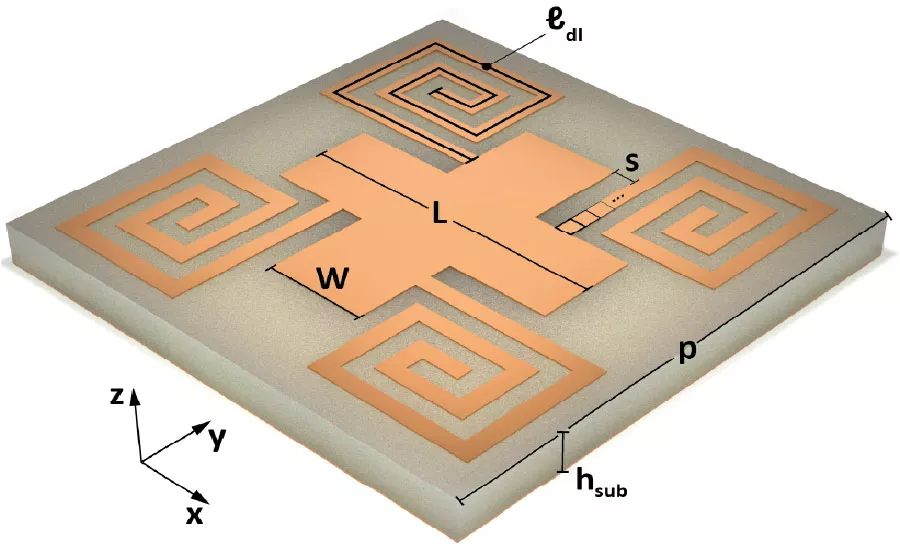
The design of large-scale coding metasurfaces poses significant computational challenges, often limited by the prohibitive time required for full-wave simulations necessary for optimization. This paper proposes an efficient design strategy based on a Hybrid Genetic Algorithm, validated through the design, fabrication, and characterization of an X-band metasurface for Radar Cross Section reduction. The proposed design strategy relies on a two-stage optimization process: a fast pre-optimization phase, based on the analytical Huygens-Fresnel principle, generates a preliminary solution which is subsequently refined by a second optimization stage utilizing full-wave simulations. Specifically, the optimization targets a 1-bit coding scheme, where meta-atoms switch between two distinct states with a phase difference of 180 ± 37°. This hybrid approach demonstrates optimal convergence, reducing computational time by 25% compared to traditional full-wave-only techniques. Furthermore, a novel ``spiralling cross'' unit cell topology is introduced. Owing to its delay-line geometry, this structure provides additional degrees of freedom for spectral tuning and supports intermediate phase shifts, thus enabling encoding schemes beyond traditional 1-bit configurations. Experimental results confirm the validity of the proposed approach, demonstrating how the combination of versatile geometry and hybrid optimization effectively overcomes the trade-offs between numerical accuracy and computational efficiency.