Vol. 164
Latest Volume
All Volumes
PIERC 164 [2026] PIERC 163 [2026] PIERC 162 [2025] PIERC 161 [2025] PIERC 160 [2025] PIERC 159 [2025] PIERC 158 [2025] PIERC 157 [2025] PIERC 156 [2025] PIERC 155 [2025] PIERC 154 [2025] PIERC 153 [2025] PIERC 152 [2025] PIERC 151 [2025] PIERC 150 [2024] PIERC 149 [2024] PIERC 148 [2024] PIERC 147 [2024] PIERC 146 [2024] PIERC 145 [2024] PIERC 144 [2024] PIERC 143 [2024] PIERC 142 [2024] PIERC 141 [2024] PIERC 140 [2024] PIERC 139 [2024] PIERC 138 [2023] PIERC 137 [2023] PIERC 136 [2023] PIERC 135 [2023] PIERC 134 [2023] PIERC 133 [2023] PIERC 132 [2023] PIERC 131 [2023] PIERC 130 [2023] PIERC 129 [2023] PIERC 128 [2023] PIERC 127 [2022] PIERC 126 [2022] PIERC 125 [2022] PIERC 124 [2022] PIERC 123 [2022] PIERC 122 [2022] PIERC 121 [2022] PIERC 120 [2022] PIERC 119 [2022] PIERC 118 [2022] PIERC 117 [2021] PIERC 116 [2021] PIERC 115 [2021] PIERC 114 [2021] PIERC 113 [2021] PIERC 112 [2021] PIERC 111 [2021] PIERC 110 [2021] PIERC 109 [2021] PIERC 108 [2021] PIERC 107 [2021] PIERC 106 [2020] PIERC 105 [2020] PIERC 104 [2020] PIERC 103 [2020] PIERC 102 [2020] PIERC 101 [2020] PIERC 100 [2020] PIERC 99 [2020] PIERC 98 [2020] PIERC 97 [2019] PIERC 96 [2019] PIERC 95 [2019] PIERC 94 [2019] PIERC 93 [2019] PIERC 92 [2019] PIERC 91 [2019] PIERC 90 [2019] PIERC 89 [2019] PIERC 88 [2018] PIERC 87 [2018] PIERC 86 [2018] PIERC 85 [2018] PIERC 84 [2018] PIERC 83 [2018] PIERC 82 [2018] PIERC 81 [2018] PIERC 80 [2018] PIERC 79 [2017] PIERC 78 [2017] PIERC 77 [2017] PIERC 76 [2017] PIERC 75 [2017] PIERC 74 [2017] PIERC 73 [2017] PIERC 72 [2017] PIERC 71 [2017] PIERC 70 [2016] PIERC 69 [2016] PIERC 68 [2016] PIERC 67 [2016] PIERC 66 [2016] PIERC 65 [2016] PIERC 64 [2016] PIERC 63 [2016] PIERC 62 [2016] PIERC 61 [2016] PIERC 60 [2015] PIERC 59 [2015] PIERC 58 [2015] PIERC 57 [2015] PIERC 56 [2015] PIERC 55 [2014] PIERC 54 [2014] PIERC 53 [2014] PIERC 52 [2014] PIERC 51 [2014] PIERC 50 [2014] PIERC 49 [2014] PIERC 48 [2014] PIERC 47 [2014] PIERC 46 [2014] PIERC 45 [2013] PIERC 44 [2013] PIERC 43 [2013] PIERC 42 [2013] PIERC 41 [2013] PIERC 40 [2013] PIERC 39 [2013] PIERC 38 [2013] PIERC 37 [2013] PIERC 36 [2013] PIERC 35 [2013] PIERC 34 [2013] PIERC 33 [2012] PIERC 32 [2012] PIERC 31 [2012] PIERC 30 [2012] PIERC 29 [2012] PIERC 28 [2012] PIERC 27 [2012] PIERC 26 [2012] PIERC 25 [2012] PIERC 24 [2011] PIERC 23 [2011] PIERC 22 [2011] PIERC 21 [2011] PIERC 20 [2011] PIERC 19 [2011] PIERC 18 [2011] PIERC 17 [2010] PIERC 16 [2010] PIERC 15 [2010] PIERC 14 [2010] PIERC 13 [2010] PIERC 12 [2010] PIERC 11 [2009] PIERC 10 [2009] PIERC 9 [2009] PIERC 8 [2009] PIERC 7 [2009] PIERC 6 [2009] PIERC 5 [2008] PIERC 4 [2008] PIERC 3 [2008] PIERC 2 [2008] PIERC 1 [2008]
2025-12-24 Latest Published
By Manish Kumar Sandeep Kumar Singh Madhukar Deshmukh Siti Nor Farhana Yusuf
Progress In Electromagnetics Research C, Vol. 164, 15-26, 2026
Abstract
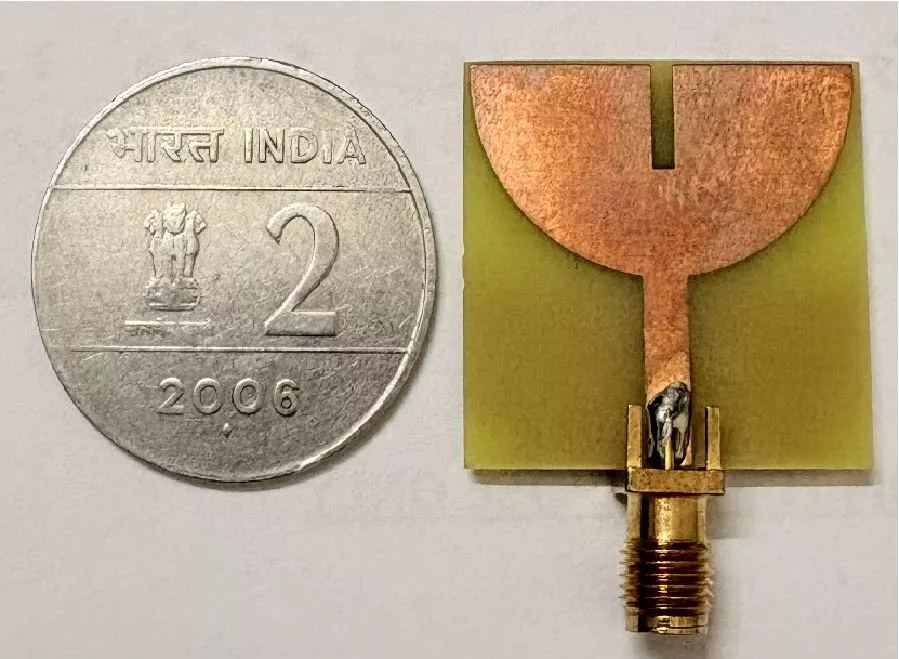
This work presents a compact coplanar waveguide (CPW) fed super wideband (SWB) antenna realized on a low-cost FR4 substrate (εr = 4.4, thickness = 1.6 mm). The 20 × 20 mm2 radiator integrates a multi-slotted patch within a hexagonal ground plane aperture and a carefully optimized tuning stub that excites and merges multiple resonances into a continuous broadband response. The antenna achieves a measured |S11| ≤ -10 dB impedance bandwidth from 2 to 34 GHz (177.7%), encompassing sub-6 GHz 5G, WLAN/WiMAX, and millimeter wave (Ku/Ka) allocations. Radiation measurements reveal quasi-omnidirectional patterns with a peak gain of 6.60 dB and maximum radiation efficiency of 82.68%. Time-domain analysis demonstrates an almost constant group delay (approximately 0.1 to 0.5 ns, mean 0.19 ns) with a single localized deviation near 24.4 GHz, confirming low dispersion and excellent phase linearity, which are desirable for IR-UWB and high data rate communication systems. Parametric optimization and equivalent RLC circuit modeling validate the broadband mechanism, while simulation studies performed using CST Microwave Studio exhibit excellent agreement with experimental results. The proposed design therefore offers a cost-effective, compact, and high-performance antenna solution suitable for 5G/6G front ends, radar imaging, and broadband sensing applications.
2025-12-24
PIER C
Vol. 164, 15-26, 2026
download: 7
A Compact CPW-Fed Super-Wideband Antenna on FR4 for 5G, 6G, and Wireless Applications
Manish Kumar, Sandeep Kumar Singh, Madhukar Deshmukh and Siti Nor Farhana Yusuf
This work presents a compact coplanar waveguide (CPW) fed super wideband (SWB) antenna realized on a low-cost FR4 substrate (εr = 4.4, thickness = 1.6 mm). The 20 × 20 mm2 radiator integrates a multi-slotted patch within a hexagonal ground plane aperture and a carefully optimized tuning stub that excites and merges multiple resonances into a continuous broadband response. The antenna achieves a measured |S11| ≤ -10 dB impedance bandwidth from 2 to 34 GHz (177.7%), encompassing sub-6 GHz 5G, WLAN/WiMAX, and millimeter wave (Ku/Ka) allocations. Radiation measurements reveal quasi-omnidirectional patterns with a peak gain of 6.60 dB and maximum radiation efficiency of 82.68%. Time-domain analysis demonstrates an almost constant group delay (approximately 0.1 to 0.5 ns, mean 0.19 ns) with a single localized deviation near 24.4 GHz, confirming low dispersion and excellent phase linearity, which are desirable for IR-UWB and high data rate communication systems. Parametric optimization and equivalent RLC circuit modeling validate the broadband mechanism, while simulation studies performed using CST Microwave Studio exhibit excellent agreement with experimental results. The proposed design therefore offers a cost-effective, compact, and high-performance antenna solution suitable for 5G/6G front ends, radar imaging, and broadband sensing applications.
A Compact CPW-Fed Super-Wideband Antenna on FR4 for 5G, 6G, and Wireless Applications
2025-12-24
PIER C
Vol. 164, 8-14, 2026
download: 7
Experimental Investigations of Pure Carbon Dioxide Splitting Using a Rod-Electrode-Type Microwave Plasma Source at Atmospheric Pressure
Hidenori Sekiguchi
The purpose of this study is to experimentally investigate the applicability of a rod-electrode-type microwave plasma source (MPS) for pure carbon dioxide (CO2) splitting at atmospheric pressure. This paper demonstrates that the rod-electrode-type MPS can convert pure CO2 gas into plasma. The CO2 splitting by the CO2 plasma is investigated in terms of the pure CO2 flow rate into the rod-electrode-type MPS and the average transmission power to the rod-electrode-type MPS. In the investigations, the emission spectrum of the CO2 plasma is measured using a spectrometer to observe the dissociation reaction of the CO2 gas, and the exhaust gas after the CO2 plasma generation is analyzed using a mass spectrometer to evaluate the CO2 conversion. As a result, the CO2 conversion decreases with an increase in either the average transmission power to the rod-electrode-type MPS or the CO2 flow rate into the rod-electrode-type MPS. Under the experimental conditions, the highest CO2 conversion and energy efficiency are 6.3% and 3.7% at a specific energy input of 4.9 eV/molecule (equivalent to approximately 19.6 kJ/L), respectively.
Experimental Investigations of Pure Carbon Dioxide Splitting Using a Rod-Electrode-Type Microwave Plasma Source at Atmospheric Pressure
2025-12-24
PIER C
Vol. 164, 1-7, 2026
download: 16
Design of a High-Selectivity C-Band Tunable Filter by Dielectric Movable Elements for SATCOM Applications
Davide Guarnera, Santi Concetto Pavone, Tommaso Isernia and Gino Sorbello
In this paper, the design of a mechanically tunable band-pass filter in waveguide technology operating in the C-band tunability range [4.4-5] GHz, for satellite communications (SATCOM), is presented. The resonance frequency tunability has been obtained by mechanically inserting movable dielectric cylinders within the waveguide filter. The impedance matching has been achieved by using two movable dielectric ridges, working as quarter-wave transformers. They have been placed at input and output filter ports and can move jointly with the dielectric tuning elements. Filter design has been carried out by adopting a suitable theoretical model, whereas the optimization has been achieved by numerical simulations. The proposed design approach provides key advantages in terms of simplicity, design effectiveness and reproducibility, rendering it particularly suitable for industrial applications. A prototype of high-selectivity tunable filter has been fabricated and characterized within the whole tunability range. The measurements show excellent agreement with simulated results.
Design of a High-selectivity C-band Tunable Filter by Dielectric Movable Elements for SATCOM Applications